E-Paper



Joshimath crisis: Cabinet okays ₹45-crore relief for displaced locals
The Uttarakhand cabinet on Friday approved several proposals in connection with the Joshimath subsidence crisis, including releasing ₹45 crore for interim relief to around 3,000 affected families, building prefabricated buildings at rehabilitation sites and waiving for six months electricity and water bills of families and individuals affected.

 Prefer HTon Google


The Uttarakhand cabinet on Friday approved several proposals in connection with the Joshimath subsidence crisis, including releasing ₹45 crore for interim relief to around 3,000 affected families, building prefabricated buildings at rehabilitation sites and waiving for six months electricity and water bills of families and individuals affected.
In the cabinet meeting, chaired by chief minister Pushkar Singh Dhami at the Secretariat in Dehradun, it was decided to increase the amount being given by the state government to the affected families to pay rent from ₹4,000 to ₹5,000 for the next six months.
“It was also decided that based on the report of the Chamoli district magistrate if there is a need to increase the rent amount further, the chief minister has been made authorised to take a decision on the same,” Uttarakhand chief secretary SS Sandhu told reporters after the meeting.
The proposal to provide an advance amount of ₹1 lakh —which will be adjusted later in the compensation amount — and a non-adjustable amount of ₹50,000 for transportation of goods and immediate needs to each affected family in Joshimath was also approved by the cabinet. “An amount of ₹45 crore has been released from the state contingency fund for allocation of ₹1.5 lakh to each affected family,” he said.
The chief secretary said that each affected family staying in temporary relief camps will be paid ₹950 per room per day for their accommodation in hotels or residential units designated as relief camps besides ₹450 per head per day for food expenses. Affected families that own cattle will get ₹15,000 to shift the animals. “In addition, ₹80 per day will be provided for the fodder of large cattle and ₹45 per day for the fodder of small animals,” he said.
The cabinet gave an in-principle approval to the construction of prefabricated houses for short-term rehabilitation of the affected people of Joshimath at identified locations in Koti Farm, Pipalkoti, Gauchar, Gaukh Selang, and Dhak villages after their survey, said Sandhu. “Instructions were also given by the cabinet that after conducting the surveys. A decision will be taken to provide houses or give funds in the form of a package to the affected families,” he added.
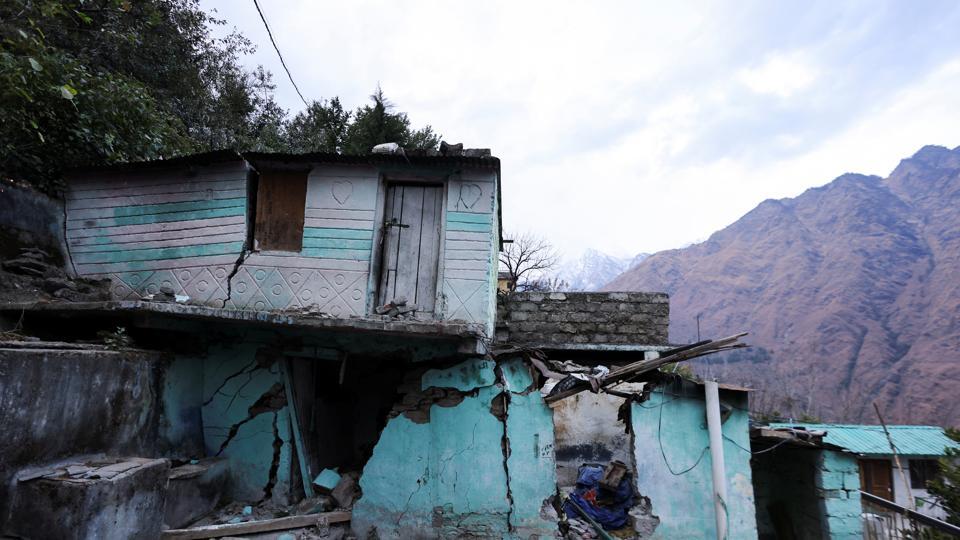
Joshimath, the temple town in Chamoli district and gateway to Badrinath and Hemkund Sahib pilgrimage sites, is facing a major challenge due to largescale land subsidence. According to the bulletin released by the state government on Friday evening, a total of 185 families consisting of 657 members have been shifted to relief centres so far. Of these, 25 families were shifted on Friday. Overall, 760 buildings out of nearly 4,200 structures in the temple town have developed cracks due to subsidence, with authorities declaring 147 of them as unsafe.
According to district officials, the interim relief amount of ₹1.5 lakh each has been provided to 62 families so far.
The cabinet also decided to waive the electricity and water bills of the affected families in Joshimath for six months, starting from November 2022. “In relation to the postponement of the recovery of loans taken from the banks by affected families, instructions have been given to cooperative banks to postpone the same with immediate effect for the next one year,” the chief secretary said. “For loans taken from commercial banks, a request would be made to the Centre to postpone loan recovery.”
Sandhu said the cabinet also approved the proposal to conduct studies on the carrying capacity of Joshimath and all other hill towns in the state.
Under the geotechnical study and drainage scheme of Joshimath, WAPCOS Limited in Haryana’s Gurugram has been shortlisted by the irrigation department for carrying out the works related to the treatment of toe-erosion and land subsidence in EPC (Engineering, Procurement, and Construction) mode. “In order to get it done quickly, the chief minister has been authorised to take a decision on allocating works to the irrigation department or WAPCOS — based on who can prepare the DPR at the earliest and start the work soon,” said Sandhu.
After the assessment of damage to land and buildings through the district-level committee, a decision will be taken by the state cabinet within a week on a compensation package and the same will be then sent to the Centre, said the senior IAS officer.
The state government will spend funds on various short-term and medium-term works in Joshimath from its resources till the time a package is allocated by the Centre, Sandhu said. The amount will be adjusted when the package is received from the Union government.
As per new standards of the state disaster response fund (SDRF), it has been decided that two adult members of the affected families whose means of livelihood have been affected due to the land subsidence will get wages fixed under MGNREGS (Mahatma Gandhi National Rural Employment Guarantee Scheme).