Karnataka released its final electoral roll on Tuesday, dropping 9.97 million names after the special intensive revision, with the state capital Bengaluru accounting for the highest percentage of deletions and the coastal district of Udupi accounting for the lowest.
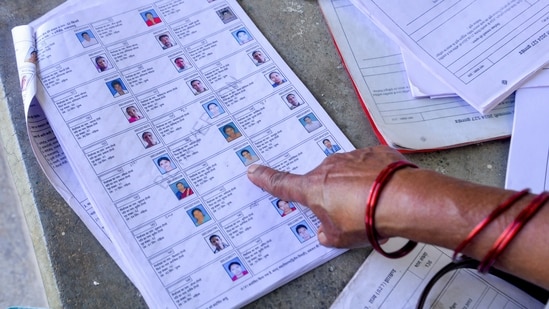
The final electoral roll contains 45,455,689 general electors, compared to 55,432,314 on the rolls as of June 16, when SIR began, marking a reduction of 9,976,625. Including 44,322 service electors, the final statewide total stands at 45,500,011.
Karnataka’s deletion of 18% of the pre-SIR roll is the highest among major states.
Notices, additions, deletions and modifications
Chief electoral officer V Anbukkumar said that after completion of the verification and disposal of claims and objections, as well as the disposal of notices, 1,008,038 electors were added, 188,324 deleted, and 896,519 modifications were made to the draft electoral roll in accordance with laws and instructions of the Election Commission of India.
{{/usCountry}}Chief electoral officer V Anbukkumar said that after completion of the verification and disposal of claims and objections, as well as the disposal of notices, 1,008,038 electors were added, 188,324 deleted, and 896,519 modifications were made to the draft electoral roll in accordance with laws and instructions of the Election Commission of India.
{{/usCountry}}“We issued notices to approximately 43.8 lakh electors and conducted hearings. During these proceedings, electoral registration officers (EROs) and assistant electoral registration officers (AEROs) found certain individuals ineligible. Following the prescribed inquiry and the issuance of reasoned orders, 61,960 names were identified for deletion,” he said.
Of the 188,324 deletions, 1,091 were of deceased electors, 184 were of absent electors, 762 were of those already enrolled or with duplicate entries, and 124,327 were related to shifts of residence, resulting in the automatic generation of Form 7, he said.
By adding voters between the draft and final rolls, Karnataka has followed the broader trend of all states and UTs seeing an increase between the strength of the draft and final SIR roll, except for West Bengal and Goa.
Category-wise breakdown of electoral deletions
A district-wise analysis showed that the Bengaluru region accounted for a large share of electoral deletions. Four urban districts in Bengaluru — Bangalore Urban, BBMP (South), BBMP (North) and BBMP (Central) — accounted for a total of 4.5 million deletions between the pre-SIR and final roll. This is 45% of the total deletions in the state. These four districts had a share of just 19% in the state’s total pre-SIR elector count. Their elector share in the final roll has fallen to 13% now.
The note issued by the CEO showed that the ratio of electors to projected population in the three BBMP districts – North, Central and South, at 53.4%, 51.1% and 45.8% respectively – was the lowest in the state and significantly lower than the 66.1% for the state.
These four districts were the only ones that saw more than 40% deletion of electors between the pre-SIR and final electoral roll. In ten districts, the deletion was less than 10%, the number being the lowest (4.7%) in Udupi in the coastal Karnataka region. Dakshina Kannada, which has the highest population share of Muslims in the state, saw the second lowest (6.9%) deletions.
Women outnumbered men in the final roll, where 22,583,107 were male, 22,914,063 were female and 2,841 categorised as other. An age-wise breakup showed that the largest number, 10.26 million, was in the 30-39 category.
The CEO said between June 16 and October 26, the authorities received 1,062,336 Form 6 applications, 4,872 Form 6A applications, 229,235 Form 7 applications and approximately 1.327 million Form 8 applications, taking the total number of applications received to approximately 2.6 million.
He said that, except for around 4,000 applications submitted offline, the rest were filed online. He said roughly 303,000 applications were rejected, 2 million accepted and 255,000 were pending.
Referring to media reports that officials generated around 60,000 Form 7 applications to delete voters, the CEO clarified that there was no provision for bulk generation of Form 7. “Every such form must be generated in the name of the competent officer after the prescribed inquiry and the passing of a speaking order.