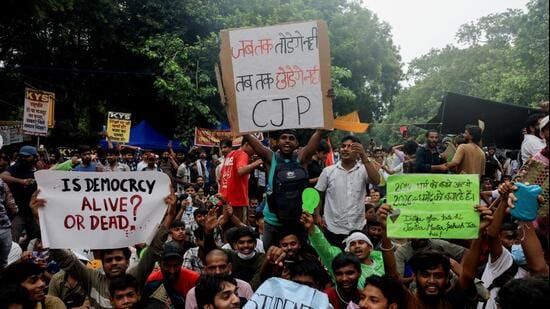
On July 31, Prime Minister Narendra Modi rued the abusive language he and even his late mother were subjected to during the protest at Delhi’s Jantar Mantar against examination irregularities as the dust over the issue began to settle following Union education minister Dharmendra Pradhan’s resignation. He underlined that dragging such “misguided children” into court would not resolve the problem and that he wanted to forgive them.
In a video on Instagram, Modi said he could understand the anguish in
On July 31, Prime Minister Narendra Modi rued the abusive language he and even his late mother were subjected to during the protest at Delhi’s Jantar Mantar against examination irregularities as the dust over the issue began to settle following Union education minister Dharmendra Pradhan’s resignation. He underlined that dragging such “misguided children” into court would not resolve the problem and that he wanted to forgive them.
In a video on Instagram, Modi said he could understand the anguish in society, but stressed that this was the time to guide the youngsters. He added that people make mistakes. “But this is a cultural shock that our daughters are using such abusive language.”
Modi’s comments came amid the controversy over some of the protesters allegedly using abusive language against him. On the same day, the Cockroach Janta Party (CJP), which organised the protests, questioned the now-withdrawn case against a woman for allegedly using abusive language against Modi. It asked why similar action was not taken against ruling Bharatiya Janata Party (BJP) leaders accused of using objectionable language.
Modi’s statement that the abusive language he and his mother were subjected to has no place in a civilised society made many wonder whether the government will contemplate action in checking profanity that is common in society. Politicians use it, and this is reflected in films and popular culture as well.
In Uttar Pradesh, some abuses are intertwined with festivals and traditions. Accusations, sometimes in not-so-civil language, fly thick and fast, particularly during election season. Many politicians believe that an abuse clip gets them more eyeballs than a long sensible speech. With caste and religion being important parts of the polls, slurs are common too. Big leaders are not averse to using cuss words and their supporters do it brazenly.
Abusive language is mostly directed towards women. When profanity has become an integral part of political speeches and public discourse, why censure the youth? In their impressionable years, they pick up these abuses from the streets, screens, political rallies, homes, and schools, and find them cool. Ironically, some student protesters demanded education reforms using crass language.
In 2008, the Supreme Court restricted the use of specific caste names to safeguard the dignity of Dalits, establishing how verbal discrimination is handled under the Scheduled Castes and Scheduled Tribes (Prevention of Atrocities) Act. It ruled that even if a term is historically or etymologically a valid caste name, using it to insult, demean, or humiliate someone constitutes a punishable offence. Despite some violations, the use of those derogatory words has significantly declined.
From a legal perspective, the mere use of abusive language does not ordinarily constitute a criminal offence. Under the Bharatiya Nyaya Sanhita, 2023, it can amount to an offence under Section 352 if intended to provoke a breach of peace, or under Section 196 if used to promote enmity between different religious, racial, linguistic, or caste groups.
Publishing obscene content online is considered a cyber crime. Online humiliation, trolling, and public shaming are still not clearly recognised under the legal framework, leading many to believe they can abuse others online without consequence. Abusive language is often used to express frustration and anger. But the question remains whether these abuses should be considered harmless or a habit worth breaking.
One Subscription.
Get 360° coverage—from daily headlines
to 100 year archives.
Archives
HT App & Website