On August 15, 2018, 40-year-old Jijo Abraham was across the Indian Ocean in Muscat, but his eyes were glued to visuals from Kerala. Terrified, he watched as the television screen showed the river Pampa cascading dangerously into human settlements; he worried for his parents in their home just on the banks of the enraged river.
He remembers calling almost incessantly; his father’s breathless voice; the sound of furniture being dragged across the floor as the family desperately shifted furniture and appliances from the ground to the first floor of their two-storey home in Chengannur. “In those days, I would call every few hours to check on them. Till about 2am, my father had moved most things to higher ground. By then, floodwater had already begun to seep in. That was my last phone conversation with him,” Jijo said.
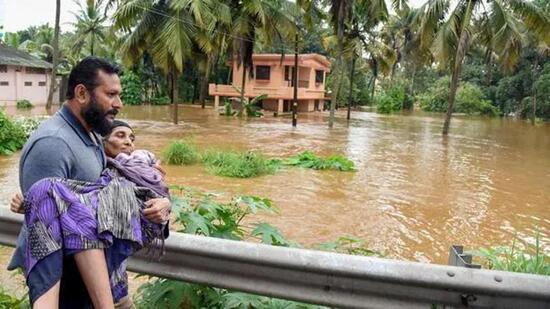
By the time the sun rose, things had turned a deathly grim. Floodwaters engulfed the neighbourhood. Those in single-storey homes were evacuated to relief camps in boats and canoes by local fishermen. Abraham’s family were, for the most part, safely ensconced on the first floor, waiting for the rain to subside. But at one point in the morning, Jijo’s father, CG Abraham stepped out and braved the shoulder-high water to bring his sister-in-law, who lived nearby, home. On the way, he found time to assist locals to carry a generator from a nearby church to higher ground.
He returned securely from all this daredevilry, but at 8.30 am, waded out into the water again, to shut the front gate. “He didn’t return for a while, and I stepped downstairs to look for him,” said his wife Soshamma. The water was ice-cold; the current so strong the 63 year old woman could barely stand. Desperate, she persisted, and stumbled through, only to find what she had most feared. Her husband lay prone next to a tree. He was breathing, but barely; it was clear he had slipped and fallen in the water. Within minutes, the shallow sound of air whistling through his nose was gone. He was dead.
{{/usCountry}}He returned securely from all this daredevilry, but at 8.30 am, waded out into the water again, to shut the front gate. “He didn’t return for a while, and I stepped downstairs to look for him,” said his wife Soshamma. The water was ice-cold; the current so strong the 63 year old woman could barely stand. Desperate, she persisted, and stumbled through, only to find what she had most feared. Her husband lay prone next to a tree. He was breathing, but barely; it was clear he had slipped and fallen in the water. Within minutes, the shallow sound of air whistling through his nose was gone. He was dead.
{{/usCountry}}Jijo was in disbelief, but for the family in Chengannur, there was no time for grief. The waters were still rising, and there was no sign of a rescue mission. So, for two days and two nights, the 63-year-old Soshamma and her sister-in-law, sat with a body tied to a staircase to prevent it from floating away. Jijo flew in on the 18th, and only when he called everyone he could--the local legislator, journalists, and local officials- were they evacuated. They had to wait 12 more days for a cremation.
Five years later, Jijo’s two-storey home, white and brown with a green roof still stands, but carries the markers of the Kerala’s “nootandile pralayam”(flood of the century) that claimed 480 lives and affected over five million people, swallowing homes, panchayat offices and large tracts of paddy fields in areas like Chengannur. In one corner of the living room for instance, the plaster continues to peel off despite being painted several times over, showcasing the structural damage to the home.
In many ways, the flood was a watershed moment in Kerala’s ecological history, raised pertinent questions about the state of rivers and streams, dam management, disaster preparedness and quality of weather alerts.
Half a decade on, HT spent time in Chengannur speaking to victims and officials to understand if the state is equipped to handle another deluge, or if like the Abraham home, the fresh paint masks untended damage within.
What went wrong
Between August 1 and August 30, 2018, Kerala received 821 mm of rainfall as against a normal of 419.3 mm, a departure classified by the India Meteorological Department(IMD) as “large excess”. A report submitted by the state relief commissioner of the state disaster management authority (SDMA) in September 2018 noted that the extreme rainfall came in two batches, from 8-10 August in northern Kerala and 15-17 August in the south.
Except, for such a prodigious amount of rainfall (the first twenty days of August broke a 87-year record), there was no warning. 62-year-old Pushpavally Kunjamma who has a home that stands less than 500 metres from the Pampa, said that waterlogging during the monsoons was not unusual. So when it started to rain, she did not think much of it. “But that day, the water rose fast. I was at home with my elder daughter and her two children aged three and two. By the evening, the water had entered my kitchen. I knew if we waited, we would drown. We picked up our identity cards, property certificates and just left. There was no warning, and there was no time,” she said.
The SDRF report red-flagged this lack of warning, noting that IMD had issued a red alert in four districts on August 15, but the eventual rainfall showed that a red alert should have been issued in all 14 districts. A red alert is issued for ‘very heavy rainfall’ ranging between 115.6 mm and 204.4 mm in a 24-hour period .
A second report by the National Institute of Disaster Management into the floods said that the rainfall till the end of July, that was at 857.4 mm, higher than the July average of 726.1 mm, meant that all 35 major reservoirs in the state were close to the full reservoir level (FRL). “They had no buffer storage to accommodate the heavy inflows from 8th August onwards. The continued exceptional heavy rainfall in August in catchment areas compelled authorities to resort to heavy releases downstream. This led to overflowing of river banks which in turn led to widespread flooding,” the report, released in 2020 said.
Overall, the SDMA report outlined, 9,500 kilometres of roads were destroyed, over 10,000 houses fully damaged, 99,000 partly damaged and over 65,000 hectares of land inundated for days.
The things that have changed…
One of the first things the chief minister Pinarayi Vijayan-led government announced after the floods was the ‘Rebuild Kerala Initiative’ (RKI), an expansive policy framework that would prepare the state for future disasters. The core aim, the chief minister said, was to rebuild the state but from the perspective of climate resilience -- from establishing ‘civil defence forces’ to strengthening wetland monitoring mechanisms to a central command centre for reservoir management.
Sekhar L Kuriakose, member secretary of the Kerala SDMA said that several important facets of these have been worked on in the past five years. “One of the primary projects under the RKI is that we have published flood susceptibility maps. Whether it is policy or legal interventions, they are now part of risk-informed master planning.”
A key issue in 2018, that led to bitter criticism by the opposition, was improper dam management that many believe accentuated the crisis. These concerns were given heft by a 2021 Comptroller and Auditor General (CAG) report tabled in the state assembly that said, “Communication infrastructure was non-functional in some areas including dam sites and government offices during or subsequent to the 2018 floods...the responsible authorities failed to issue mandatory alerts or warning when the rain situation deteriorated.”
Professor R Ramakumar, an expert member of the Kerala State Planning Board, said there are now better protocols in place. “We now have warning systems in place to alert locals when shutters are opened to release excess water. Blue, orange and red alerts now exist when sluice gates are opened depending on the urgency.”
He added that there are time appropriate mechanisms to relocate people to relief camps and safer areas in landslide-prone zones. “There are also ‘karma senas’ or action teams deployed at the panchayat level to respond to disasters.”
A major area where the government says it has made serious interventions is the clean-up of existing rivers, streams, and canals as well as the reclamation of river systems that disappeared in recent decades.
In Chengannur, for instance, before 2018, the Illimala-Moozhikkal stream, once an important rivulet of the river Pampa that coursed through four panchayats, was clogged with sediment and solid waste. A natural drainage system, its health is key to releasing the pressure on Pampa, particularly during floods.
Between April 2021 and March 2022, the 12 kilometre stream was finally desilted and cleaned, officials said. At 3pm on August 3, at the border between the Puliyoor and Pandanad panchayats, 64-year-old Sunny pointed at the banks. For the first time in several decades, he said, the pace of the water is high, the sides cleaned and strengthened on both sides using boulders. “In 2018, one of the reasons why floodwaters rose rapidly is because streams like these were jammed. There was no way for the water to flow out,” he said.
The things that haven’t…
But 8 kilometres away from Puliyoor, under the Cheloorkadavu bridge in Edanadu, there is evidence of continued infringement, and that not everything has been accomplished yet. In the year 2013, a project to revive the river Varattar, a system that was once believed to be the original course of the Pampa but has since disappeared, was launched. There was a full-fledged campaign that included local stakeholder participation-- panchayats, legislators and ministers-- under the name ‘Varatte Aaru’. But the floods in 2018 undid a lot of that work, with large scale deposits of silt and mud. Barely any work since then have meant that the river has dried up again; the river-bed is over-run by weeds and invasive plants.
2022 saw the “second phase” of the rejuvenation project launched, but on the ground, there has been little progress over the last six months. On one side of the Cheloorkadavu bridge, there is barely any depth, men are able to cross without wetting the knees. On the other side, the river is visibly narrow, hemmed in by banks with wild plant growth.
PR Pradeep Kumar, a Communist Party of India (CPI) leader and former councillor admitted that this was once a “big river”. “It used to be called the Adi Pampa as it was the earlier form of Pampa. It was a big river, but has now shrunk considerably to resemble a stream. Work has now started to clear the encroachments on both sides so that it can absorb the excess water from Pampa. It is an important instrument of flood control.”
In May 2019, the Left Democratic Front (LDF)-led government also announced a “room for river” project, borrowing the idea from the Netherlands, a country to which chief minister Vijayan paid a visit in the same month. The Dutch had conceptualised the project in 2007 to manage the water level in the Rhine, Meuse, Waal and Ijssel rivers, with the regions around them, Gelderland and South Holland, below sea level and therefore leaving cities like Rotterdam and Dordrecht prone to flooding.
The idea was to create more “space” for the river to flow during times of high discharge by lowering the levels of the flood plans, relocating levees and creating flood bypasses. After his return from Netherlands, chief ,minister Vijayan said that the model could be replicated in Kuttanad, a region in central Kerala that grows paddy below sea level. In June 2020, IIT Madras was entrusted to conduct hydrodynamics studies before a pilot project was kick-started in the Pampa.
Three years on, only an interim report from IIT has been submitted to the Chief Minister’s Office (CMO) and a final draft is expected soon, officials said.
CR Neelakandan, a prominent environmental activist and writer said that the only achievement that the Kerala government could boast of, was dam management. “We can say that the way excess water is released from them is better. That is the only positive from my perspective.”
Neelakandan said that there had been little control on illegal quarrying, and that illegal “pattayams” or land deeds were being legalised and distributed in hill districts such as Idukki and Wayanad. “Encroachment of rivers has also increased, and while they are being cleaned, there is no scientific process followed. This has led to uneven sand banks on river beds.”
Back in Chengannur, at home in the last few days of his vacation, Jijo Abraham breathes a little easier, his mind at rest because of the improved dam management. “I don’t fear another flood because if water was released at regular intervals, the river wouldn’t have flooded like that. My family has lived here for generations, and that flood was once in a lifetime.”
His mother isn’t as sanguine. She lives in fear, and in memory. “She is afraid because of what happened to my father. She lived that experience,” he said.