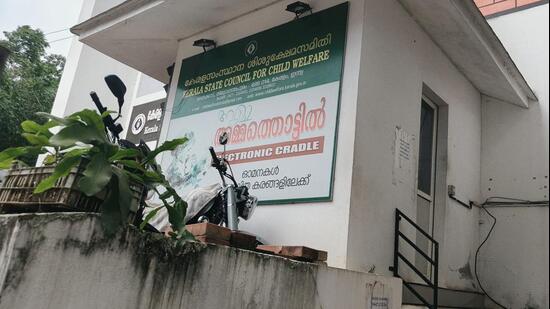
It was on the eve of Christmas in 2002. G Sasidharan, then a novice programme officer with the Kerala State Council for Child Welfare (KSCCW), remembers the day like it was only yesterday. Around 1:30 am, when most of Thiruvananthapuram had drifted off to sleep, a siren rang in the nursing station inside the KSCCW, then nestled in a small building on Gandhi Bhavan Road, he said. It was a watershed moment – a baby had been ‘received’ at the ‘Ammathottil’ (mother cradle) facility in front of the building.
Within two minutes, caregivers and security officials at KSCCW rushed towards the cradle, scooped up a few days-old baby girl and proceeded to give her urgent medical care. Sasidharan, who had gone home, rushed to the office along with other staff, filled with excitement.
“We were all curious and interested, to see what she looked like. It was a big deal. She was named Nithya,” said Sasidharan, now a legal consultant and personal assistant to the KSCCW general secretary. “She stayed with us for about a year before being adopted by a family.”
The arrival of Nithya and her subsequent adoption was vindication for those like Sasidharan and others at KSCCW that the idea and the system worked. On November 14, Children’s Day, 2002, MK Muneer, then minister for social justice, had inaugurated ‘Ammathottil’ – a project that grants parents a safe, anonymous way to give up their infants rather than abandoning them or causing harm to them. It’s a modest electronic cradle, in a cabin with electronic doors and sensors that would light up and send signals when a baby is placed in it. The parents can quietly slip away while the baby gets turned over to the safe guardianship of the State.
Cut to August 4, 2026, at 3:35 am, the ‘Ammathottil’ project marked a significant milestone when the 1,000th infant was ‘dropped off’ inside the electronic cradle outside the KSCCW building in the state capital. Just five days old and weighing 2.57 kilograms, she was named ‘Sahasra’ – the Sanskrit word for one thousand.
{{/usCountry}}Cut to August 4, 2026, at 3:35 am, the ‘Ammathottil’ project marked a significant milestone when the 1,000th infant was ‘dropped off’ inside the electronic cradle outside the KSCCW building in the state capital. Just five days old and weighing 2.57 kilograms, she was named ‘Sahasra’ – the Sanskrit word for one thousand.
{{/usCountry}}“She is the light of a thousand hopes,” described GL Arun Gopi, the general secretary of KSCCW, who named the infant girl.
Among the 1,000 infants received in ‘Ammathottil’ facilities across the state over the last 24 years, at least 97% have been adopted by families in India and abroad. Of them, 681 were girls and the remaining 319 boys. Even twins have been received over the years and gone on to find safe abodes. Over 65% of the infants were received at the facility in Thiruvananthapuram.
In an ideal world, Gopi said, ‘Ammathottil’ facilities shouldn’t exist. “That’s the dream,” he said.
“But, due to various social factors, people are forced to surrender their children at our facilities. A woman may have been forced to become a mother for several reasons. She must not be made to feel like a criminal. The society must not grill her. Only then can this problem be solved to a large extent,” he added.
From 0 to 1000: A 24-year journey
The idea of the ‘Ammathottil’ germinated in the minds of the then KSCCW governing council members in 2002 after a few heartbreaking episodes of infants being abandoned in public places.
In one incident, an abandoned infant, just days old, was found to have been mauled and dragged away by stray dogs outside the SAT Hospital in Thiruvananthapuram city that year – a case that had huge ramifications in Kerala, a state known for superior health infrastructure. In another incident, a baby left behind in a rubber estate was found to be swarming with ants and worms.
“It was at that time that some students from the Thiruvananthapuram engineering college proposed the concept of a facility with sensors and automatic doors where a baby can be received safely. The idea was implemented in the state capital in November 2002 and replicated in Malappuram district the same year,” said Sasidharan.
Today, in 11 of the state’s 14 districts, there are such electronic cradles located near district or taluk hospitals. In Kannur, Wayanad and Idukki districts, work is ongoing to build new high-tech cradle facilities after the old ones fell into disrepair.
Once an infant is received in an ‘ammathottil’, the information is relayed to the nearest police station and the child welfare committee (CWC), underlined Gopi. After being administered first aid, the infant is shifted to a government hospital for a medical check-up.
“The baby’s health is assessed. If he/she is medically fit, they are brought to the KSCCW or the district adoption centres where nursing facilities are available. We then put out newspaper ads about the baby being received and wait for 60 days to see if the parents turn up. If no one turns up, the infant is certified as ‘legally fit for adoption’ (LFA) and its information is passed on to the Central Adoption Resource Authority (CARA),” he said.
If parents turn up to reclaim their children within the stipulated 60-day time period, necessary DNA tests are conducted to verify the claim. In the last three years, there have been 4-5 such cases of parents coming forward to stake claims, the general secretary said.
Infants come with several kinds of health complications, he said, including being born premature, with physical and mental shortcomings and reduced body weight.
“Once, we received a baby which weighed just 900 grams. We nurtured the baby here till it was 1.5 years old by using a special caretaker. The baby was later adopted by a couple who lived abroad,” said Gopi.
“We believe every infant coming to us has the right to lead a dignified life and grow up as a positive individual, like every other child born across the world. Once we receive a child, we draw up special health plans for it and ensure adequate care. It’s a big responsibility,” he pointed out.
The KSCCW headquarters in Thiruvananthapuram has elaborate nursing facilities for infants, including wards and special rooms. It has a staff strength of 110 comprising ayahs, caretakers, nursing supervisors, social workers and counsellors, all of whom are contractual employees, working in shifts round the clock. Paediatricians from government hospitals drop in when required to check up on the children.
By January 2027, a ‘human milk bank’ is set to be installed at KSCCW in the state capital, which would allow mothers to donate their breast milk for the infants being cared for at adoption centres across the state. Once realised, Kerala would be the first state to have such a facility, said officials.