On January 11, 2020, authorities in China announced the first death due to a new coronavirus. At the time, the virus had only infected 59 people, spreading out, it was suspected, from a seafood market in the city of Wuhan. The same day, Chinese researchers made public the genetic sequence of the virus, then called the novel coronavirus nCov-2019. Running into roughly 30,000 characters, this code would allow scientists to design within three days one of the leading vaccine candidates against the infection.
In some ways then, January 11 — the day the world heard of the death of Mr Zhang from Wuhan (the man is identified only by his last name) — also marked the arrival of a small but significant breakthrough that would ultimately lead to the beginning of the end of the pandemic. Within two months, a 76-year-old man from Karnataka with multiple co-morbidities became the first Indian to die of the virus, and five days later, on March 15, India declared the outbreak a disaster.
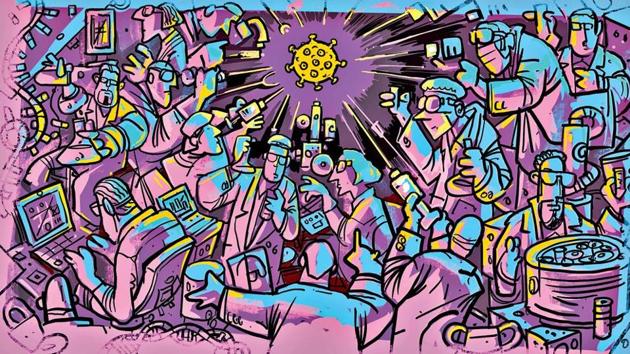
Scientists, doctors, public health officials and pharmaceutical companies around the world have since embarked on a race against time, redirecting their collective focus and energies in a manner that has paralleled some of history’s greatest collaborative efforts such as the Manhattan Project or the Apollo programme.
This race has largely been centered on trying to understand the virus and the disease it causes, and to find ways in which lives can be saved and the virus stopped. In the past year, PubMed Central, the largest database for free, open-access research literature in biomedical sciences, has carried 89,000 submissions on Covid-19.
{{/usCountry}}This race has largely been centered on trying to understand the virus and the disease it causes, and to find ways in which lives can be saved and the virus stopped. In the past year, PubMed Central, the largest database for free, open-access research literature in biomedical sciences, has carried 89,000 submissions on Covid-19.
{{/usCountry}}THE FIRST SIGNS
It would not be until January 20 that the world would find out that the virus spread between humans, and January 26, that it could also spread among and by asymptomatic individuals. By this time, the number of confirmed infections in China had reached 2,000, and these two crucial facts were the first indicators of the coronavirus’s potential to cause a pandemic.
As the world entered the spring of 2020, the virus took hold in more Asian regions — Japan, Singapore, Hong Kong — and its first cases emerged in Europe and the United States. By now, researchers were able to determine that the Sars-CoV-2, as it officially came to be called starting February 11, had a basic reproduction number (R0, or R naught) of 2.4 to 2.6. This meant that, on average, two infected people would pass on the virus to five more, and those five to at least 31 more people.
These figures projected an exponential explosion in cases. On March 16, five days after World Health Organization (WHO) declared Covid-19 a pandemic, researchers from Imperial College London predicted that if nothing was done to control the epidemic, at least 510,000 people would die in the United Kingdom and 2.2 million in the United States. The need was clear: lock down to flatten the curve of infections so that hospitals could be spared a surge of cases.
Over the rest of the year, the need to flatten the curve would drive countries around the world to turn to lock down in a reluctant game of cat and mouse to contain the spread of the virus. Among populous nations, India was one of the few that locked down at the beginning of the outbreak, an approach criticised for having caused widespread economic damage, but one that may have also bought the nation time to improve its capacities to test and treat.
COURSE CORRECTION
The need for locking down cities has been one of the approaches government, public health authorities and experts have largely agreed upon through the course of the pandemic. The early stage of the pandemic was marked by conflicting evidence and recommendations, most notably on whether people should wear masks.
After initially saying that masks did not help the uninfected, WHO on June 6 — almost three months after declaring the pandemic — updated its guidance to advise people to wear masks in regions with community transmission. By this time, total global infections were at 6.6 million, and fatalities close to 400,000.

At this point, it also became clear that sharing the same air posed the biggest risk, but painstaking contact tracing would later show that not everyone in an enclosed space would contract the virus: how the air flowed in such spaces played a role, but so did the duration of contact. Some activities, such as singing or speaking loudly, shoe-leather epidemiologists discovered, heightened the likelihood of infections.
The understanding of how to treat Covid-19 patients too evolved. As the virus tore through the elderly populations of Italy, Spain and France in April, clinicians began using re-purposed drugs, including those that showed promise in treating HIV/Aids, broad-spectrum antivirals such as remdesivir, and plasma-rich antibodies from recovered patients. Over the course of the year, there have been hardly any major breakthroughs in treatment. Remdesivir and favipiravir have shown mixed outcomes, anti-HIV drugs lopinavir and ritonavir were proven to be ineffective; even benefits of convalescent plasma therapy have been unclear. One drug appeared to have clear benefits in saving lives: dexamethasone.
WORRYING DISCOVERIES
That dexamethasone worked was linked to a worrying new facet of the Sars-CoV-2: it did not only cause respiratory disease. People who developed severe symptoms or succumbed to the virus showed signs of widespread organ damage. Blood tests and autopsies revealed the disease would often put the body on a warpath with itself, confusing people’s immune systems into going into an overdrive.
This led to damage to organs such as lungs, kidneys and the heart, scans and autopsies revealed. Some people also developed blood clots that could trigger strokes, while a worryingly large number suffered from persistent “long Covid” symptoms, often unable to regain energy, concentration or their sense of smell for months after an infection.
In December, virologists and geneticists in the UK discovered a new strain of the virus, with more genetic tweaks than seen in the 12 months since it began spreading. The strain appeared to be more infectious, steadily becoming more prevalent than other strains. Already, countries around the world have begun to respond to this: London declared a complete lockdown barely days before the Christmas holidays and several Latin American and European countries have imposed flight bans to the UK. So has India.

More research will be required to determine whether the new strain poses a threat to current efforts to contain the disease, which in themselves have struggled to slow down the march of the pandemic. It is also an unknown if the mutation, or any that might yet take place, could render current vaccine candidates ineffective. Vaccines are usually broad-spectrum — they target multiple viral proteins to avoid an eventuality such as this — but there is always a possibility that a virus could mutate enough to dodge them.
UNRELENTING EFFORTS
The sheer volume of research now out in open-source repositories like PubMed Central represents a relentless mission by scientists around the world to not just uncover the secrets of the virus, but also the millions of factors that are at play in its spread.
This mission has brought together not just biomedical researchers, but also mathematicians, computer modelers and artificial intelligence experts. Their frenetic efforts capitalised on decades of advances in medical sciences. Scientists are now able to inspect its structural secrets. They have even been able to visualise how its protruding spike proteins— the component that it uses to latch on to and infect cells — combines in groups of three and can swivel as if mounted on a hinge, enhancing its ability to infect targets. Frontline biotechnology, such as gene editing, have been repurposed to add to the arsenal of tools the world has deployed against Covid-19. Pharmaceutical companies have created lab-grown antibodies, which are akin to building your own army of specialised coronavirus hunters.
Even the bleeding edge of computation promises to bolster the human race’s ability to fight such threats. Take, for instance, the breakthrough in November by artificial intelligence company DeepMind, which was able to accurately determine the shape of proteins. Such technology can help take a closer look at the Sars-Cov-2, helping tailor therapies and drugs.
But the most watched among these breakthroughs is the rapid development of a vaccine — the candidate mentioned at the beginning of this essay, for example, was approved a little over 11 months later, while normally, the process (development, testing, and approvals of vaccines) can typically take close to a decade.
MILESTONE MOMENTS
This vaccine was developed by Moderna, in collaboration with the US National Institute of Allergy and Infectious Diseases, and used a platform that in itself has been hailed as groundbreaking. Another American company, with a German partner, uses the same platform and both have shown high efficacy. Several other vaccine makers are racing against time to complete the testing process. These include old platforms, such as the many candidates that use a weakened or an inactivated virus to elicit an immune response and new ones, like Oxford-AstraZeneca’s Trojan horse-like strategy known as a viral vector.
To be sure, many unknowns still remain: can vaccines leave lasting immunity? Will the virus mutate to beat it (and our immune systems)? Are there more long-term effects we have not yet identified?
It is uncertain when these mysteries will be unravelled by modern science. But if the year 2020 is any indication, chances are scientists and doctors will find a way for the world to live with the virus, if not eradicate it completely.
It is also certain that the world, scientifically and technologically, has never been better prepared to deal with a virus of its nature than it is right now. The scientific legacy of battling this virus is likely to further this preparedness and help achieve what experts have always sought: more focus and funding on health and science.