Over the past three years, the month of December has twice been dry in the picturesque Kashmir valley, a phenomenon that has worried environmentalists and disappointed tourists.
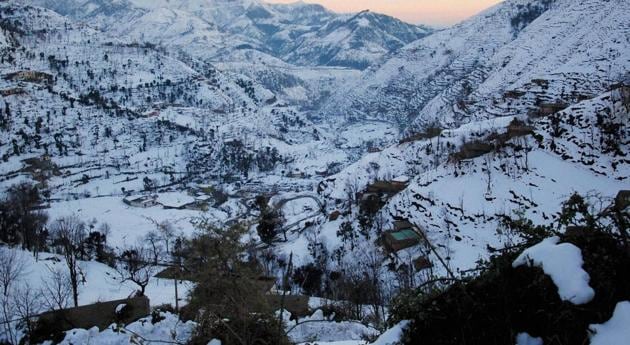
This year, it is for the sixth time since 1993 when Kashmir saw a dry, or almost dry, month of December.
Apart from a brief spell of snow or light rains on December 11 and 12 this year, local residents and tourists have been looking ahead to snow in the mountains and plains. In Kashmir, the harshest period of winter starts from December 21 and ends by the end of January.
Yashpal Sharma, weather officer at the Met office, said that anything above 100mm of rain or snow in the month of December in Srinagar station would be considered heavy precipitation.
Quoting records, he said there was record snowfall and rains of 209mm in December in 1985, followed by 185mm in 1986, 244mm in 1990, and 154mm in 1994.
But the years 1993, 1998, 1999, 2005, 2014 and 2016 have seen dry Decembers.
Sharma said there was moderate to good snowfall or rains in Decembers in only four years over the last 17 years.
{{/usCountry}}Sharma said there was moderate to good snowfall or rains in Decembers in only four years over the last 17 years.
{{/usCountry}}“We had 43mm of rain or snow in 2010, 59mm in 2008, 72.2mm in 2006, and 59.4mm in 2003. For the rest of the years, it has been very low or negligible,” Sharma said.
Prof Shakil A Romshoo, head of Kashmir University’s department of earth sciences, told HT that the percentage of snowfall in Kashmir valley was decreasing over the years.
“If we see the long term trends of precipitation in the past 130 years in Kashmir, there is no change in overall precipitation. But we are witnessing a decrease in overall snowfall and an increase in rains, particularly during winters,” he said.
Romshoo attributed it to the changing climate across the globe. “We are now getting extreme temperatures. The data indicates that minimum temperatures have increased and this increase is not allowing rain to fall as snow. In fact some researchers suggest that we may get 30%-70% less snowfall by the end of this century,” he said.