At least 74 people have been killed in lightning strikes in the past 24 hours in Rajasthan, Uttar Pradesh, and Madhya Pradesh. Of these, 11 are visitors who were killed on Sunday when lightning struck them at Amer Fort near Jaipur.
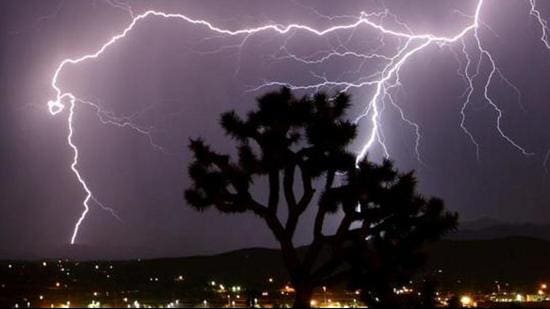
The numbers may seem high but should not surprise anyone.
Thunderstorms accompanied by lightning strikes (usually in the pre-monsoon and monsoon months) are the single-largest killers among natural disasters (extreme weather events) in India, according to National Disaster Management Authority (NDMA). Lightning strikes have killed at least 2,000 people every year in India since 2004, India Meteorological Department (IMD) said last month in an awareness workshop on lightning strikes.
In 2019, there were 2,876 deaths due to lightning strikes, compared to fewer than 1,500 on an average, annually, between 1968 and 2004. There was a brief period of three to four years in between when lightning strikes killed more than 1,500 people, but the larger trend held.
The disaster management division of ministry of home affairs is yet to update the data on lightning deaths for 2020.
According to a paper published in Elsevier journal, Weather and Climate Extremes by the ministry of earth sciences titled “An assessment of long-term changes in mortalities due to extreme weather events in India: A study of 50 years’ data, 1970–2019”, the mortality rate of tropical cyclones reduced by 94% over a 20 year period, whereas that for heatwaves and lightning, increased by 62.2% and 52.8%, respectively.
{{/usCountry}}According to a paper published in Elsevier journal, Weather and Climate Extremes by the ministry of earth sciences titled “An assessment of long-term changes in mortalities due to extreme weather events in India: A study of 50 years’ data, 1970–2019”, the mortality rate of tropical cyclones reduced by 94% over a 20 year period, whereas that for heatwaves and lightning, increased by 62.2% and 52.8%, respectively.
{{/usCountry}}Monsoon break created conditions for killer strikes
Normally, lightning strikes are high in frequency during the pre-monsoon season, and when the monsoon is about to make an onset over Bihar, Uttar Pradesh and neighbouring states. This is the time when moisture levels increase, and the surface temperature is high, creating favourable conditions for development of thunder clouds.
This year, however, there have been massive lightning strikes and associated casualty in mid-July, mainly due to the long monsoon “break” when surface temperatures were very high in the absence of rain.
“There has been around a ten-day break in monsoon. There has been significant surface heating during this period. As the monsoon is reviving, moisture levels have also increased. This is the most favourable condition for development of thunder clouds and collision of ice particles which leads to charging and lightning strikes,” explained SD Pawar, project director, Thunderstorm Dynamics, Indian Institute of Tropical Meteorology, Pune.
Thunder clouds require heat and moisture to form. They are also required to be deep, around nine to 10 kilometres for collision of ice particles to take place. And that’s what is happening now.
Why are we seeing a spike in lightning strikes in recent years?
According to Pawar, the spike in lightning strikes can certainly be linked to the climate crisis.
“Both surface temperature and moisture levels have increased significantly in recent years. Urbanisation leading to loss of tree cover also contributes to the rise in surface temperature. We think the two have mainly contributed to rise in incidence of lightning. The rise in deaths due to lightning can be because more people are outdoors and possibly exposed to lightning in recent years,” Pawar added.
Lightning mortalities are only going to increase in coming years. “Climate projections indicate that temperature and moisture will increase further in the future,” said Roxy Mathew Koll, climate scientist, Indian Institute of Tropical Meteorology (IITM).
“The use of electrical appliances has also increased significantly in the past 30 years, from mobile phones to TVs to power lines. Lightning can interfere with their electromagnetic field,” M Mohapatra, director general, IMD, said during the workshop last month.
How can deaths be prevented?
IMD’s Damini app provides area specific lightning warnings, but lightning is an extremely localised phenomenon, and the warnings often don’t reach the last mile. However, one can do certain things in the event of a lightning strike to save one’s life, such as going to a safe structure but avoiding medal constructions and sheetings and finding shelter in low-lying areas that aren’t flooded. Crouching with your arms and legs together, not lying flat on the ground to make yourself a wider target, and keeping away from utility lines (phone, power sockets, etc) as well as medal fences, trees (they conduct electricity) and hilltops are some other ways to keep safe during such an event. Rubber soled shoes and car tyres, however, do not offer protection from lighting.