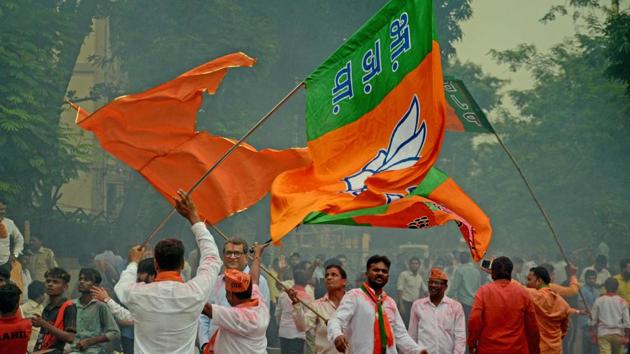
The Bharatiya Janata Party (BJP) and Shiv Sena alliance has won 161 assembly constituencies (ACs) in the Maharashtra assembly elections. The Congress and Nationalist Congress Party (NCP) have managed to improve on their 2014 assembly performance, winning 98 ACs.
Do the election results hold any other messages other than these headline takeaways? Among the most interesting statistics in the 2019 assembly results is the combined vote share of the parties other than BJP, Shiv Sena, Congress and NCP, which is 25.3%. This is almost equal to the vote share of the BJP, and more than what the other three major parties -- Shiv Sena, NCP and the Congress -- have got. Does this mean that political competition in Maharashtra is opening up and there is scope for a third political front other than the two main alliances?
An analysis of assembly results since 1999, the year the NCP contested an election for the first time, suggests that this is not the case. In fact, the 2019 assembly elections have seen a concentration of political support in the state.
Since 1999, there have been three assembly elections -- 2004, 2009 and 2019 -- when the BJP-Shiv Sena and Congress-NCP fought in an alliance. The combined vote share of these four parties is the highest in 2019 when compared to 2004 and 2009. This is also seen in the median Effective Number of Participants (ENOP) for the state assembly. ENOP is calculated at the AC level and is the reciprocal of sum of square of vote shares of each candidate. So, if there were only two candidates and both got 50% of the vote, ENOP would turn out to be 2. This number would change to 1.2 if the two candidates had 90% and 10% vote shares. The median ENOP for 2019 assembly elections is the lowest since 1999, which suggests that candidates other than those fielded by major political alliances have experienced a squeeze in their fortunes. Median victory margins, as a share of votes polled, are also the highest for 2019 since 1999. The number of ACs where results were determined by spoilers is also the lowest in the 2019 assembly elections since 1999. A seat is defined as a spoiler when a candidate finishing third polls more votes than the victory margin.
{{/usCountry}}Since 1999, there have been three assembly elections -- 2004, 2009 and 2019 -- when the BJP-Shiv Sena and Congress-NCP fought in an alliance. The combined vote share of these four parties is the highest in 2019 when compared to 2004 and 2009. This is also seen in the median Effective Number of Participants (ENOP) for the state assembly. ENOP is calculated at the AC level and is the reciprocal of sum of square of vote shares of each candidate. So, if there were only two candidates and both got 50% of the vote, ENOP would turn out to be 2. This number would change to 1.2 if the two candidates had 90% and 10% vote shares. The median ENOP for 2019 assembly elections is the lowest since 1999, which suggests that candidates other than those fielded by major political alliances have experienced a squeeze in their fortunes. Median victory margins, as a share of votes polled, are also the highest for 2019 since 1999. The number of ACs where results were determined by spoilers is also the lowest in the 2019 assembly elections since 1999. A seat is defined as a spoiler when a candidate finishing third polls more votes than the victory margin.
{{/usCountry}} 
It is the BJP-Shiv Sena alliance which has benefited more from this political concentration. Both these parties have registered their best-ever strike rates – seats won as percentage of seats contested – since 1999. This is also true for contested vote share of both the BJP and the Shiv Sena in this period.
Among the new political entrants in Maharashtra, the Vanchit Bahujan Aaghadi (VBA) and All India Majils-E-Ittehadul Muslimeen (AIMIM) have attracted a lot of attention. These two parties fought in an alliance in the 2019 Lok Sabha polls and managed 7.6% vote share across the state and one Lok Sabha seat. While there was no alliance between the two parties in the assembly elections, the AIMIM has managed to retain its 2014 assembly election tally of two seats. However, their combined vote share has gone down by 1.7 percentage points compared to the 2019 Lok Sabha elections. The VBA was only formed in 2018, so it did not contest the 2014 assembly elections. The fact that the VBA and AIMIM have not been able to increase their vote share in these elections suggests that even though they might have influence in selected pockets, they are yet to emerge as a political force to reckon with in Maharashtra politics.
Unless things change drastically in the future, Maharashtra will continue to remain a bipolar polity with the change that the erstwhile senior partners of each alliance -- Shiv Sena and the Congress -- might have to adjust to becoming junior partners vis-à-vis the BJP and NCP, respectively.