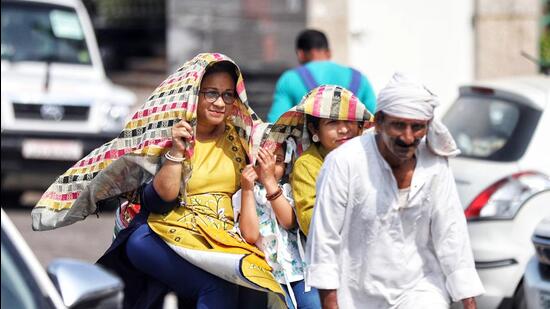
The last few weeks have been unusually hot in large parts of India. An HT analysis of Indian Meteorological Department (IMD) data shows that the average maximum temperature in the country has reached levels that were historically breached in mid-April. The reason for this kind ofweather is the lack of rain. IMD data also shows that so far, this has been India’s driest March since 1901.
This early heat has turned the March 1 to March 20 interval of 2022 the 14th hottest March 1-March 20 interval by maximum temperature since 1951. The March 14-March 20 week of 2022 is the third hottest since 1951. As is expected, the 2022 temperatures for all days from March 14 to March 19 were the among the top five for those days since 1951.
{{^htLoading}} {{/htLoading}} However, none of these days in the past week was the hottest since 1951 for India.
This is perhaps only because not all states experienced their hottest day of the year on the same day. Kerala’s hottest day this year was on March 14 (35.8°C), while Bihar’s hottest day was on March 20 (36.6°C). Even at these early dates in the year, however, 11 states -- Kerala, Karnataka Gujarat, West Bengal, and all North-East states except Sikkim -- have already experienced a daily maximum temperature that is higher than the normal for any day of the year in those states.
Another five states – Maharashtra, Rajasthan, Odisha, Telangana, and Tamil Nadu – have experienced a daily maximum temperatures less than a degree below the highest value that normal maximum temperature takes in a year. Rajasthan, Telangana, and Maharashtra have also experienced daily maximums that correspond to a normal maximum further ahead in time. The 40.49°C average maximum experienced in Rajasthan on March 17, for example, arrives in the normal chart for the state earliest on May 13. The corresponding dates for Telangana and Maharashtra are April 28.
{{^htLoading}} {{/htLoading}} The region of the national capital (the gridded dataset goes beyond Delhi’s administrative boundaries) experienced its hottest day of the year on March 20, with maximum temperature reaching 37.72 degrees. While this was still 3.69 degrees less than the highest daily value in the 1981-2010 averages (41.41 degrees), it was the hottest March 20 since 1951. In the historical average chart, Delhi breaches the 37 degree figure only from April 14 onwards. The March 16-March 20 week this year was the 2nd hottest since 1951.
{{^htLoading}} {{/htLoading}} What explains this unusually hot March?
A large and unprecedented deficit in rainfall is one. In the 1961-2010 period (called the Long Period Average or LPA), India received 16.9 mm rainfall on average in the March 1-March 20 interval. This year, it has received just 2.5 mm of rainfall in this interval, the lowest since 1901. The trend of large deficiency is reflected across states to such an extent that the state with the best rainfall (compared to LPA) this March so far is Rajasthan, which has a 2% surplus compared to its LPA. All states except Rajasthan, Karnataka (13% deficit), Kerala (28% deficit), and Tamil Nadu (56% deficit) have a deficit higher than 60%, which is considered a “large deficient” by IMD.
{{^htLoading}} {{/htLoading}} These trends in rainfall themselves are a result of a lack of active western disturbances this month and anti-cyclonic activity over central and western India, according to Mrityunjay Mahapatra, director general Meteorology at IMD. The former is a Mediterranean storm that brings rainfall in the winter months of India. The latter is, as the name suggests, the opposite of a cyclone. Instead of rising, an anti-cyclone is the case of the air sinking and getting warm and therefore becoming capable of holding more moisture, preventing rainfall. This is unlike the case where rising warm air carries moisture higher up, gets cold, cannot hold moisture, and causes rainfall.
To be sure, the average maximum temperature has come down from the 35°C Celsius threshold on March 19 and 20, the latest data for which data was available at the time of writing this story (See Chart 1). While no landfall has been predicted for Cyclone Asani, IMD has forecast light and scattered rainfall on the eastern coast, along with Kerala and Karnataka, with thunderstorms and lightning for the next five days. Similar kind of rainfall is also expected in North-East states.
{{^htLoading}} {{/htLoading}}