
 E-Paper



Modi revamps Prime Minister’s Office to boost efficiency
The new Prime Minister’s Office, as a result, bears little resemblance to the old. Many of the old faces are gone, and in other cases, responsibilities have been reassigned.

 Prefer HTon Google


Before boarding the flight to Houston for the “Howdy, Modi!” mega show on September 20, Prime Minister Narendra Modi reorganised his office, or the PMO, with work allocation to senior officers designed to boost efficiency and ensure optimum delivery, completing a process that he began in late August.
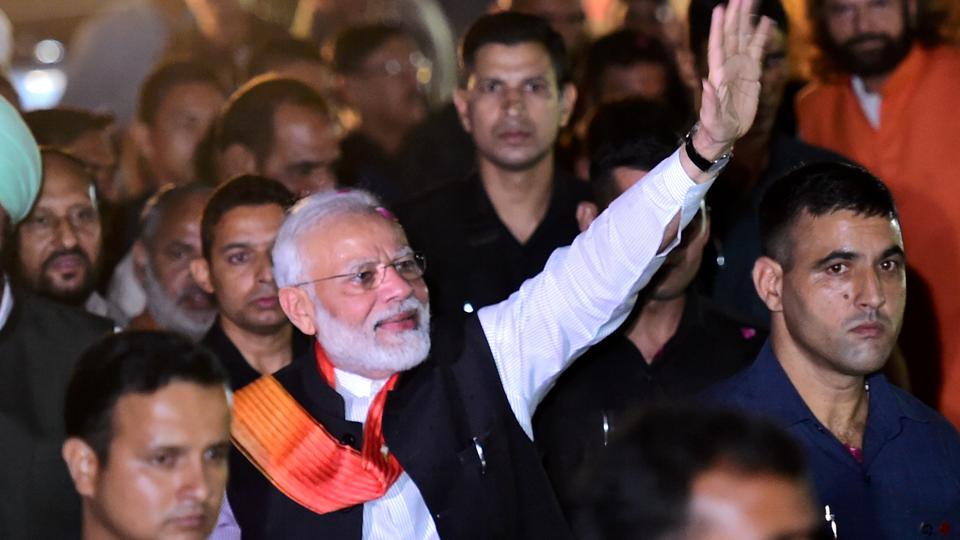
The new Prime Minister’s Office, as a result, bears little resemblance to the old. Many of the old faces are gone, and in other cases, responsibilities have been reassigned.
Thus additional secretary Tarun Bajaj, a 1988 batch Indian Administrative Service (IAS) officer, has charge of several key ministries (including the ones focused on science and technology) — Parliament, Right to Information (RTI), and also Jammu & Kashmir and the Northeastern states and Haryana. In addition, he has oversight of finance, trade, corporate affairs, NITI Aayog and statistics.
His batchmate Arvind Kumar Sharma is in charge of most infrastructure ministries, including civil aviation and petroleum (these are new additions to his portfolio). He has also been given charge of the politically important states of Gujarat, Uttar Pradesh, Kerala and Odisha.
While Debashree Mukherjee has been made joint secretary in-charge of social sectors including health, human resources, skill development and social justice, foreign service officer Gopal Baglay continues to handle defence, external affairs and atomic energy.
Charge of all finance and industry-related departments is with Arvind Shrivastava. And V Seshadri, who will report to Bhaskar Khulbe, secretary to the Prime Minister, will oversee personnel, anti-corruption unit and appointments committee of the Cabinet.
The agriculture and rural sectors have been allocated to Shrikar Pardeshi. Work pertaining to other states has been distributed among the other joint secretaries, except Baglay.
There was a similar order, dated February 5, and compared to that it is clear that in the new PMO the work allocation is a whole lot more specific. PM Modi has also ensured that all joint secretaries serve their tenures and leave the PMO without being given an extension.
Both private secretaries to PM are part of his personal staff and have no tenure just as principal secretary PK Mishra, national security adviser Ajit Doval and principal adviser PK Sinha are political appointees with a tenure co-terminus with the PM’s.
In the previous United Progressive Alliance (UPA) regime lasting a decade, 1974 batch UP cadre officer Pulok Chatterji served the PMO from 2004 to 2014 with a brief interregnum of two years at the World Bank with number of joint secretary level officers serving in the high powered office for an extended tenure of seven years.
Chatterji, a former district magistrate of Rae Barelli, also served in the PMO from 1985
to 1990 in the Rajiv Gandhi regime.
In the Modi 2.0 PMO, the work allocation has not only been confined to officers but also personal office staff. After principal secretary to PM Nripendra Misra demitted office on August 30, all the personal office staff (some with over a decade in a particular office) of all top officers have been rotated for more transparency.
While principal secretary Mishra is the administrative head of the PMO, PM Modi has separate direct lines to NSA Doval, who largely functions out of Sardar Patel Bhawan, as part of the national security silo, and principal adviser Sinha, who heads the economic silo.


