E-Paper



Modi hit Cong over class, with a dash of cultural nationalism
Prime Minister Narendra Modi’s reply to the debate on the President’s speech in the Lok Sabha on February 7 was delivered in his characteristic style, containing a mix of his government’s achievements and a blistering attack on the Congress

 Prefer HTon Google


Prime Minister Narendra Modi’s reply to the debate on the President’s speech in the Lok Sabha on February 7 was delivered in his characteristic style, containing a mix of his government’s achievements and a blistering attack on the Congress.
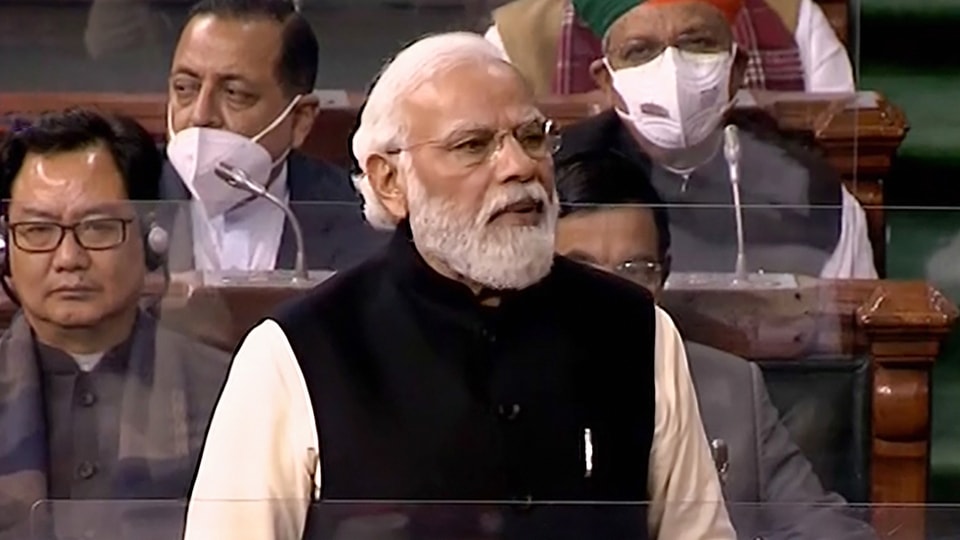
While a rigorous fact checking of the speech can highlight some gaps, political speeches, unlike academic writing, often mix facts with polemics to build a larger narrative. The latest speech of the Prime Minister does gives an idea about the Bharatiya Janata Party’s political narrative at the moment. Here are four charts that explain this in detail.
The BJP is willing to confront the Congress’s economic attack from the left flank
While speaking in the Lok Sabha on February 2, Rahul Gandhi referred to the “double A variant,” accusing the government of being biased towards the two biggest industrialist families in the country: the Ambani and Adani groups. It is not the first time Gandhi has accused the BJP of being pro-big capital.
While speaking in Parliament on February 7, Modi took this criticism head on and reminded the Congress that its governments in the past were also accused of being pro-capitalist by those from the left. Modi went on to say the Congress seems to have borrowed the characteristics of the left by beginning to attack the capitalist class in the country. This trait was harming the Congress, Modi said, trying to isolate Gandhi in his party.
Polemics aside, this is a significant line of attack on the Congress. Its ability to manage contradictions between the rich and the non-rich has been crucial to the Congress’s survival and growth, both before and after independence. There continues to be a large section in the Congress that is not programmatically opposed to big business in India.
Of late, the Congress has been losing its support among big business in the country, the biggest proof of which can be seen in a sharp fall in corporate donations for the party and an unprecedented rise in the BJP’s income from this segment. This presents a dilemma to the Congress. If the Congress wants to go full throttle against big capital, at the very least, it needs to change its political finance model.

What makes the BJP so confident about attacking the left turn of the Congress?
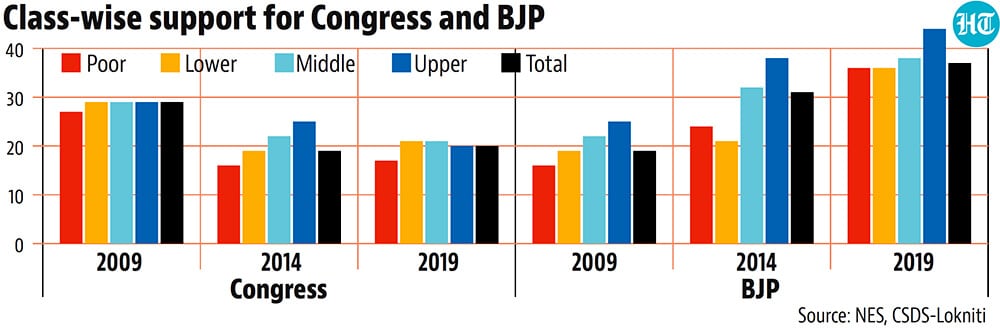
Many political commentators described Narendra Modi’s 2014 victory as India’s Ronald Reagan/Margaret Thatcher moment. The experience after eight years of the Modi government shows that such expectations were not entirely true. While most people would cite lack of adequate reforms to support this argument, an even bigger proof of the current government not being a typical laissez-faire regime is the political capital it has invested in welfare programmes. The importance of the current government’s welfare schemes – Modi mentioned them prominently in his February 7 speech as well – in the BJP’s political victories, especially at the national level, has been well-recognised by political scientists.
“For starters, the ‘new welfare’ push has delivered handsome electoral returns for the incumbent BJP government at the Centre…Analyses of 2019 National Election Study data have found that voters were significantly more likely to credit the central government than state or local governments when it comes to welfare schemes – a reversal of past trends,” Milan Vaishnav, senior fellow and director at think tank Carnegie South Asia Program wrote in an essay published in the Seminar magazine.
Class-wise voting patterns – which show the BJP has managed to increase its support among both the rich and the poor – from National Election Studies conducted by the CSDS-Lokniti underline this argument. Modi’s political weapon in dealing with attacks accusing his regime of being pro-big capital is his welfare transfers.
Do welfare transfers mean a carte blanche for Modi and BJP?
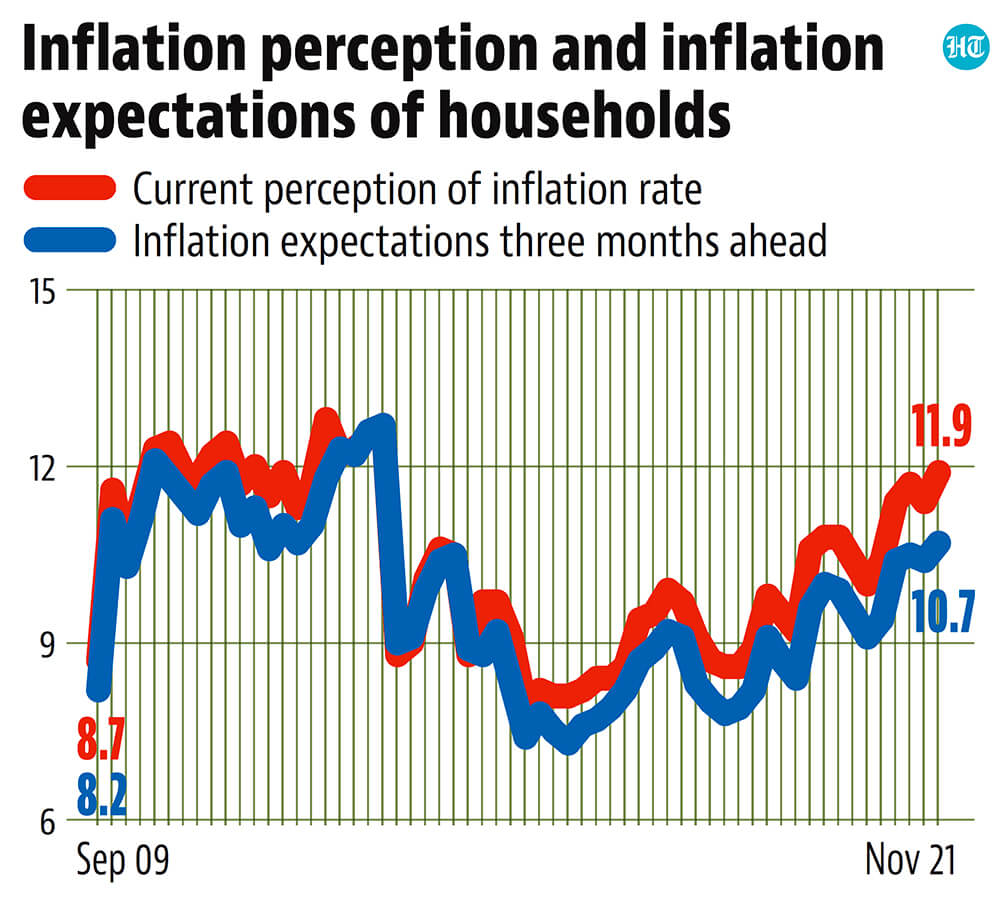
Not at all. Most of the current government’s welfare schemes have been asset rather than income enhancing in nature. It means that they offer little protection against an income slowdown because of a deceleration in growth. What made things easier for the Modi government until 2019 elections might have been the fact that inflation had a much more benign trajectory under its first term than during the second United Progressive Alliance (UPA) government. Modi brought up this fact in his speech as well.
The benign inflation outlook, however, seems to be changing. While headline inflation is still below the upper limit of the Reserve Bank of India’s tolerance band of 6% (it was at double digit levels in the UPA II years), inflation expectations are beginning to harden and not far from levels seen during the UPA II era. This is bad news for the Modi government, as higher inflation in an economy where most workers do not have indexed incomes can cause more economic pain than just a slowdown in growth.
The latest Budget and Economic Survey numbers suggest that the government is hoping that things will stabilize on the inflation front. The Economic Survey, for example, assumes crude prices in the range of $70-75 barrel in the fiscal year 2022-23 against the current levels more than $90 per barrel. If these expectations do not materialize, there could be political trouble for the government.
This is when the BJP will hope to use its cultural nationalism insurance
The other major attack which Modi made on the Congress in his speech was accusing Rahul Gandhi of promoting a divisive agenda and undermining the nation itself. Interestingly, Modi chose to evoke Jawaharlal Nehru, India’s first Prime Minister, while attacking Gandhi. He quoted extensively from Nehru’s Discovery of India, his famous Tryst with Destiny speech and even his emphasis on civic responsibilities to delegitimise Gandhi’s criticism of the BJP under Modi being a centrist or autocratic force. He also quoted from the Vishnu Purana (a Hindu religious text) to argue that the concept of the Indian nation was ancient.
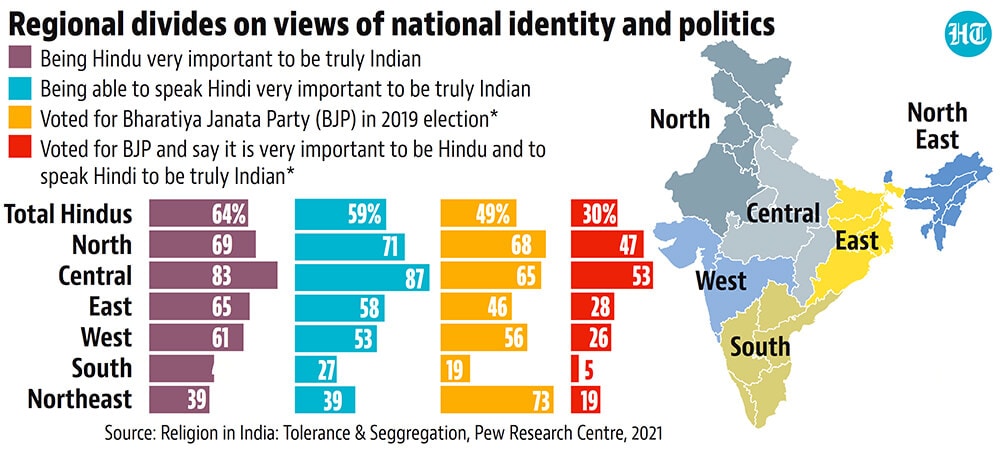
In making such an argument, Modi might be laying ground for consolidation of even if things get difficult for the BJP on the economic front. While the BJP has found it difficult to capture power in most non-Hindi speaking regions on its own (Gujarat and Karnataka are the only exceptions), its electoral success in Hindi speaking regions is of unprecedented magnitude.
It is in these regions, and not places such as Tamil Nadu or West Bengal -- states with strong sub-national sentiments -- that the appeal of BJP’s cultural nationalism pitch of Hindu-Hindi-Hindustan is the biggest, as was seen in the findings of Pew Research Centre Survey conducted in 2021. The Congress, under the leadership of the Gandhi siblings, has been trying to manage this problem by indulging in activities such as temple-hopping during elections, but so far it does not seem to be working for them.