
 E-Paper



More curbs eased in Delhi; all shops, salons to open
Government officials later said salons and barber shops, too, can restart.

 Prefer HTon Google


Beginning Monday, Delhi will be step closer to a complete unlock as all shops will be allowed to operate through the week, restaurants will reopen for dine-in after nearly two months of closure and restricted functioning of weekly markets will be permitted, chief minister Arvind Kejriwal announced on Sunday, with the national capital emerging from of its worst wave of Covid-19 infections so far.
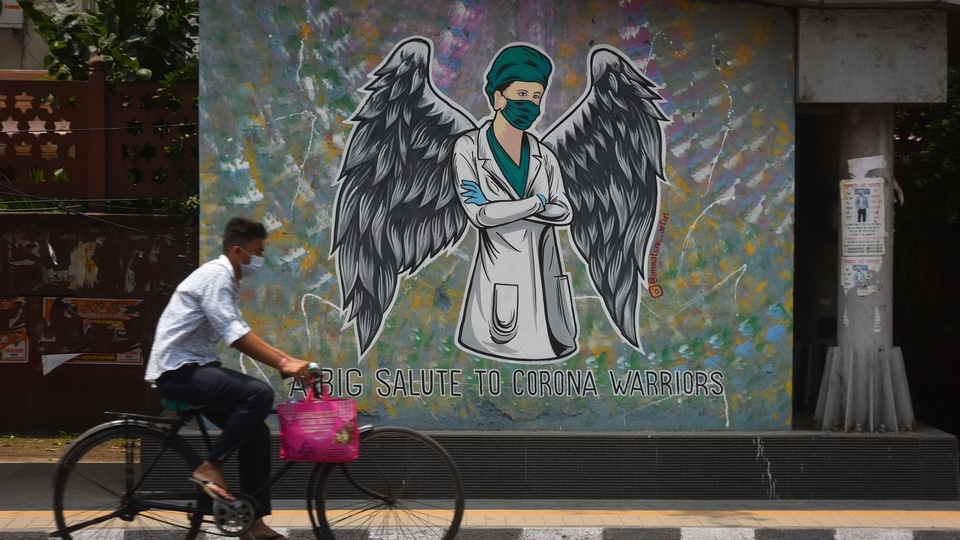
Government officials later said salons and barber shops, too, can restart.
The chief minister said the outbreak in Delhi is largely in control but the government will continue to observe the trends in the coming weeks. “If (daily) cases continue to keep going further down, all restrictions can be scaled down in a phased manner in the coming days. However, if cases go up, we may have to impose restrictions again. I urge everyone to strictly adhere to regulations and Covid-19-appropriate behaviour,” he said at a digital press briefing.
Also Read | As Delhi unlocks, bruised restaurant industry hopes for reprieve
Sunday’s announcement is the third time that the Delhi government has withdrawn lockdown restrictions in subsequent weeks. “From Monday 5am, more or less all economic activities will be allowed except a few,” Kejriwal added.
All shops in markets, market complexes and malls can reopen from 10am to 8pm from Monday, instead of operating in an odd-even basis, the CM said. In the past week, half the shops in markets and malls were allowed to open on alternate days of the week.
Now, all shops in the city — essential and non-essential — can open with no restrictions. This also includes salons and barber shops, at least two government officials said. Spas, however, will remain shut for now.
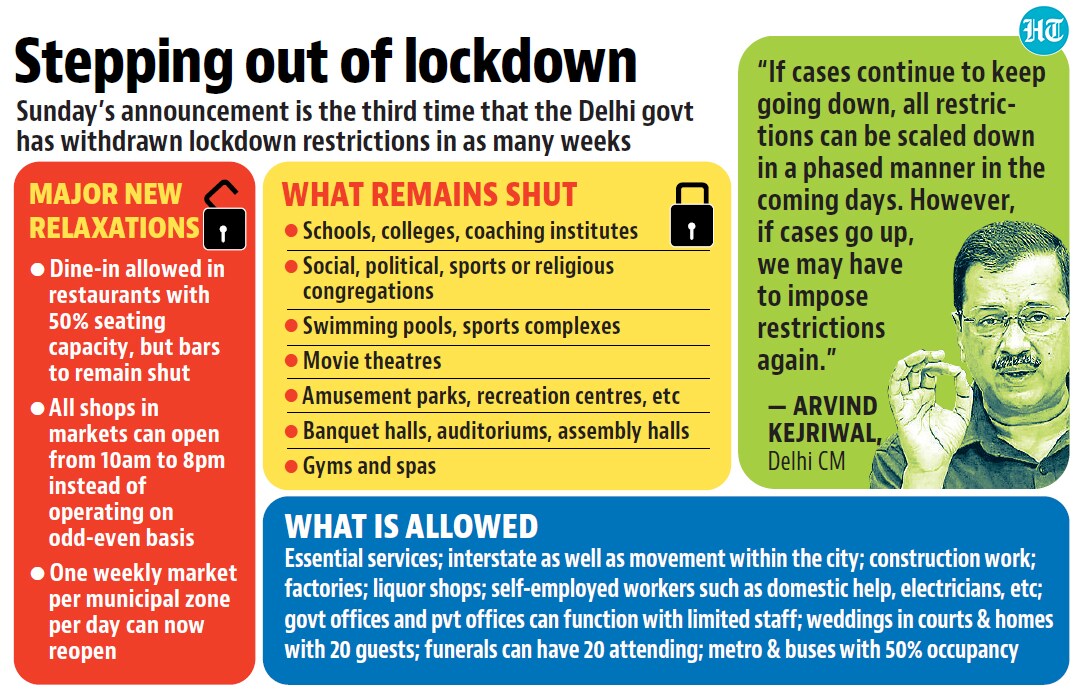
Kejriwal said weekly markets — which were barred during the lockdown — can reopen but only one weekly market per municipal zone can operate in a day with up to half of the normal count of vendors at a time. Delhi has a total of 12 municipal zones.
“No weekly market will be allowed to function on roadsides. The weekly markets can function at suitable nearby grounds/school grounds, where SOP/guidelines of DDMA are strictly implemented,” an order issued by the Delhi Disaster Management Authority said. It also said random testing of Covid-19 will be carried out by district authorities outside these markets.
Restaurants can open their doors for dine-in patrons, but only with 50% seating capacity to ensure social distancing on a “trial basis” until June 21, the order released after Kejriwal’s address said.
Consumption of alcohol, tobacco, pan and gutka is prohibited in restaurants, malls and markets, the DDMA order said. A third senior DDMA official later clarified that restaurants cannot serve alcoholic drinks and bars will remain closed for now.
“A very close watch and supervision will be maintained on the overall functioning of markets, market complexes, malls and restaurants,” DDMA said, warning that if cases of the disease start increasing in the city, these places will be “closed forthwith without any loss of time”.
Places of worship, too, can open but devotees will not be permitted inside, the DDMA statement said.
Some of the previous restrictions and relaxations will remain as they are.
This means private offices can function with up to 50% staff in attendance, public buses and Delhi Metro services will run as usual at 50% seating capacity, and cabs and autorickshaws can carry two passengers per vehicle. The cap of 20 guests for weddings, which can only be held at courts or inside personal residence, will remain. Funerals can be held with up to 20 people in attendance.
All educational institutes will remain shut; so will swimming pools, gymnasiums, cinema halls, banquet halls, entertainment parks, public parks and banquet halls, the order said. All gatherings — social, political, religious and academic — are still barred.
Delhi went into a strict lockdown on April 19 as a mounting caseload of Covid-19 cases weighed down the health infrastructure in the city, which was firmly in the grip of its fourth wave of infections. The runaway outbreak — which was the worst the city has seen in over a year of the pandemic — forced people to scramble from hospital to hospital for medical oxygen and life-saving drugs, while bodies piled on in crematoriums across the Capital.
The situation eased in early May as the central and Delhi governments scaled up health facilities and the spread of the virus slowed down, likely as an impact of the lockdown and the adherence to Covid-appropriate behaviour.
The seven-day average of daily infections, which indicates a region’s Covid-19 curve, has fallen to 271 a day for the week ending Sunday – a drop of 99% from the April 23 peak of 25,294 average number of cases a day, the highest ever recorded in the city. On Sunday, Delhi added 255 new cases and 23 more deaths.
The Delhi government, which earlier this month allowed factories and construction activities to restart, is now focusing on economic revival along with preparing in advance for a potential fifth wave of infections in the city. The Aam Aadmi Party-led government earlier said it is preparing for a peak of around 37,000 infections per day in the next outbreak by increasing the number of hospital beds, creating robust medical oxygen infrastructure and storing stocks of essential medicines.
Experts say it is crucial that restrictions are withdrawn in a phased manner, crowding in public places is banned, and mask compliance is enforced strictly.
“The government should be very meticulous about the phased relaxations. Hundred percent mask compliance should be mandatory, not just on paper, but it should be enforced efficiently as more public spaces open up. For markets and offices, the government should draft a policy of staggered timings to ensure that the crowd is under control. The government should keep a close watch on Covid-19 trends and take its time in lifting restrictions from closed spaces such as gyms, cinema halls, etc. Also, gatherings of any kind should not be allowed at this stage,” said Dr Jacob John, former head of the clinical virology department at Christian Medical College in Vellore.
Restaurant owners welcomed Sunday’s announcement, but urged the government to allow bars to open as well. Manpreet Singh, a Delhi-based restaurateur and treasurer of the National Restaurants Association of India (NRAI), said: “It is a welcome decision. The industry could not recover from the shock of the first lockdown by the time the second lockdown happened. The industry is in distress. We hope that in the coming days, we will witness economic recovery. We will ensure that all regulations and Covid-19 protocols are followed. But the government should also allow bars to open. Prohibiting bars, especially when liquor stores are open and dine-in is allowed, makes no sense.”
The reaction from organisers of weekly markets echoed similar views. “Allowing weekly markets to finally operate is a welcome move. The government should have allowed them earlier with strict protocols. But better late than never. Weekly market vendors are in extreme distress. Many of them are migrants and they have been struggling for food and ration,” said Arbind Singh, coordinator of the National Association of Street Vendors of India.


