Mumbai rains show that India is becoming a country of drowning cities
Heavy rains brought Mumbai, the country’s financial capital, to a standstill for several days. As it limps back to normalcy, the focus is back on urban city planning – or the lack of it.
Updated on: Aug 30, 2017, 21:48:54 IST
Hindustan Times, New Delhi | By Chetan Chauhan, New Delhi
First Bengaluru, then Chandigarh, and now Mumbai – the three Indian cities to have been submerged in recent times following heavy rain have something more in common than the misery they were subjected to. All three have their own urban planning – or the lack of it – to blame.
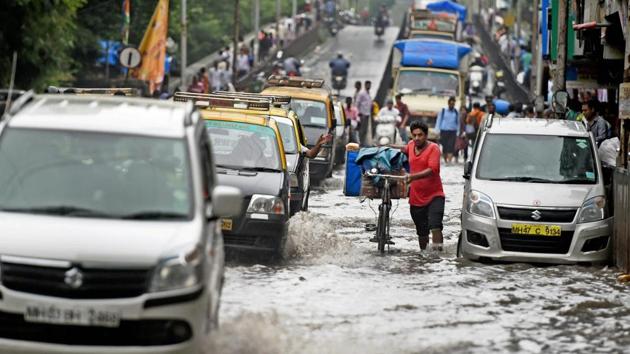
Vehicles ply on a waterlogged road after heavy rains left Mumbai submerged on Wednesday. (PTI Photo)
{{^htLoading}} {{/htLoading}}
According to the latest report of the Wetlands Atlas of India, all three cities have abysmally failed in protecting their water bodies that normally would have absorbed or drained out excess water. The deluge in the wake of heavy downpour was therefore more man-made than an ‘act of God’.
According to the report, over half of the water bodies in the three cities have simply vanished.
Experts say the water bodies have either been encroached upon, reclaimed or their flow channels into rivers have been blocked by unplanned development. The few that have survived are not doing much better. Many have become virtual garbage dumps. When it rains, the garbage – including plastic – overflows and chokes the drains, impeding the drainage of storm water.
{{^htLoading}} {{/htLoading}}
{{^usCountry}}
Other studies have found marshlands that once stretched across 5,000 hectares in Chennai – which was marooned two years ago – have shrunk to one-tenth of their original size. Mumbai’s wetlands in Sewri and other areas are being used to dump solid wastes. Open and natural spaces around Chandigarh are being transformed into concrete blocks of residential colonies.
{{/usCountry}}
{{#usCountry}}
Other studies have found marshlands that once stretched across 5,000 hectares in Chennai – which was marooned two years ago – have shrunk to one-tenth of their original size. Mumbai’s wetlands in Sewri and other areas are being used to dump solid wastes. Open and natural spaces around Chandigarh are being transformed into concrete blocks of residential colonies.
{{/usCountry}}
Heavy downpour is aggravating matters further.
Mumbai has received 290 mm of rain in two days since August 29 — the equivalent of what it normally gets over a period of 11 days in the monsoon. Bengaluru received the heaviest showers in the last 127 years on August 14. It rained 25 times more than it rains normally during the mosoon season.
{{^htLoading}} {{/htLoading}}
Chandigarh came to halt on July 27 with a sudden downpour of 121 mm of rain in six hours, the highest in a decade and 23 times higher of the daily average. A month later, on August 22, it rained even more. The city received 130mm of rainfall that day.
Officials say the extreme weather could be because of climate change.
“Our data shows that such events would increase in coming years as monsoon will become more difficult to predict,” says R Krishnan of the Indian Institute of Tropical Meteorology, Pune.
But the consequences of the rains are being magnified by the ineptness of our civic authorities. Though the annual rainfall in the cities of Bengaluru, Chennai and Mumbai has declined over the past 20 years, floods are being triggered more often by sudden spurts of rain.
{{^htLoading}} {{/htLoading}}
So, better urban planning and protection of natural drainage systems are the only way to prevent the recurrence of flooding.
“Our advice to the municipal bodies is — incorporate such events in the city planning or Mumbai like devastation will be common across cities”, Krishnan added.
Chetan Chauhan is the National Affairs Editor looking into all aspects of news and features from across India. A Chevening scholar with over three decades of experience in reporting and news management, Chetan has extensively covered all important aspects of the social sector, political economy, environment and climate change nationally and internationally. He did a journalism course at the Reuters Institute of Journalism in Oxford and Digital Media training at Nanyang Technological University in Singapore. He started as a reporter with The Statesman in 1996 and joined the Hindustan Times in 2000 in the metro bureau covering environment, crime and Delhi politics. He covered hot local news, from the Jessica Lal murder case to the rebellion of Delhi Congress MLAs against then Chief Minister Sheila Dikshit, to the replacement of toxic vehicle fuel with cleaner compressed natural gas (CNG) in the national capital. Some of his stories on air pollution became part of the Supreme Court’s landmark MC Mehta versus Government of India case in the National Capital Region (NCR), forcing the government to take corrective measures. As part of the national political bureau since 2004, he covered important central sectors such as environment, education, social justice, labour, rural development, water resources, renewable energy, agriculture, broadcasting and the Planning Commission for more than a decade producing several exclusive and investigative breaking stories. His specialisation is the environment, having covered at least a dozen United Nations global conferences on climate change, biodiversity and wildlife including climate summits in Paris, Copenhagen and Bali. He also covered India’s two five-year plans ---11th and 12th and reported on drafting and execution of right based laws such as Right to Education, Right to Information and rural job guarantee law, MG-NREGA, now being introduced in new format as VG-RAM-G Act. He has in-depth knowledge of social sector issues. He was one of the first to report on tigers vanishing from Sariska and Panna wildlife reserves in 2004 and 2008, respectively, leading to the setting up of the National Tiger Conservation Authority (NTCA) and the introduction of stringent penal provisions for poaching. He has written extensively on the rising human-animal conflict in India and the degradation of India’s biodiversity hotspots because of mining and other activities. Since 2004, Chetan has covered Parliament comprehensively and participated in training on the nuanced coverage of Parliament proceedings. He has travelled extensively across India to cover national and provincial elections since 1998, especially in the Hindi heartland states, considered India’s road to power. He writes a regular column for Hindustan Times, Ecostani, on important national politics, economy, Himalayan ecology and environmental issues. His other responsibilities include providing inputs for edits and edit page articles for the publication, apart from managing news flow from across India.
Get the latest India News, breaking headlines and real-time updates from across the country. Stay informed about politics, government policies, crime, weather and major national developments.
Get the latest India News, breaking headlines and real-time updates from across the country. Stay informed about politics, government policies, crime, weather and major national developments.