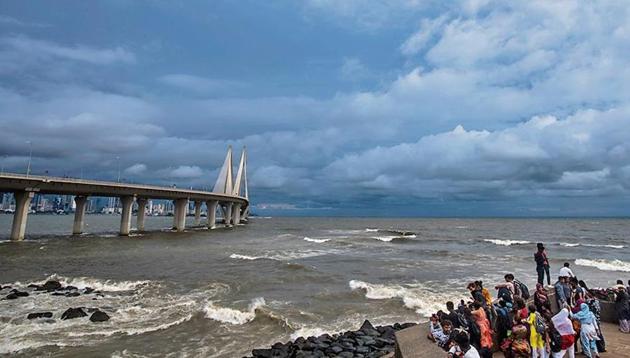
A bright blue sky and sunny conditions, with light showers in the afternoon, characterised Mumbai’s cleanest air day of 2019 on Tuesday, as pollution levels fell to their lowest so far this year.
The pollutant measuring indicator — air quality index (AQI) — read 21, falling in the ‘good’ category for the PM2.5 pollutant — fine particles that can stay in the air for days or weeks and are small enough to invade even the narrowest of airways leading into the body.
“Active monsoon conditions are leading to more moisture in Mumbai’s air. High moisture levels increase the pollutant-carrying capacity of the air. Fast winds originating from the ocean (westerly winds) further lead to an overall dispersion of pollutants,” said Gufran Beig, project director, SAFAR.
This is the third-lowest recorded AQI since the System of Air Quality Weather Forecasting and Research (SAFAR) started monitoring pollution levels from June 2015. The city’s air quality on Tuesday was better than that of Delhi, Pune, and Ahmedabad, where SAFAR monitors AQI.
The cleanest air day of the past four years was recorded on June 25, 2018, when the AQI dropped to 13 (good), followed by an AQI of 18 (good) on June 6, 2018. Prior to Tuesday, the lowest AQI this year was on June 28, at 22 (good).
{{/usCountry}}The cleanest air day of the past four years was recorded on June 25, 2018, when the AQI dropped to 13 (good), followed by an AQI of 18 (good) on June 6, 2018. Prior to Tuesday, the lowest AQI this year was on June 28, at 22 (good).
{{/usCountry}}According to the India Meteorological Department (IMD), the surface visibility level during the day was up to 10km in the city, owing to low pollution levels. On an average, it ranges between five and six km.
SAFAR categorises AQI for PM2.5 in the 0-50 range as good; 51-100 as satisfactory; 101-200 as moderate; 201-300 as poor; 301-400 as very poor and above 400 as severe.
The AQI is expected to rise marginally to 26 (good) on Wednesday.
Of the 10 locations where SAFAR monitors and forecasts AQI levels, all areas recorded ‘good’ air quality (see graphic) with Colaba and Mazgaon having the cleanest air in the city, with AQI levels as low as 6 and 7. The highest AQI in the city was recorded at Malad — 47 (good) — followed by Borivli 23 (good). “Such conditions are likely to continue for the rest of the month with AQI levels fluctuating between good and satisfactory,” said Beig.
PM2.5 concentration was also the lowest so far this year with 12 micrograms per cubic metre (µg/m3) against the safe limit of 60µg/m3 for 24 hours. For Wednesday and Thursday, the concentration is likely to rise to 14µg/m3.