In the 43 days between being released to the wild and being brought back into an enclosure in Madhya Pradesh’s Kuno National Park, five-year-old Namibian cheetah, Oban, now renamed Pawan, travelled more than 300km, keeping the forest staff on their toes.
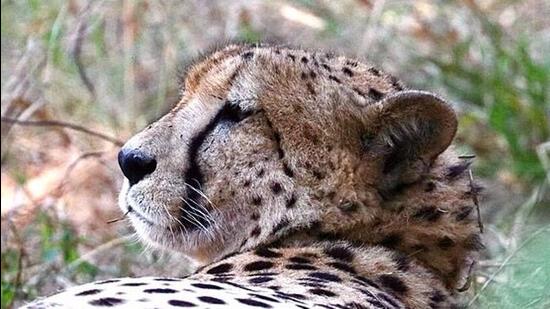
The distance that he covered was the reason for the Madhya Pradesh forest department asking the National Tiger Conservation Authority (NTCA) to look for a second home for cheetahs, after they realised that the 738 sq km area of Kuno National Park (KNP) may not be enough to house all 20 cheetahs -- brought from Namibia and South Africa as part of the ambitious translocation project -- in wild.
On March 11, Pawan was the first male cheetah to be released in the wild from a 6 sq km enclosure, and he started exploring the forest from the very next day, according to officials aware of his movements. His daily travel log, recorded with the help of his geo-tagged collar and accessed by HT, showed that he walked an average of 10km every day, mostly towards the east.
Also Read| ‘Cheetah deaths within expected mortality rates’ : South African government
{{/usCountry}}Also Read| ‘Cheetah deaths within expected mortality rates’ : South African government
{{/usCountry}}“For 20 days, he explored Kuno National Park and was found sitting near small water bodies. He stepped out of the forest on the night of April 1. He was seen in Baroda village on April 2 morning, which is 20km from Kuno National Park,” Uttam Sharma, field director, KNP.
Sharma said that Pawan stayed outside Kuno for five days, which created fear among some villagers, who claimed that he has killed a cattle. “Although no evidence of cattle kill was found, he was tranquillised in Bairad forest near Shivpuri border on April 7 and shifted back to Kuno,” he said.
After five days in Kuno, Pawan again started moving east and reached Madhav National Park on April 18, about 35km away from KNP. “He was heading further towards the east in Madhav National Park where three tigers were translocated on March 10,” said a second official, who asked not to be named.
Also Read: Cheetah brought from Namibia to India gives birth to four healthy cubs
In Madhav National Park, this official added, Pawan may have sensed the presence of the tiger because he started moving in a different direction to leave the park. “He covered almost 150km and reached the Uttar Pradesh border on April 22. The way he was moving, he was about to reach Jhansi, and was tranquillised and left in a soft predator-free enclosure in Palpur on April 22.”
When asked about Pawan travelling outside the park, Madhya Pradesh’s chief wildlife warden, JS Chauhan, said, “It is good that he is adopting to the wild habitat but it would be difficult for us to track all 20 cheetahs.”
What has emerged as a cause of worry for the MP forest department is the stress that the cheetahs could face if kept in long captivity. Also, the sudden death of a six-year-old cheetah, Uday, who was translocated from South Africa earlier this year, has added to fear that more cheetahs could die in captivity.
Uday died of cardiopulmonary failure, his preliminary post-mortem report revealed, and the department is waiting for his final autopsy report.
No infectious disease
On Friday, the South African forestry, fisheries and environment ministry released a statement on the death of cheetah, and the condition of the remaining 11 cheetahs, saying there was no indication of any infectious disease or similar threat to any of them.
“All the South African cheetahs are in larger enclosures and are closely monitored twice daily. As they are wild cheetahs, their behaviour, movements, and body condition must be evaluated from a distance, limiting the ability of teams on the ground to gain precise knowledge of their health status,” it said in a press communique.
“Many of the released cheetahs will escape the boundaries of Kuno National Park (on their release over the next few months) and may have to go through short-term stress during the recapture process. Once the cheetahs have established home ranges, the situation will stabilise,” Peter Mbelengwa, spokesperson of the South African ministry said.