E-Paper



Four cheetahs born in India after seven decades
Union minister Bhupendra Yadav tweeted pictures of four cubs in a 6 square km enclosure in Madhya Pradesh’s Kuno National Park.

 Prefer HTon Google


A cheetah translocated from Namibia on September 17, 2022 gave birth to four cubs last week, officials said on Wednesday, announcing the first of the big cats to be born in the country in decades and representing success for the National Cheetah Project.
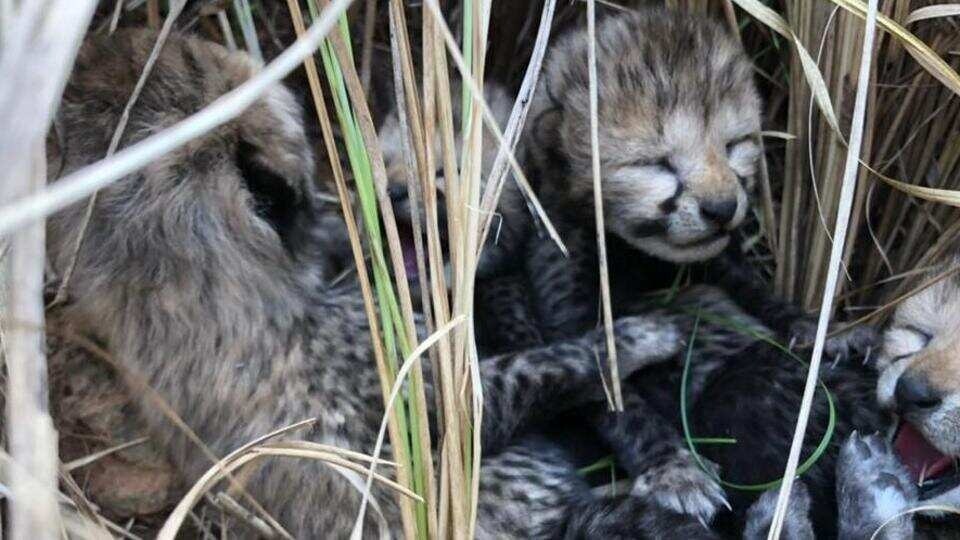
Union environment minister Bhupendra Yadav tweeted pictures of four cubs in a 6 square km enclosure in Madhya Pradesh’s Kuno National Park, which had received 20 cheetahs in two tranches --- eight from Nambia and 12 from South Africa --- since September. Of these, four have been released in the wild, one has died of kidney failure, and 15 are in the enclosure.
The cubs were born to three-year-old cheetah Siyaya. Terming the births as momentous for India’s wildlife conservation, Yadav tweeted: “I am delighted to share that four cubs have been born to one of the cheetahs translocated to India on 17th September 2022, under the visionary leadership of PM Shri @narendramodi ji.”
Also Read: Cheetah brought from Namibia dies of kidney ailment at Kuno National Park
Madhya Pradesh’s principal chief conservator of forest (PCCF) JS Chauhan said Siyaya was not visible for five days, and her radio collar showed her at the same location. “When Namibian cheetah expert Eli Walker checked her today (Wednesday) by entering the enclosure, he found her with four cubs,” the official added.
Madhya Pradesh CM Shivraj Singh Chouhan said: “A special team is taking proper medical care of the new guests and the female cheetah.” He lauded the efforts of Prime Minister Narendra Modi for bringing cheetahs to India and to Kuno.
Experts said the birth of the cubs was a positive sign for the intercontinental translocation of cheetahs. “The cheetahs mate only in a stress-free environment and the birth of four cubs proved that they are comfortable and have adapted well in Kuno National Park. They are themselves expanding the population of cheetahs,” said YV Jhala, former chief scientist of the cheetah project.
Cheetahs have a gestation period of three-four months.
Wildlife expert Anish Andheria said that the forest department should now allow the mother to teach hunting skills to her cubs. “Though the mother is captive-reared, the forest officials should allow her to bring up the cubs in the wild. For these cubs, the spotted deer will be known prey and it is also good for the expansion plan of the cheetah project in other places,” he added.
Senior scientist and veterinarian from South Africa, Adrian Tordiffe said: “I am delighted to hear that Siyaya has given birth to four seemingly healthy cubs. She is still in her hunting camp in Kuno National Park and her cubs will therefore have a high level of protection as that area is free of competing predators.”
He added: “Hopefully they will grow to be healthy strong adults and fulfil their ecological role wherever they end up in India. The fact that she was successfully mated, carried her cubs to term and gave birth naturally are all good signs that the cheetahs have adapted to conditions in India and are carrying on with normal natural behaviours. This also suggests that these animals are not stressed.”
According to a Madhya Pradesh forest department official another female cheetah, named Asha, who was released into the wild last week, appeared to be pregnant. “It can only be confirmed after birth of cubs,” this person said, asking not to be named.