New Delhi Indicating a significant policy shift, the newly formed Bharatiya Janata Party (BJP) government in Rajasthan has announced its intention to introduce fresh legislation on religious conversion.
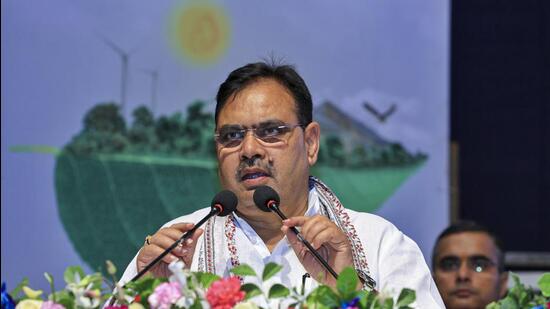
The Bhajan Lal Sharma-led government filed an affidavit in the Supreme Court on Tuesday, stating that while the state currently lacks specific legislation on religious conversion, it is actively working on drafting a new law. Until the legislation is enacted, the state will strictly adhere to existing laws and any guidelines or directions issued by the Supreme Court, it added.
“The State of Rajasthan does not have any specific legislation with respect to conversion from one religion to another...the State of Rajasthan is in the process of bringing its own legislation and till such time will strictly abide by the law on the subject, guidelines or directions passed by this Hon’ble Court,” the affidavit stated.
The move by the BJP government, which came to power in the state in December last year after ousting the Congress, aligns Rajasthan with several other BJP-ruled states, including Uttar Pradesh, Gujarat, Madhya Pradesh, Himachal Pradesh and Uttarakhand, that have enacted stringent anti-conversion laws.
The BJP government’s stance marks a clear departure from the views of former Rajasthan chief minister Ashok Gehlot, who had been vocally critical of anti-conversion laws implemented in BJP-ruled states. Gehlot had argued that such legislations “will leave consenting adults at the mercy of state power,” emphasising the potential for misuse and the infringement on personal liberties.
The affidavit has been filed by the state in response to a petition by advocate Ashwini Kumar Upadhyay, who has demanded strict actions against forced conversions in the wake of alleged mass conversions of socially and economically underprivileged people across the country.
{{/usCountry}}The affidavit has been filed by the state in response to a petition by advocate Ashwini Kumar Upadhyay, who has demanded strict actions against forced conversions in the wake of alleged mass conversions of socially and economically underprivileged people across the country.
{{/usCountry}}Rajasthan had also promulgated an anti-conversion law in 2006 during the first tenure of former CM Vasundhara Raje’s government but despite being passed by the state assembly, but it could not come into force for want of assent of the governor and the president. However, a set of guidelines issued by the high court in December 2017 allows scrutiny and prior approval by the state machinery into interfaith marriages. The high court said that till the time the state government came up with a law, the court had a duty to issue some guidelines to “check the problem of forcible conversion of religion for the purpose of solemnising marriage only”.
There are at least ten states in the country where similar legislations on unlawful conversions are in force. States of Odisha (1967 Act), Madhya Pradesh (1968 Act), Arunachal Pradesh (1978 Act), Gujarat (2003 Act, amended in 2021), Himachal Pradesh (2006 Act, re-enacted in 2019), Chhattisgarh (1968 Act, amended in 2006), Jharkhand (2017), Uttarakhand (2018) and Uttar Pradesh (2020) have specific legislation against unlawful conversion, which provide for penal consequences in case of conviction.
The UP government passed the law, famously known as the ‘love-jihad’ law in February, 2023, following enacting the ordinance on the same subject in November 2020. The law, considered one of the most stringent laws on the subject, prescribes a jail term up to 10 years and fine up to ₹ ₹50,000 for conversion under marriage, fraud, coercion or enticement.
Karnataka, ruled by the BJP at the time, too framed a law of its own in 2022, incorporating some of the harshest provisions in terms of jail term. While most states had not provided for a minimum jail term, the Karnataka anti-conversion law prescribed a minimum punishment of three years behind bars upon conviction. While the minimum punishment in UP is one year, in Karnataka, it was three years. However, after the BJP was ousted by the Congress in the last assembly polls, the Siddaramaiah government announced repealing this law in June 2023.
India has a long history of anti-conversion laws which can be dated back to pre-Independence era. While the British did not enact any law, many princely states did so to restrict the missionary activity. Some of the examples of such legislations are: Raigarh State Conversion Act, 1936, Patna Freedom of Religion Act, 1942, Sarguja State Apostasy Act, 1945, Udaipur State Anti-Conversion Act, 1946. Further, specific laws against conversion to Christianity were enacted in Bikaner, Jodhpur, Kalahandi and Kota.
The last attempt made at a central legislation was in in 1978 when an All India Freedom of Religion Bill was introduced in Lok Sabha by Morarji Desai’s Janata Party government. However, it was never discussed, and was dropped after the government fell in July 1979.
As the Rajasthan government moves forward with its legislative agenda, the proposed anti-conversion law is likely to renew a debate surrounding the necessity of such laws to protect vulnerable populations as opposed to the risks to individual freedoms and the potential for communal tension.