...
...
Next Story

India’s first Chief of Defence Staff will direct three service chiefs

While the implementation committee is still to define the charter for the CDS, people familiar with the matter said the chief will be a single-point military adviser to the government, as suggested by the K Subrahmanyam-led Kargil Review Committee.

Updated on: Nov 19, 2019, 08:03:41 IST
Hindustan Times, New Delhi | By
Prefer HTon Google
Advertisement

India’s first Chief of Defence Staff (CDS) is expected to be announced next month — along with the appointment of a new army chief to replace Gen Bipin Rawat, who is retiring on December 31 — with powers to direct the three service chiefs and to create new theatre commands for an optimal military response in case of hostilities.
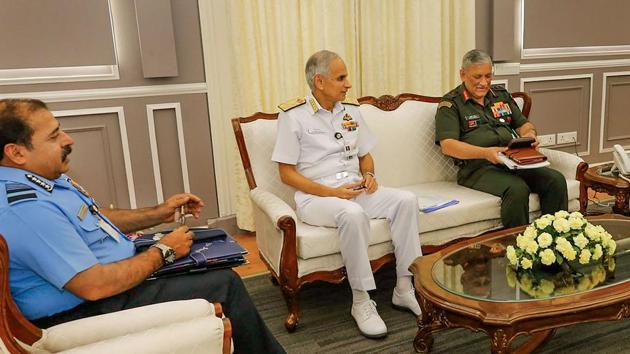
Chief of the Army Staff General Bipin Rawat, Chief of the Naval Staff Admiral Karambir Singh and Chief of the Air Staff Air Chief Marshal RKS Bhadauria. (PTI FILE)

While the implementation committee, appointed by Prime Minister Narendra Modi and headed by national security adviser Ajit Doval, is still to define the charter for the CDS, people familiar with the matter said the chief will be a single-point military adviser to the government, as suggested by the K Subrahmanyam-led Kargil Review Committee.

The people cited above also said that the CDS “will not be a paper tiger”, but someone whose advice will be binding on the three services chiefs.

They added that apart from being responsible for promoting jointmanship, the new CDS will be heading all tri-service structures, with the existing post of Integrated Defence Staff being converted into the Vice Chief of Defence Staff. The current IDS chief Lt Gen PS Rajeshwar is being posted to India’s only tri-service command at Andaman and Nicobar islands. He will succeed Vice-Admiral Bimal Verma, who is retiring on November 30.

The people said that though the CDS will carry four stars (like chiefs of the three services do), he will be the “first among equals”, with the task of prioritising hardware for future Indian military needs, allocating tri-services assets to the new theatre commands, and designating tasks to these formations.

The new CDS will be at the heart of Indian military diplomacy, spelling out the new jointmanship terms to break silos between the three services, which, experts say, have been prone to protecting their own turfs while joining hands only on common issues such as pay and pension.

Jointmanship, as military experts including former service chiefs have pointed out, is more important in the event of a two-front war on India’s northwestern and northeastern borders. China has already divided the People’s Liberation Army into military regions and theatre commands for pinpointed military application. The Pakistani armed forces, meanwhile, operate on a joint staff headquarters concept, with the army playing the lead role under its Corps Commanders.

Former Northern Army commander Lieutenant General BS Jaswal (retd) said jointmanship is extremely important to optimise all the resources that are available in the armed forces. “It is especially important in the light of the philosophy of theatre commands,” he added.

 
ABOUT THE AUTHOR
Shishir Gupta

Shishir Gupta is Executive Editor at Hindustan Times and one of India's top journalists covering national security, strategic affairs, foreign policy and geopolitics. Over the past three decades, he has extensively reported on India's military, diplomatic and security landscape, covering every major conflict and national security challenge, from the 1999 Kargil War and the 2020 East Ladakh standoff to Operation Sindoor in 2025. He has also covered major terror attacks, including the IC-814 hijacking, the 26/11 Mumbai attacks and the 2025 Pahalgam terror strike, along with numerous Pakistan-backed terrorist incidents in the Kashmir Valley and across India. He has reported on national and state elections for more than three decades. A recognised authority on strategic affairs, Gupta has covered India's nuclear programme since the Pokhran-II (Shakti series) tests in May 1998 and has written extensively on global nuclear issues, Indian diplomacy and the country's expanding global outreach. He has also reported widely on international conflicts and terrorism, with a special focus on the Indian subcontinent. Gupta has interviewed Prime Minister Narendra Modi more than four times, including Modi's first interview with the print media after becoming Prime Minister in May 2014. His other interviews include three with the Dalai Lama, as well as conversations with Benjamin Netanyahu, Amit Shah, Yogi Adityanath, S. Jaishankar, Nirmala Sitharaman and Piyush Goyal. He is the author of Indian Mujahideen: The Enemy Within (Hachette, 2011) and Himalayan Face-off: Chinese Assertion and Indian Riposte (Hachette, 2014). He was awarded the Chevening-Wolfson Joint Scholarship at Wolfson College, University of Cambridge, UK, in 1998 and participated in the International Visitor Leadership Program (IVLP) of the US State Department in 2006. He received the Ben Gurion Prize from Israel in 2011 and the K. Subrahmanyam Prize for Strategic Studies in 2015 from the Manohar Parrikar Institute for Defence Studies and Analyses (MP-IDSA). Since 2024, he has hosted Point Blank, Hindustan Times' weekly YouTube show on global geopolitics.

Get the latest India News, breaking headlines and real-time updates from across the country. Stay informed about politics, government policies, crime, weather and major national developments.
SHARE THIS ARTICLE ON
Hindustantimes wants to start sending you push notifications. Click allow to subscribe