Prime Minister Narendra Modi on Tuesday set the stage for the India Semiconductor Mission (ISM) 2.0, saying the new phase will usher in “next-generation reforms” with policies that reflect long-term commitments rather than short-term signals.
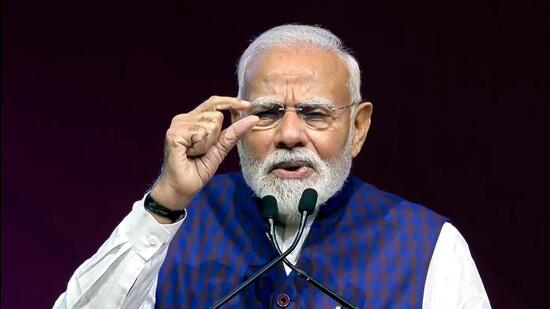
“The design is ready, the mask is aligned, and it’s time to execute with precision and scale. It won’t be long before chips are designed in India, made in India, and trusted by the world,” Modi told industry leaders at Semicon India 2025, urging global investors to join India’s semiconductor journey.
A government official told HT that the next phase of ISM is likely to include display fabs as a key area of focus.
The global semiconductor market is currently valued at $600 billion and is expected to surpass $1 trillion in the coming years. Given India’s rapid progress, the country is poised to claim a significant share of this growth, the Prime Minister said.
“In the world of semiconductors, there is a saying ‘Oil was black gold, but chips are digital diamonds’,” said the PM. “The last century was defined by oil. Global economy went up and down based on how much petroleum will come out of oil wells. But the strength of the 21st century has accumulated in a small chip.”
Under the government’s India Semiconductor Mission (ISM), 10 semiconductor units have been announced and approved, with a total investment of $18 billion. Just last week, a pilot facility of the CG Semi plant in Sanand was inaugurated, marking the starting point for the first Made-in-India chip to be prepared for mass production. To be sure, these chips are being assembled in India, not manufactured from scratch in a fabrication plant.
{{/usCountry}}Under the government’s India Semiconductor Mission (ISM), 10 semiconductor units have been announced and approved, with a total investment of $18 billion. Just last week, a pilot facility of the CG Semi plant in Sanand was inaugurated, marking the starting point for the first Made-in-India chip to be prepared for mass production. To be sure, these chips are being assembled in India, not manufactured from scratch in a fabrication plant.
{{/usCountry}}Emphasising the importance of speed in semiconductor manufacturing, the PM said that the less time it takes to clear ‘paper’ work, the faster ‘wafer’ work will happen.
IT minister Ashwini Vaishnaw presented the PM with a commemorative plaque featuring 33 chips designed and assembled in India. At its centre was a chip from ISRO, encircled by chips from four semiconductor plants in Sanand, Gujarat - namely Micron, Kaynes, CG Semi and Tata. The remaining chips were contributed by institutions such as IITs, NITs and C-DAC.
“The ISRO chip goes in the rocket. There are not many countries in the world which can say that their students in educational institutions have designed chips. And India has 20 such institutes where our students are designing,” said the IT minister, adding that the chips were assembled in the Semiconductor Laboratory in Mohali, Punjab.
“The priorities in ISM 2.0 will increase. 1.0 was about starting the industry in our country right from scratch. Time to increase the scope of the work we face in ISM 2.0,” he said.
In the next phase of the ISM, the focus will expand beyond fabs to strengthen the broader supply chain by supporting equipment makers, material suppliers, and ecosystem partners, while also pushing for the development of complete chipsets with intellectual property designed in India, two priorities that go beyond the objectives of ISM 1.0, he said.
“The PM always asked us to focus on a 20-25 year journey. And getting the ecosystem, partners into the country is very important because that is the way to sustainably grow,” the minister added.
The event, scheduled to run from September 2 to 4, saw attendance of major semiconductor companies like ASML, Applied Materials, Tokyo Electron Limited, among others.
At the semicon event, four country pavilions from Singapore, Malaysia, Japan, and South Korea will be there. Six country-specific roundtables are also planned with the US, Netherlands, Japan, Singapore, South Korea, and Malaysia. Nine states, in comparison to six states last year, are participating in the event. No Chinese exhibitors are participating this year despite China being a leading nation in semiconductors.
This year, 350 exhibitors have set up booths, compared to fewer than 200 last year. The number of booths has risen to 1,100, reflecting the increased interest in India’s semiconductor sector. Over 50 CXOs and delegates from 33 countries are expected to attend, alongside researchers and academicians.
Also present at the event was Odisha chief minister Mohan Manjhi and Delhi CM Rekha Gupta.