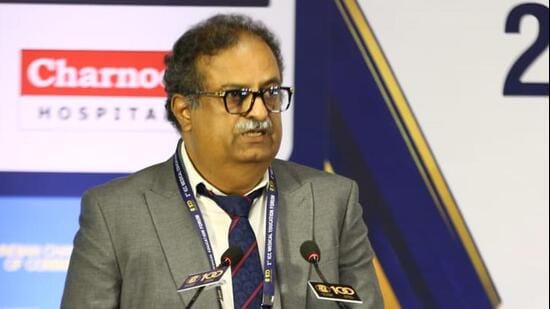
The National Medical Commission (NMC) chairperson Abhijat Sheth called for a stronger focus on quality, competency and technology-enabled learning as India rapidly expands its medical education system, warning that growth in the number of colleges and seats must not come at the cost of standards.
NMC chief Abhijat Sheth calls for quality, competency and AI skills as India expands medical colleges and MBBS seats.
{{^htLoading}} {{/htLoading}}
Addressing the Indian Chamber of Commerce’s Medical Education Forum in Delhi, Sheth said India now has more than 800 medical colleges, describing the expansion as a “purposeful national strategy” aimed at strengthening the healthcare workforce and addressing geographical and demographic disparities.
India’s medical education capacity has expanded sharply over the past decade, with the number of medical colleges more than doubling from 387 in 2014 to 844 in 2026, while undergraduate Bachelor of Medicine and Bachelor of Surgery (MBBS) seats have nearly tripled from 51,348 to 1,39,489.
“The ultimate measure of our success will not be how many doctors we are going to create, but what kind of doctors we are going to create who will be serving the society,” Sheth said.
{{^htLoading}} {{/htLoading}}
{{^usCountry}}
“As we expand, our greatest responsibility is to ensure that expansion doesn’t compromise quality while ensuring access and equity,” he added.
{{/usCountry}}
{{#usCountry}}
“As we expand, our greatest responsibility is to ensure that expansion doesn’t compromise quality while ensuring access and equity,” he added.
{{/usCountry}}
Highlighting the changing role of technology and artificial intelligence (AI) in medical education, Sheth said that AI would increasingly assist diagnosis, data analysis and clinical decision-making. However, he said, “AI should never replace professional responsibilities and accountability.”
He said that medical students must learn not only to use AI but also understand algorithmic bias, data privacy, cybersecurity, informed consent and the limitations of AI-generated information. India, he added, should develop AI systems suited to its own population, healthcare challenges and data.
Calling for a shift towards competency-based education, faculty development, simulation-based learning and lifelong research, Sheth said India’s objective should be to produce doctors capable of shaping the future of medicine.
Sanjay Maurya is a Principal Correspondent with Hindustan Times, where he covers education, with a focus on school and higher education, competitive examinations, education policy and governance. Working as part of the National Bureau, he is based in New Delhi and reports on the Ministry of Education and covers various statutory bodies like UGC, AICTE and NCTE and autonomous bodies like CBSE and NCERT. His reporting also tracks the implementation of key government reforms and policies from school education to higher education including in IITs, NITs, IIMs, central and state universities, and their impact on students and educational institutions. His reporting on the irregularities and rushed implementation of CBSE's On-Screen Marking (OSM) system for evaluation of Class 12 board exams 2026, triggered administrative action, leading to the transfer of the board's two senior-most officials and the constitution of a committee to probe alleged irregularities in procurement process of the system. He joined Hindustan Times in December 2024. Prior to that, he had a three-year stint at Careers360, where he reported on school and higher education, entrance examinations, admissions, rankings and various education policies involving universities and professional education bodies. Over the years, Maurya has reported extensively on major developments in India's education sector, including the implementation of the National Education Policy (NEP) 2020, reforms in the National Testing Agency (NTA) following the NEET-UG 2024 controversy, changes in school education, higher education regulation, and the evolution of entrance examinations such as NEET, JEE and CUET. He regularly produces data-driven and explanatory stories based on government documents, parliamentary proceedings, court records and official data. His focus remains on helping readers understand how education policies and institutional decisions affect millions of students, teachers and educational institutions across the country.
Get the latest India News, breaking headlines, and real-time updates from across the nation. Stay informed on politics, government policies, crime, weather, and major national developments.
Get the latest India News, breaking headlines, and real-time updates from across the nation. Stay informed on politics, government policies, crime, weather, and major national developments.
Home/India News/NMC chief calls for quality focus as India expands medical education
{{^htLoading}}
Advertisement
{{/htLoading}}
SHARE THIS ARTICLE ON
{{#usCountry}}{{/usCountry}}
Notifications
Get breaking alerts directly from the newsroom
Notifications are on!You'll be notified when news breaks