The Meghalaya High Court on Wednesday pulled up the state police over its investigation into the August 19 Shillong violence, questioning why officers failed to stop a Khasi Students’ Union (KSU) black-flag bike rally in Shillong after participants allegedly breached several conditions set for the rally.
A bench of chief justice Revati Mohite Dere and justice W Diengdoh expressed dissatisfaction with the probe’s progress and raised pointed questions regarding the police response before, during, and after the procession, saying it was “not happy” with the investigation.
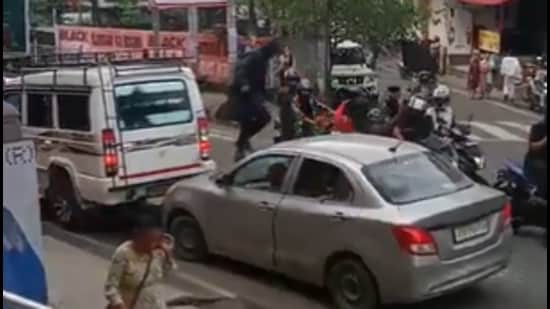
Protesters vandalised and set ablaze vehicles, including those with Assam registration numbers, and damaged a glass panel of a statue of philosopher Swami Vivekananda. Only four people, however, were arrested for the violence. The high court asked why others were not taken into custody.
The court said the rally had been approved under strict conditions, including an undertaking that participants would not cover their faces. However, the bench was informed that many protesters covered their faces, obscured the registration numbers of their vehicles and carried lathis and other potentially dangerous objects.
The court observed that timely police intervention could have averted the subsequent violence and destruction and enquired whether the procession had been videographed from the beginning and whether officers intervened once the violations became apparent.
{{/usCountry}}The court observed that timely police intervention could have averted the subsequent violence and destruction and enquired whether the procession had been videographed from the beginning and whether officers intervened once the violations became apparent.
{{/usCountry}}Turning to the investigation, the court expressed concern over the lack of arrests though 22 FIRs were registered across state capital, Shillong. The bench said the arrest of only four persons was disproportionate given that the violence involved “hundreds of miscreants.”
Four FIRs were filed at the Sadar police station, nine at Rynjah, seven at Mawlai, and one each at Laitumkhrah and Lumdiengjri.
Police said investigators had also seized two vehicles, obtained call detail records for eight phone numbers, and collected CCTV footage from 27 locations for analysis.
The bench stressed that the investigators must go beyond arresting KSU office-bearers and identify and apprehend those directly responsible for individual acts of violence.
The court also told the police to produce the case diary in connection with the attack on two high court vehicles, noting that all cases, including an attack on a public transport bus, must receive the same expeditious consideration.
The high court had earlier taken suo motu cognisance of the violence after the August 19 KSU black-flag bike rally descended into clashes, vandalism, and targeted attacks on vehicles. The violence subsequently heightened tensions along the Meghalaya-Assam border and disrupted interstate transit.
The state government has since constituted a Special Investigation Team (SIT) led by Inspector General of Police Marak to probe the incidents.
The high court directed that its observations be communicated to the SIT chief and ordered the IGP, the East Khasi Hills SP, and the officers-in-charge of the Sadar and Lumdiengjri police stations to appear in person at the next hearing to explain the progress of the probe.
The court has called for a fresh status report to be submitted at the next hearing on September 7.