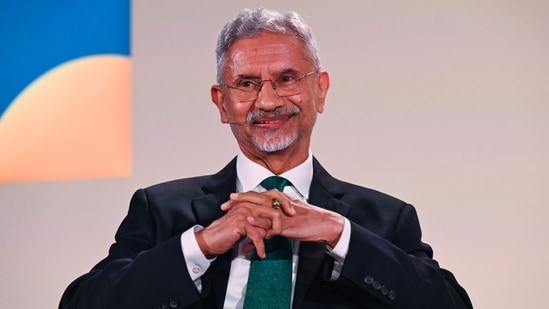
External affairs minister S Jaishankar said at an event on Wednesday that calling India a “middle power” would be “limiting itself” by that definition.
S Jaishankar spoke at the Bloomberg New Economy Forum being held in Delhi on Tuesday, October 13. (Bloomberg)
During a panel discussion at the Bloomberg New Economy Forum, Jaishankar was asked why India does not like to be described as a “middle power”, to which he said that more than that, India is the “power in the middle”.
{{^htLoading}} {{/htLoading}}
{{^usCountry}}{{/usCountry}}
He also quoted Prime Minister Narendra Modi on his definition of a “middle power” as “the countries who have the power to empower” before adding that it would be not be a “comfortable” description for India.
Deep Dive
What did S Jaishankar mean by calling India a “power in the middle”?
He said India’s role is not adequately described by the label “middle power.” In his view, India is a power positioned to shape arrangements and bring its own interests and capabilities to the table.
Why does Jaishankar say “middle power” is a limiting description for India?
He said the label does not reflect India’s population, its roughly $4 trillion GDP or its growth potential. He described it as an uncomfortable definition that could limit how India’s global position is understood.
How does Jaishankar say countries should respond to global choke points?
He said countries should think independently, identify their own interests and develop their own policies. They can then make arrangements with one another based on what each brings to the table.
“More than a middle power, in a way, we are powers in the middle. What would really define a middle power? To use the Prime Minister's words, the countries who have the power to empower... Would India be a middle power? It's not a comfortable description,” Jaishankar said.
{{^htLoading}} {{/htLoading}}
{{^usCountry}}
“… because if you are the most populous country in the world, you have a GDP of $4 trillion, give or take, and you have a lot of growth ahead of you, staring you in the face, then the middle power somehow seems to be limiting itself by that definition....” he added.
{{/usCountry}}
{{#usCountry}}
“… because if you are the most populous country in the world, you have a GDP of $4 trillion, give or take, and you have a lot of growth ahead of you, staring you in the face, then the middle power somehow seems to be limiting itself by that definition....” he added.
{{/usCountry}}
{{^htLoading}} {{/htLoading}}
Jaishankar also said that the "middle powers would now each apply their own mind, stake out their own interests, figure out their own policies, and then reach arrangements with each other."
‘World of choke points’
The external affairs minister also spoke about how “choke points” have taken over the world, even in areas such as finance and sanctions.
“... It's not just a world of middle powers. It is also today a world of choke points. The tendency to weaponize, we tend to think of rare earths as an example. But the fact is even finance and sanctions is a choke point…” he said.
{{^htLoading}} {{/htLoading}}
He then spoke about how things are moving towards a point where competition would be about who brings what to the table and that there should not be a “pessimistic” view about this.
"We are moving to a world where the competition is going to be to some degree who has what to bring to the table and then deals among them saying, 'You do this, I do this, let's develop this together, let's trade this for each other'... The table will exist. People will come to that in different ways, with different things to bring to the table. The behavior around the table will change. Who will talk how loudly and who will sit next to whom will also change. We should not have a pessimistic view about this process of change. This process of change was happening. It's just taken turns which we may not have anticipated," Jaishankar said.
Follow the latest breaking news, major developments and agenda-setting stories from India and around the world with the newsdesk at Hindustan Times. Operating round the clock, the desk brings together experienced editors, reporters and correspondents to deliver fast, accurate and contextual reporting across subjects that influence public policy, governance, business, society and international affairs. The HT News Desk covers politics, elections, government policies, the economy, business and markets, science and technology, the environment, law and order, infrastructure, education, climate issues and geopolitics, while closely tracking developments across states, institutions and global capitals. The team also leads coverage of major breaking news events, policy announcements, court proceedings, natural disasters, public emergencies and significant international developments. Reports published by the newsdesk are based on information gathered from reporters on the ground, official statements, government agencies, court records, regulatory filings, recognised institutions and other authoritative sources. Stories undergo editorial scrutiny and verification processes to ensure accuracy, fairness and relevance, and are updated as events evolve and additional information becomes available. Whether covering a key political decision in New Delhi, an economic policy shift affecting millions, a landmark court ruling or a major global event, the HT News Desk aims to provide readers with reliable, fact-based journalism that delivers not only the latest developments but also the context and analysis needed to understand their wider implications.
Get Latest News, breaking headlines, and top India News, and today real-time updates from across the nation. Stay informed on politics, government policies, crime, Today Weather, and major developments on Hindustan Times
Get Latest News, breaking headlines, and top India News, and today real-time updates from across the nation. Stay informed on politics, government policies, crime, Today Weather, and major developments on Hindustan Times
Home/India News/‘Not middle power, but power in the middle’: EAM S Jaishankar on India's global position
{{^htLoading}}
Advertisement
{{/htLoading}}
SHARE THIS ARTICLE ON
{{#usCountry}}{{/usCountry}}
Notifications
Get breaking alerts directly from the newsroom
Notifications are on!You'll be notified when news breaks