
 E-Paper



Notify sacred groves Oran in state as forests, Supreme Court orders Rajasthan
The bench also formed a five-member committee to recommend inclusion of desert ecosystems such as Dev-van and Rundh within definition of ‘deemed forests’

 Prefer HTon Google


NEW DELHI: The Supreme Court on Wednesday directed the Rajasthan government to grant legal protection to sacred groves or Orans in Rajasthan as “forests” and carry out a district-wise mapping of such lands not based on their size but on their ecological and cultural significance.
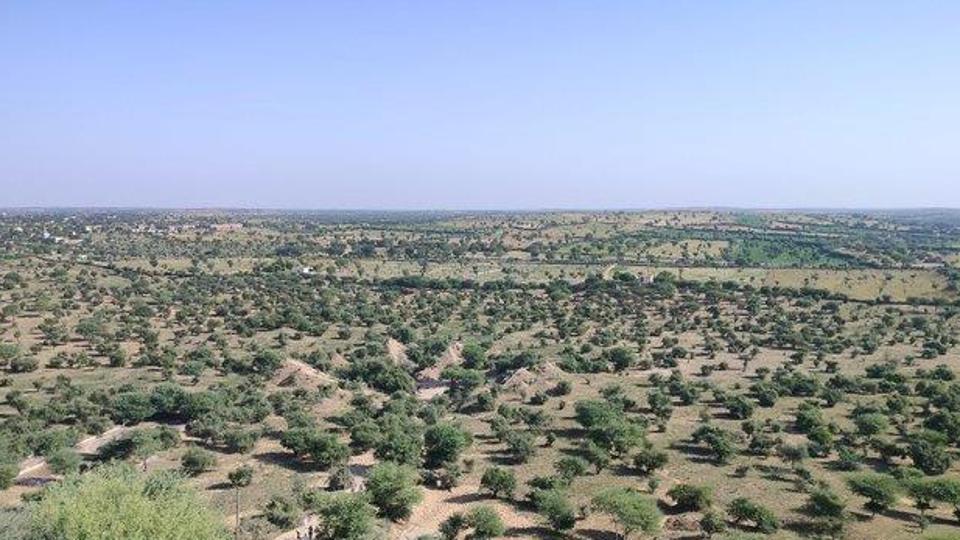
A bench of justices Bhushan R Gavai, SVN Bhatti and Sandeep Mehta observed how these groves are pivotal to biodiversity preservation.
“Given their ecological, cultural, and spiritual significance, Oran lands must be granted the legal status of ‘forests’ under the Forest Conservation Act. This designation would not only ensure their protection against encroachment and degradation but also reinforce community participation in sustainable forest management,” the bench said.
The top court also recommended that Orans be granted protection under the Wildlife Protection Act, 1972, specifically through Section 36-C, which allows for the declaration of ‘community reserves.
The court noted that there were similar community forests or sacred groves known by different names in other states like Devban in Himachal Pradesh, Devarakadu in Karnataka, Kavu in Kerala, Sarna in Madhya Pradesh, Devrai in Maharashtra, Umanglai in Manipur, Gramthan in West Bengal, and Pavithravana in Andhra Pradesh, and directed the Ministry of Environment, Forests and Climate Change (MoEFCC) to frame comprehensive guidelines for the governance and management of sacred groves across the country.
The bench also formed a five-member committee headed by a retired judge of the Rajasthan high court along with a domain expert (preferably a retired chief conservator of forests) and senior officers drawn from the central government and the Rajasthan forest department to recommend the inclusion of other desert ecosystems such as Dev-van and Rundh within the definition of ‘deemed forests’.
The case was posted for January 10 for reporting compliance on the setting up of the committee.
The issue concerning the protection of Orans came before the top court in an application filed by a Rajasthan resident Aman Singh alleging violation of the top court’s judgment in July 2018 in the TN Godavarman case where a direction was given to the state to undertake identification of Orans, or community forests which are preserved and managed by local communities.
The application produced a list of 100 such Orans that need to be protected and directed the state to undertake the exercise of identification of such lands which ought to be included within the definition of forests.
The bench said the protection of Oran lands as ‘forests’ was imperative to uphold both ecological sustainability and cultural heritage.
While the Rajasthan Forest Policy 2010 provided a detailed framework for protecting sacred groves, this protection was diluted under the 2023 Policy which relegated them to a broader category of community lands.
The judgment said that across Rajasthan alone, there were about 25,000 Oran spread across an area of about 600,000 hectares. About 1,100 major Oran are in an area of more than 100,000 hectares in the state and these provide livelihood to the rural population.
Directing the state to undertake a survey as a first step, the 50-page judgment said the forest department must carry out detailed on-ground mapping and satellite mapping of each sacred grove in each district to ensure their preservation and classify them as a forest. This was recommended in 2005 as well by the Central Empowered Committee (CEC) - an expert body assisting the court on environmental issues.
The bench said, “This classification should not depend on the size or extent of the groves but instead, focus solely on their purpose and their cultural and ecological significance to the local community.”
The court further directed the Rajasthan government to identify “traditional communities” that have historically protected sacred groves and designate these areas as a ‘community forest resource’ under Section 2(a) of the Forest Rights Act.
The court cited a community-driven conservation effort in Piplantri village in Rajasthan which came to be known as the “Piplantri model” in Rajasthan’s Rajsamand district where the tragic death of a girl child of the village sarpanch led them to plant 111 trees for every girl born. The village had previously suffered due to excessive marble mining, which led to water shortages, deforestation, and economic decline.
Over the years, the court recounted that the Piplantri model led to the planting of 40 lakh trees that in turn helped raise the water table and cooled the climate by 3-4 degrees centigrade. While on one hand it improved local biodiversity and protected the land from soil erosion and desertification, the female population in the village rose to 52% and created sustainable jobs for the local population by trading in aloe vera and bamboo products.
“These communities have shown a strong cultural and ecological commitment to conservation, and their role as custodians should be formally recognized,” justice Mehta, writing the judgment for the bench, said, adding, “Models like Piplantri village demonstrate how community-driven initiatives can effectively address social, economic, and environmental challenges in a cohesive manner.”
The court also ordered the Centre and state governments to support these models by providing financial assistance, creating enabling policies, and offering technical guidance to communities.
Senior advocate K Parmeshwar assisting the court as amicus curiae pointed out that these groves reflect ancient traditions of forest conservation, where nature is respected and protected and helps combat soil erosion and recharge aquifers. He further stated that the Rajasthan government has initiated the process of identifying and notifying sacred groves as forests through district-wise notifications.
The bench said, “While this development is commendable, it is important to highlight the significant delay in commencing this critical process.”


