A village in Odisha’s Koraput district is opposing aluminium maker Nalco’s plan to build a new red mud pond, alleging the toxic waste would render their fields unsuitable for agriculture while causing diseases.
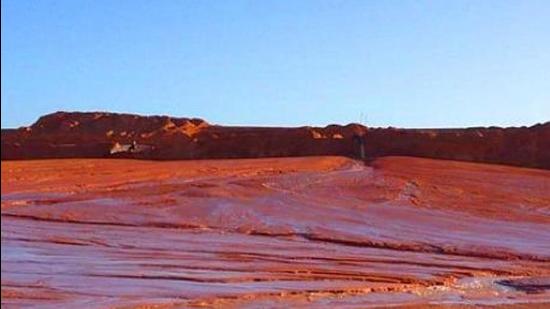
Since last week, more than 600 tribals, Dalits and members of Other Backward Castes (OBCs) in Dengajaniguda village under Dasamantpur block of Koraput district have been preventing the revenue officials from identifying land near their village for construction of Nalco’s second red mud pond. Red mud, also known as bauxite residue, is an industrial waste generated during the processing of bauxite into alumina (the Bayer process) and is composed of various oxide compounds, including iron oxides which give it the red colour. The disposal and utilisation of red mud have been traditionally hindered due to its extreme alkalinity (pH about 10.5–13.5).
Villagers led by Bansi Bisoyi said the existing red mud pond of the alumina refinery, situated about two kms from the village, has already led to several health problems. “Our tubewells spew red water and it is leading to several skin problems among villagers. The doctors are not able to detect the ailments. Water seeping from the first red mud pond has destroyed our farmland, natural streams, nullahs and has affected many people. We are forced to collect water from nearby streams,” alleged Bisoyi. Another villager Tuni Muduli alleged leaching of chemicals from the existing red mud pond has rendered farmlands unsuitable for cultivation.
Bisoyi said as the proposed red mud pond is just about 200 metres away from their village, it would further imperil their life. “We have been suffering for more than a decade due to the existing red mud pond that was started in 1986. Imagine what would happen when the new one comes up very close to our homes. We would not let it happen,” said Bisoyi. The proposed red mud pond at Damanjodi block is located on the border of Dasmantpur and Damanjodi.
{{/usCountry}}Bisoyi said as the proposed red mud pond is just about 200 metres away from their village, it would further imperil their life. “We have been suffering for more than a decade due to the existing red mud pond that was started in 1986. Imagine what would happen when the new one comes up very close to our homes. We would not let it happen,” said Bisoyi. The proposed red mud pond at Damanjodi block is located on the border of Dasmantpur and Damanjodi.
{{/usCountry}}Officials said local tehsildar Ajay Tirkey, accompanied by revenue inspectors, supervisors and a platoon of police force were not allowed to do a survey of the area last week. “The villagers asked us to return and didn’t listen. We had to come back,” said an official of the Koraput administration.
Pinki Bisoyi, another villager, said they have not gained anything from Nalco’s alumina refinery, which came up in 80’s in Damanjodi. “As there is no high school, our children are unable to study beyond class 5. There is no employment for our youths,” she alleged.
However, Nalco’s group general manager (refinery) Bhimsen Pradhan said the villagers’ allegations are not true. “Contrary to what the villagers allege, there is no leaching of chemicals from the existing red mud pond. For the new red mud pond, we are giving an extra layer of protection,” he said.
Local politicians, meanwhile, have lent their support to the popular protest. “Nothing should be done at the expense of the health and lives of people. Nalco has not kept its promise in the past and so local people are wary of the company’s promises,” said Bharatiya Janata Party BJP leader Bhrugu Buxipatra.
“It is injustice towards people from villages near Damanjodi who were affected due to Nalco’s mines and plant,” said Koraput district’s Biju Janata Dal (BJD) president Ishwar Chandra Panigrahi. Koraput MLA and district planning board chairman Raghuram Padal urged Nalco authorities to conduct a baseline socio-economic survey to ascertain the condition of people affected by the company’s plant and mines.
In July 2019, the Comptroller and Auditor General (CAG) hauled up Nalco for exceeding its limit on daily discharge of red mud and red mud pond effluent. “The daily discharge of red mud and red mud pond effluent from the refinery was consistently higher than the corresponding limits specified by the Odisha State Pollution Control Board during the period from 2012-13 to 2016-17,” CAG report said, noting that Nalco discharged 6,723 tonnes of effluent daily, against the 6,087 tonnes limit set by the board. Similarly, on red mud pond effluent, the limit was set for 5,200 kilolitres per day but Nalco recorded 5,425 kilolitres discharge per day.
“The company cannot change or alter either the quality or quantity of the rate of discharge without the previous approval of OSPCB,” the report said, recommending legal action under various laws.
Incorporated in 1981 as a public sector enterprise of the central government, Nalco runs Asia’s largest integrated aluminium complex in Damanjodi. However, Nalco’s operations have been criticised for severe social, economic, cultural and environmental impacts, including displacement and inadequate compensation for rehabilitation.
In the late 80’s, Nalco acquired over 250 acres of land from 9 families of Dengajaniguda for a pittance. Over the last 4 decades, the 9 families have split up and become more than 100 due to separation and marriages in the families. As the new families did not gain anything from the rehabilitation package declared decades ago, there is considerable resentment.
A 2018 research into development, dispossession and impoverishment in villages displaced by Nalco, done by B K Srinivas and Jayanta Kumar, professors from Koraput’s Central University of Odisha, found that the living condition of the displaced people had turned worse over the years. “There is a lack of employment other than manual labour. Villages lacked civic amenities while children were deprived of schooling. Most of the displaced people lived in semi-pucca houses and their source of drinking water continued to be either open wells, hand pumps or pond water,” the study found.
Activist Prafulla Samantra said most of the affected villages had lost fertile agricultural land. “Damanjodi has the highest number of displaced families where agricultural land was alienated. In several villages where land was acquired, people were not given any alternate livelihood. Besides, compensation for land was given only to those farmers who had pattas, and several adivasi and Dalit families who did not posses pattas never received compensation and lost their only source of livelihood,” alleged Samantra.