E-Paper



On Ambedkar Jayanti, President Murmu calls for unity beyond caste, class and region
President Murmu also urged all sections of society to prioritise learning, especially for marginalised communities.

 Prefer HTon Google


President Droupadi Murmu on Tuesday urged citizens to rise above divisions of caste, class, language, and region to build a harmonious society, asserting that no individual should live with the “mentality of the exploited or the deprived.”
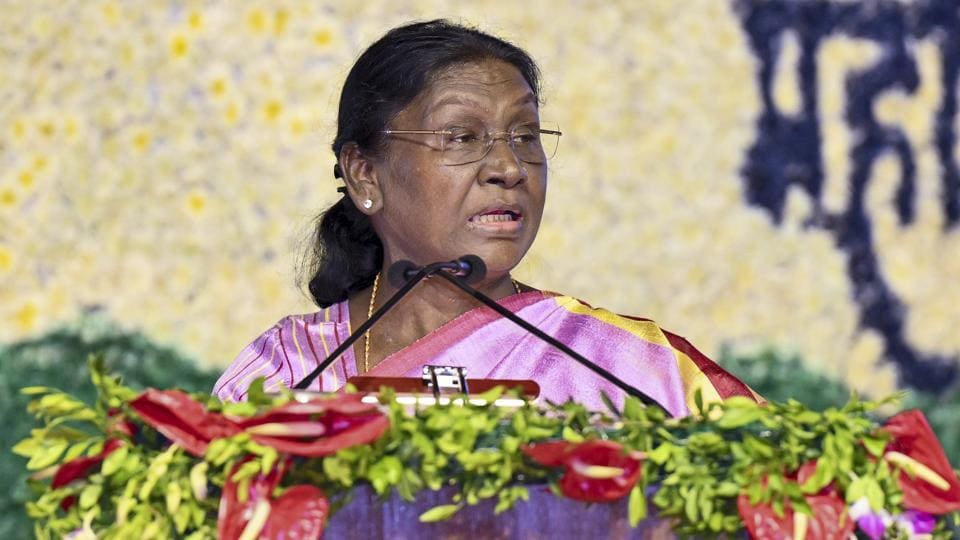
Addressing the ‘Samajik Samrasta Mahotsav’ at Lok Bhavan to mark the birth anniversary of BR Ambedkar, Murmu emphasised the need for collective progress. Babasaheb’s contributions as a legal expert, economist, and social reformer are widely discussed. However, citizens must also understand his multidimensional role as a nation-builder in fields like banking, irrigation, labour management, and revenue-sharing between the Centre and states, she said.
Invoking Ambedkar’s clarion call to “Get educated,” the President also urged all sections of society to prioritise learning, especially for marginalised communities.
“It is the responsibility of all of us to encourage people from deprived sections in every village and town to pursue education. Through comprehensive and moral education, the spirit of harmony is strengthened,” she said.
“Rising above all divisions of caste, class, language and region, and remaining united without discrimination — that is the practical form of harmony. All children of Mother India are one, unified in spirit, of one essence, and harmonious,” she added.
Drawing on personal anecdotes, the President spoke about the transition from state support to self-reliance. “My father used to say that someone will support a child only until the child learns to walk. Once they have learned to walk, they must run on their own and make efforts to move forward,” she said, noting that while the government provides support in health, education, and agriculture, individuals must eventually run on their own.
The government’s duty is to provide support, but one must also make efforts to better oneself by making use of that support, she said, cautioning against a mindset of permanent dependence.
President Murmu highlighted that the “soul of the country lives in its villages,” noting that despite caste differences, rural areas often exhibit deep mutual affection. “The path to building a harmonious Indian society passes through harmonious villages,” she added.
Reflecting on her mother’s teachings, Murmu spoke of the moral obligation to help others. “My mother used to tell me — whatever you become, always look back and see how many people are standing behind you. If you have the capability, do something for them. It is good to rise high, but that rise will be meaningful only when you make efforts to bring forward those who have been left behind,” she said.