
 E-Paper



Padma Shri awardee from Telangana sings Tribals’ histories to drum beats
The 62-year-old Adivasi has the unique ability of singing the histories of the tribal warlords eloquently, in a typical style, using a percussion instrument called Dhol.

 Prefer HTon Google


Like many unsung artistes, the name of Telangana-based Ramachandraiah in the list of Padma Shri awardees under the ‘Arts’ category didn’t ring a bell for many.
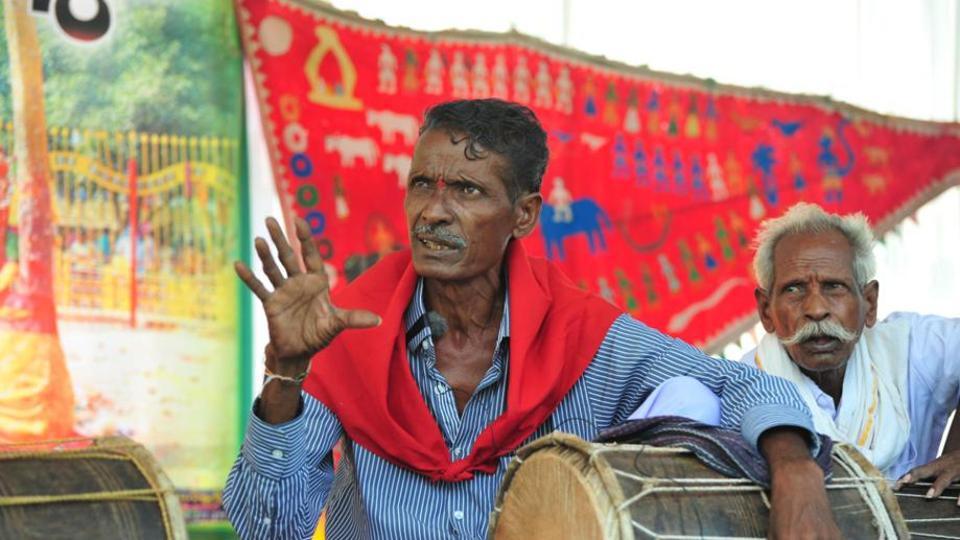
But, fame was never a motivation for Sakine Ramachandraiah, instead devoting himself towards preserving the rich legacy and history of the tribal warlords was.Living in a remote tribal hamlet of Kunavaram of Manuguru block in Bhadradri Kothagudem district, Ramachandraiah, belongs to Doli subsect of Koya tribe.
The 62-year-old Adivasi has the unique ability of singing the histories of the tribal warlords eloquently, in a typical style, using a percussion instrument called Dhol.“It is a dying art form of the Koya tribes. Ramachandraiah is perhaps the last Doli artiste who can perform this art. It is a pleasant surprise that the Centre has acknowledged the presence of this rare art and chosen Ramachandraiah for Padma Shri award,” said Jayadher Tirumala Rao, a researcher of tribal art forms, who played a major role in unearthing Ramachandraiah’s hidden talent.
According to Rao, Dolis are a sort of priests for the Koya tribes.They attend the tribal rituals like marriages and funerals and perform rituals in the form of songs, carrying narration of their histories. “There are hardly any Dolis left among the Koya tribes now. And Ramachandraiah is the only one sustaining this culture,” he said.
Ramachandraiah has mastered the art of singing about the history of the tribals, which are inscribed in the form of signs and pictures on ‘Pagide’ or ‘Dolu gudda’, a conic shaped red-coloured cloth of 6-10 metres in size.
“These Pagides are preserved in tree burrows and are opened only on specific occasions. The Dolis narrate the history by looking at these Pagides and playing drum like musical instrument. They go into trance while narrating the genealogy of the tribes. It is a typical pahadi music,” Rao said.
Ramachandraiah’s work came into limelight for the first time in 2014, when he narrated the history of Sammakka-Saralakka, two tribal women (mother and daughter) who fought against Kakatiya rulers in 13th century.
“It became an instant hit. He has also popularized other ballads such as Boponamma Katha, Godi Kama Roaju Katba, Gooderoju Katha, Chekku Chedialamma Katha, Guli Musalamma katha,” said Rao, whohas recorded and documented Ramachandraiah’s oral narrative of Sammakka Saralamma history.
While Ramachandraiah could not be contacted, his son Babu Rao said his father was not even aware of importance of Padma Shri initially. “When he realized that it was a rare honour given by the Centre, he was pleased. He wants the government to take steps to preserve such dying art forms,” Babu Rao said.


