Pakistan can approach the UN and the International Court of Justice if India revokes the Indus Waters Treaty, which would be tantamount to an “act of war”, foreign policy chief Sartaj Aziz said on Tuesday against the backdrop of New Delhi’s decision to suspend water talks.
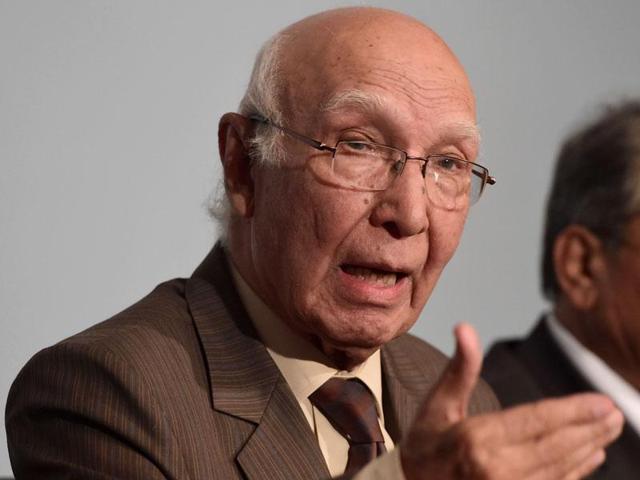
“The international law states that India cannot unilaterally separate itself from the treaty,” Aziz said while briefing the National Assembly or lower house of Parliament on the treaty.
“The Indus Waters Treaty is quoted as perhaps the most successful water treaty ever conducted between two countries. Its revocation can be taken as an act of war or a hostile act against Pakistan,” he later told the Senate or upper house.
The 56-year-old pact brokered by the World Bank was not suspended even during wars and the Kargil and Siachen conflicts, Aziz said. If India revokes or violates the treaty, Pakistan can approach the UN Security Council or the International Court of Justice, he added, according to reports in the Pakistani media.
Aziz, the adviser to Prime Minister Nawaz Sharif on foreign affairs, said India cannot unilaterally revoke the treaty under international law. There is no provision in the pact for its suspension or a unilateral exit, he added.
{{/usCountry}}Aziz, the adviser to Prime Minister Nawaz Sharif on foreign affairs, said India cannot unilaterally revoke the treaty under international law. There is no provision in the pact for its suspension or a unilateral exit, he added.
{{/usCountry}}If India tries to interrupt water flow to Pakistan or violates the treaty, it could serve as a “precedent” in the region, Aziz said. “It will provide China, for example, a justification to consider suspension of waters of the Brahmaputra river,” he said.
Aziz made the remarks a day after a meeting chaired by Prime Minister Narendra Modi in New Delhi decided to suspend water talks and to maximise India’s share of river waters by increasing the use of rivers flowing through Jammu and Kashmir.
India will explore all options to use as much water as it can within the limitations of the Indus Waters Treaty, the meeting decided.
The National Assembly unanimously passed a resolution condemning the India’s assertion at the UN General Assembly that Jammu and Kashmir is integral part of India. The resolution said the House resented parallels being drawn between Jammu and Kashmir and Balochistan.
The resolution said peace and progress depends on good neighborly relations and the only way forward is constructive dialogue and not the “threats being issued by the Indian Prime Minister to unilaterally terminate the Indus Waters Treaty”.
Pakistan’s former Indus Waters Commissioner Jamat Ali Shah criticised the stand adopted by India. “What should we believe of what the Indian PM says: Ending poverty or blocking flow of water into Pakistan…This is open economic terrorism,” he told Geo News channel.
Shah expressed fears that India may build more dams on the Jhelum and Chenab rivers if the treaty is abrogated.
During Monday’s meeting that reviewed the Indus Waters Treaty, which took a decade to negotiate and sign, Modi said: “Blood and water cannot flow together.”
India decided to review the treaty following the terror attack on an Indian Army camp at Uri that killed 18 soldiers.
The Indus Waters Treaty is considered among the most liberal water-sharing pacts in the world and has survived three wars. The agreement gives control of three eastern rivers – Beas, Ravi and Sutlej – to India, and control of the Indus, Chenab and Jhelum to Pakistan.
The pact is seen as generous to Pakistan as it gives the lower riparian state 80% of the water of the western rivers.
But repeated cross-border terror attacks and the Pakistan government’s refusal to acknowledge such strikes originating from its soil could force India to use the treaty as a bargaining chip.