
Sign in

Pakistan used Twitter handles to fan discontent during Delhi riots: Dossier

The dossier cites detailed investigations conducted by Indian agencies to add that these handles were created at the behest of the Pakistani deep state with the purpose of creating major communal disturbance in India.

Updated on: Mar 17, 2020, 08:07:08 IST
Hindustan Times, New Delhi | By
Share
Share via
  • facebook
  • twitter
  • linkedin
  • whatsapp
Copy link
  • copy link

Islamabad used about 200 Twitter handles to provoke Indian Muslims and spark discontent against the police during and after the communal riots in Delhi last month, according to an official dossier compiled by Indian security agencies.
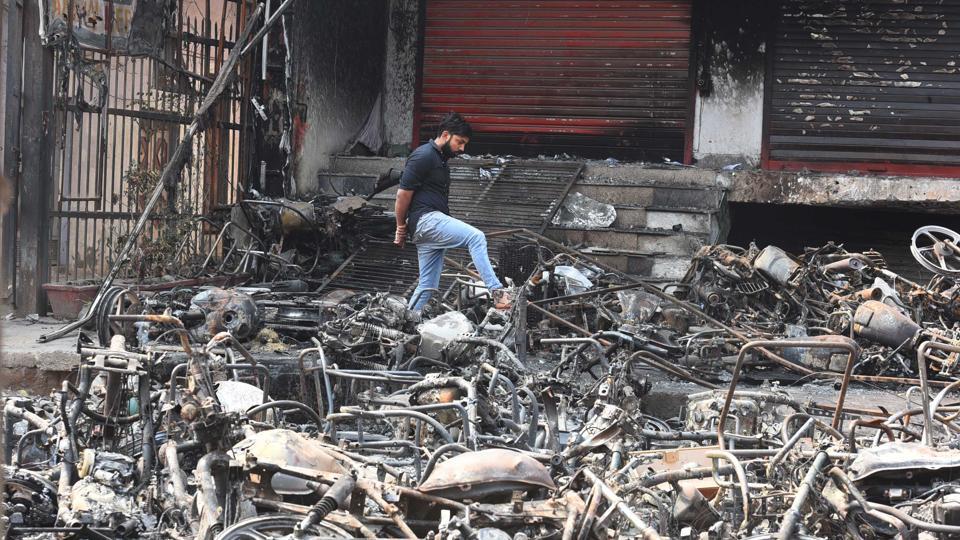
Charred vehicles are seen after they were burnt by miscreants during violent clashes over the new citizenship law in New Delhi, on Wednesday, February 26, 2020. (Raj K Raj/HT Photo)

A couple of hundred radical handles targeted the Delhi Police using hashtags such as #ShameonDelhiPolice, #DelhiPoliceTruth and #DelhiPoliceMurders, among others, between February 25 and March 3, according to the dossier, which was accessed by HT.

The dossier cites detailed investigations conducted by Indian agencies to add that these handles were created at the behest of the Pakistani deep state with the purpose of creating major communal disturbance in India.

These social media handles were also in touch with some handles created in India – many of these have been identified -- and asked them to spread inflammatory messages.

The idea behind the orchestrated exercise, according to the dossier, was to show that the Delhi Police unfairly targeted Muslims during the communal violence that killed 53 people and left about 500 injured, and to spread the violence to other parts of the country. That, however, did not happen.

The dossier lists about 70 handles from Islamabad, Rawalpindi, Karachi, Lahore tweeting under the hashtag #DelhiRiots2020, and over 100 handles tweeting under the hashtag #DelhiBurning.

The revelation comes a day after Zafar Mirza, the special adviser on health to Pakistan Prime Minister Imran Khan, brought up Kashmir at an emergency South Asian Association for Regional Cooperation (Saarc) video-conference arranged to discuss a joint strategy against the coronavirus outbreak.

Indian officials in the know said the Prime Minister’s Office directed the foreign ministry not to take cognisance of Mirza’s remarks by issuing a reaction or a statement.

“The discomfort of other Saarc leaders, particularly Bangladesh Prime Minister Sheikh Hasina, when Mirza parroted Rawalpindi’s Kashmir lines was quite evident,” a senior South Block official said.

The conference was organised at Prime Minister Narendra Modi’s suggestion.

The remarks by Mirza, though, did not come as a surprise to New Delhi, since Islamabad does not lose any chance to internationalise the Kashmir issue, experts said. At the same time, the remarks substantiated India’s argument before other Saarc leaders that Pakistan has been deliberately blocking the regional grouping, they added.

  • Shishir Gupta
    ABOUT THE AUTHOR
    Shishir Gupta

    Shishir Gupta is Executive Editor at Hindustan Times and one of India's top journalists covering national security, strategic affairs, foreign policy and geopolitics. Over the past three decades, he has extensively reported on India's military, diplomatic and security landscape, covering every major conflict and national security challenge, from the 1999 Kargil War and the 2020 East Ladakh standoff to Operation Sindoor in 2025. He has also covered major terror attacks, including the IC-814 hijacking, the 26/11 Mumbai attacks and the 2025 Pahalgam terror strike, along with numerous Pakistan-backed terrorist incidents in the Kashmir Valley and across India. He has reported on national and state elections for more than three decades. A recognised authority on strategic affairs, Gupta has covered India's nuclear programme since the Pokhran-II (Shakti series) tests in May 1998 and has written extensively on global nuclear issues, Indian diplomacy and the country's expanding global outreach. He has also reported widely on international conflicts and terrorism, with a special focus on the Indian subcontinent. Gupta has interviewed Prime Minister Narendra Modi more than four times, including Modi's first interview with the print media after becoming Prime Minister in May 2014. His other interviews include three with the Dalai Lama, as well as conversations with Benjamin Netanyahu, Amit Shah, Yogi Adityanath, S. Jaishankar, Nirmala Sitharaman and Piyush Goyal. He is the author of Indian Mujahideen: The Enemy Within (Hachette, 2011) and Himalayan Face-off: Chinese Assertion and Indian Riposte (Hachette, 2014). He was awarded the Chevening-Wolfson Joint Scholarship at Wolfson College, University of Cambridge, UK, in 1998 and participated in the International Visitor Leadership Program (IVLP) of the US State Department in 2006. He received the Ben Gurion Prize from Israel in 2011 and the K. Subrahmanyam Prize for Strategic Studies in 2015 from the Manohar Parrikar Institute for Defence Studies and Analyses (MP-IDSA). Since 2024, he has hosted Point Blank, Hindustan Times' weekly YouTube show on global geopolitics.Read More

Get the latest India News, breaking headlines and real-time updates from across the country. Stay informed about politics, government policies, crime, weather and major national developments.