AISA president Neha Bora, who was on a hunger strike for 23 days along with activist Sonam Wangchuk in Delhi over the NEET paper leaks, on Tuesday said the irregularities are a "systemic problem" arising out of shortcomings in the education system and cannot be addressed merely by enhancing punishment.
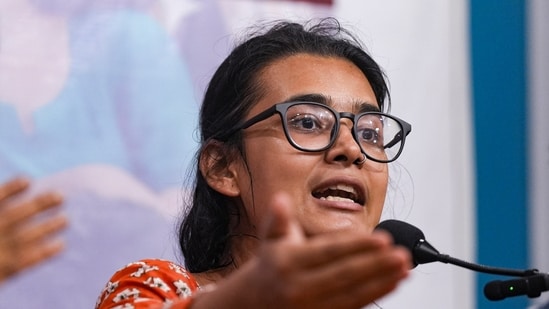
Bora, who also took part in the ongoing protest against the alleged recruitment exam irregularities in JMM-ruled Jharkhand, also called for greater unity among opposition and non-BJP political parties in handling student movements.
While addressing the media in Kolkata, she said the proposed legislation on paper leaks largely dealt with what happens after an examination paper is leaked, while failing to address the structural problems that allow such incidents to take place.
Parliament passed the Public Examination (Prevention of Unfair Means) Amendment Bill, 2026, last month. The legislation introduces stricter jail terms of 5 to 10 years and fines up to ₹50 lakh for individuals involved in exam paper leaks.
The bill was brought as a response by the government to the students' protests led by the Cockroach Janta Party (CJP) at Jantar Mantar, which started on June 20 and culminated after 36 days following the resignation of Dharmendra Pradhan as the Union education minister and acceptance of other demands by the government.
"If the education system of this country faces a systemic problem, you cannot solve it only by enhancing the punishment and such bills," she said, questioning whether the proposed measures would actually prevent paper leaks.
{{/usCountry}}"If the education system of this country faces a systemic problem, you cannot solve it only by enhancing the punishment and such bills," she said, questioning whether the proposed measures would actually prevent paper leaks.
{{/usCountry}}The JNU PhD scholar and the All India Students' Association (AISA) president also said that even if an investigation into a paper leak case is completed within 11 months, an entire admission cycle of students is over by then.
Bora, who also took part in the ongoing protest against the alleged recruitment exam irregularities and faced 'ink attack' in Ranchi, also called for greater unity among opposition and non-BJP political parties in defending student movements, hinting at the Jharkhand stir.
"Those in power in different states must lead by example and show how a government should deal with peaceful protesters," she said.
Bora argued that non-BJP parties cannot effectively challenge the BJP and RSS politically if, when in power, they handle student protests like the governments they oppose. "If they do not do that, they will face the same fate as the BJP," she said.
Bora said the recent "Gen Z rising" movement and protests across the country had demonstrated the "possibility of holding those in power accountable", pointing to the resignation of Dharmendra Pradhan as an example.
She said the significance was not merely that a minister had resigned, but that it showed representatives of democratic institutions could be held accountable.
"After years of democratic and electoral institutions being weakened one after another, such movements could revive the fight to restore them and bring hope back to the country," she said.
Bora argued that people experienced in the education system should have a greater role in framing policies.
The AISA chief also protested the alleged centralisation of education which, according to her, is leading to the privatisation of education.
The National Education Policy should be rolled back to the extent that it promotes centralisation and creates greater disparities among students, she said.
On student politics, Bora said universities are important spaces where young people learn to debate questions of justice, injustice and how society should be organised.
She defended student elections as an important democratic exercise, saying they provide a model where candidates have to face questions from students and demonstrate that they genuinely represent them.
Bora warned that weakening campus democracy and student elections would ultimately undermine critical dialogue and encourage a culture of compliance rather than questioning.
On the ongoing student protests, including those in Ranchi, she said student organisations across states should stand together as they are confronting a common crisis in the education system.
She said AISA had been part of the Ranchi protest from the beginning and criticised political parties that sought to distance themselves from student protests by questioning their legitimacy.
Bora said the difficult conditions faced by protesting students, including adverse weather and inadequate access to basic facilities, should not be ignored while assessing the movement.
On the reservation system, Bora said it was intended to provide educational access to sections of society that had historically been excluded from the education system.
She said the implementation of existing reservation provisions and the present social and educational status of disadvantaged sections needed to be assessed.
The Left-wing student leader said education should not be viewed merely as a means of obtaining a job or degree, but as an instrument through which society can overcome inequality and create a more equitable social order.
Regarding the demand for Union Home Minister Amit Shah's resignation, Bora said the use of force against citizens during the Delhi protests cannot be justified, arguing that governments have established systems and protocols for dealing with protesters.
Asked about RSS chief Mohan Bhagwat's support for Gen-Z, Bora avoided a direct reply and said social reforms would not have taken place if society had always followed the advice of its elders without question.