Prime Minister Narendra Modi inaugurated the Gandhi Solar Park at UN Headquarters in New York during a Gandhi@150 commemorative event on Tuesday to mark Mahatma Gandhi’s 150th birth anniversary and India’s global leadership in renewable energy. The park has 193 solar panels, each representing a UN member.
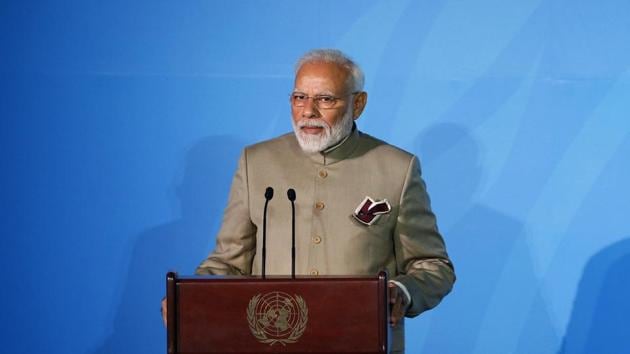
“Whether it is climate change or terrorism or selfishness in public life, Gandhiji’s ideals are the guiding light for us when it comes to protecting humanity. I believe the path shown by Gandhiji will lead to a better world,” said Modi at the event.
The 50 kilowatt-hour (kWh) rooftop solar park has been built at a cost of $1 million. Each panel is powered to reach the max of 50 KWn of power. The park’s annual output will be 86,244 KWh. This equals 61 metric tonnes of carbon dioxide, 30,242 kg of coal burned and carbon sequestered from 1,008 tree seedlings grown for 10 years.
India’s Permanent Representative to the UN, Syed Akbaruddin, said never has there been a symbolic Indian effort at the UN of such a tangible nature, which impacts every country. “The UN always talks about renewable energy. It always talks about climate action, climate change. By this small effort, we show our willingness to go beyond the talk,” said Akbaruddin.
Harjeet Singh, the global lead on climate change for non-governmental organisation Action Aid, said there is a massive change in perception about India globally, and the park symbolised that change. “India has demonstrated leadership in the sphere of renewable energy over the last few years and there has been a dramatic shift in India’s position in the UN climate talks over the past five years, and it has moved from being a laggard to a leader,” said Singh, who is in New York for the UN Climate Action Summit.
{{/usCountry}}Harjeet Singh, the global lead on climate change for non-governmental organisation Action Aid, said there is a massive change in perception about India globally, and the park symbolised that change. “India has demonstrated leadership in the sphere of renewable energy over the last few years and there has been a dramatic shift in India’s position in the UN climate talks over the past five years, and it has moved from being a laggard to a leader,” said Singh, who is in New York for the UN Climate Action Summit.
{{/usCountry}}India is the third-largest emitter of greenhouse gases after China and the US. Coal-generated power is among major sources of emission, though per capita emissions are roughly a seventh of the US and less than half the world average.
India has pledged 33-35% reduction in emission intensity (emissions associated with each unit of economic output) by 2030, compared to 2005 levels, as part of its commitments to the UN Framework Convention on Climate Change adopted by 195 countries in Paris in 2015.
Singh said in terms of emission intensity, India is on track. “India has done quite a bit of work in energy efficiency and that is a target it will easily achieve. Improving technology and the impressive shift from incandescent bulbs to LED within just a couple of years was a great shift made.’
In the renewables, there is some progress, but not enough. “India has set the target of installing 175 GW of renewable energy by the year 2022, which includes 100 GW from solar, 60 from wind and the rest from small hydro, etc. Out of 100 GW of solar, 40 GW is expected to be achieved through the rooftop solar projects. India has so far achieved only 10% of its 40 GW target of rooftop solar,” said Singh.
India also hosted an event called Leadership Matters: Relevance of Gandhi in the Contemporary World at the UN Headquarters. UN Secretary-General Antonio Guterres, South Korean President Moon Jae-in, Singapore Prime Minister Lee Hsien Loong, and his counterparts from Bangladesh, Jamaica and New Zealand Sheikh Hasina, Andrew Holness, and Jacinda Ardern addressed the event.
A special UN postage stamp on Gandhi@150 years was released and a Gandhi Peace Garden was also inaugurated. The garden is a crowd-funded project to plant 150 trees adopted by people in the memory of their loved ones at the State University of New York-Old Westbury campus.