E-Paper



Peace in border areas basis for normal India-China ties: Jaishankar
Jaishankar’s remarks, made while delivering an address on the theme “China’s foreign policy and international relations in the new era” at a conference organised by the Center for Contemporary China Studies (CCCS), came against the backdrop of the dragging military standoff in Ladakh sector

 Prefer HTon Google


Peace and tranquillity in the border areas remain the basis for normal relations between India and China though this has been “mischievously conflated” with sorting out the boundary question from time to time, external affairs minister S Jaishankar said on Tuesday.
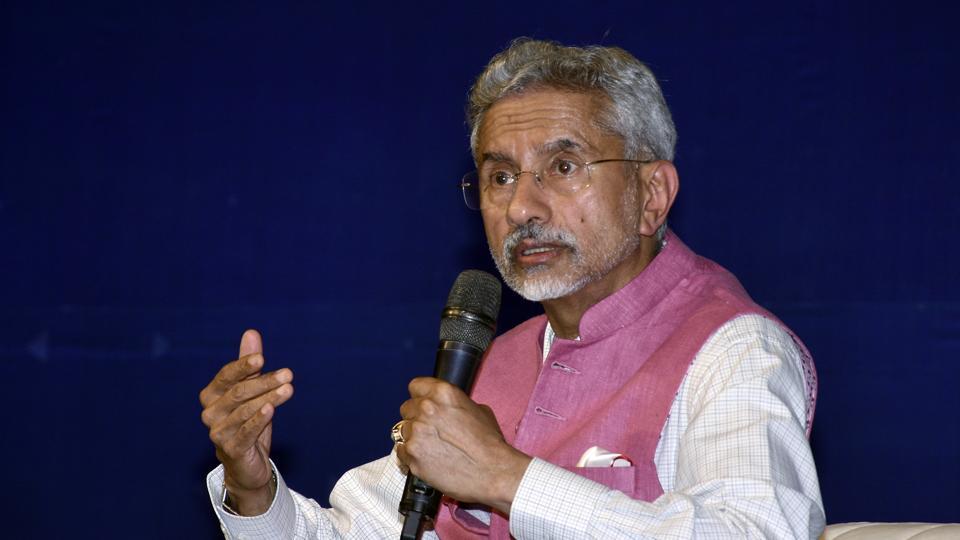
Jaishankar’s remarks, made while delivering an address on the theme “China’s foreign policy and international relations in the new era” at a conference organised by the Center for Contemporary China Studies (CCCS), came against the backdrop of the dragging military standoff in Ladakh sector. Jaishankar has maintained in recent months that the overall relationship with China cannot be normalised till there is peace and tranquillity on the Line of Actual Control (LAC).
He said that India must prepare to “compete more effectively, especially in our immediate periphery”. On the international stage, building deeper relationships and promoting a better understanding of India’s interests strengthens the country, he added.
“Peace and tranquillity in the border areas clearly remain the basis for normal relations. From time to time, this has been mischievously conflated with the sorting out of the boundary question,” Jaishankar said.
“The truth is that the prerequisite has been and remains one much more modest; and even that was breached in 2020,” he said, referring to the massing of troops on the LAC by China and attempts to alter the status quo in the border areas.
India’s search for a “more balanced and stable relationship” with China stretches across “multiple domains and many options”. He said: “Given the developments of 2020, they obviously focus on an effective defence of the border. This was notably undertaken even in the midst of Covid.”
Noting that the two countries must display the willingness to take a long-term view of their ties, he said: “Establishing a modus vivendi between India and China after 2020 is not easy. Yet, it is a task that cannot be set aside. And this can only become sustainable on the basis of three mutuals: mutual respect, mutual sensitivity and mutual interest.”
He added, “The last few years have been a period of serious challenge, both for the relationship and for the prospects of the continent. The continuation of the current impasse will not benefit either India or China. New normals of posture will inevitably lead to new normals of responses.”
Looking back at seven decades of engagement with China, Jaishankar said it would be fair to state that India had “essentially taken a determinedly bilateral approach” and there were many reasons for this, including a “sense of Asian solidarity [and] a suspicion of third party interests that emanated from other experiences”.
Indian policy in the past exhibited a “remarkable degree of self-restraint” that led to the expectation that “others can have a veto over its choices”, he said. “That period, however, is now behind us. The ‘new era’ is apparently not just for China,” Jaishankar said.
While pointing to divergences between India and China, he said it is the structural gaps that have developed over the past 60 years which present a challenge. “These have two broad metrics: one, the Cumulative Border Balance (CBB) and the other, Comprehensive National Power (CNP),” he said.
“Any objective analysis of the relationship must necessarily take both into account, recognising that there is a linkage between them,” he said.
In the economic field, progress in expanding manufacturing and promoting Atmanirbhar Bharat (self-reliant India) are key, Jaishankar said.