...
...
Next Story

Plan to buy Predator drones put on hold

The centre was planning to acquire 30 Predator armed drones for use across services at the cost of at least $3 billion from US-based General Atomics

Published on: Feb 23, 2022, 07:05:24 IST
Advertisement

India has put its plan to acquire 30 Predator armed drones from the US on the back burner, on account of its focus on indigenous development and manufacturing, as well as the prohibitive cost involved. HT learns that the Pentagon has been informed of the decision.
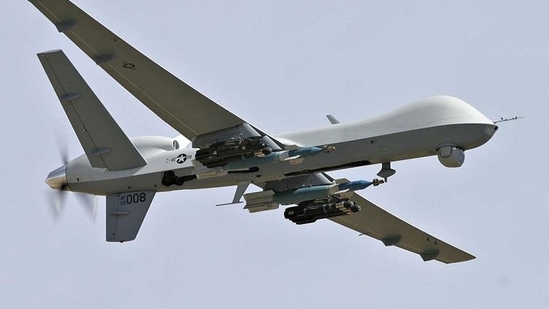
India plans to acquire 30 Predator drones in a proposed $3 billion deal.

Although the Narendra Modi government on February 9 banned the import of drones, acquisition of unmanned aerial vehicles for defence and security purposes are exempt, but still require special and specific clearances. “As of now, the Predator deal is off,” said a top South Block official who asked not to be named.

Spearheaded by the Indian Navy, India was planning to acquire 30 Predator armed drones for use across services (10 each for the navy, air force and army) at the cost of at least $3 billion from US-based General Atomics. The Indian Navy already has taken two surveillance Predators on lease from the US company and uses them for conducting reconnaissance of India’s maritime and land borders with China and Pakistan.

The decision to put the acquisition on hold was taken as India already has some capability in armed drones; it is currently upgrading the Israeli Heron drones. The Predator platform with armed payload, as in missiles and laser-guided bombs, costs nearly $100 million apiece, but the platform has an endurance of nearly 27 hours.

While the Indian Defence Research and Development Organization (DRDO) is expected to unveil its medium altitude long endurance (MALE) drone latest by March, the country’s national security planners are looking at futuristic high altitude pseudo satellite (HAPS) technology for surveillance and targeting capability.

India has already demonstrated its capacity and capability for the manufacture of swarm drones, as was showcased in the Beating Retreat ceremony this year.

Besides DRDO, private Indian companies are also involved in the development of drones that are cheaper to operate compared to the Predator and pack similar lethality.

While the Indian Navy and Army have significant use for the drones for domain awareness, the Indian Air Force was sceptical of Predators due to congested air space, and the presence of surface to air missiles and radars in Pakistan occupied Kashmir. The Air Force is in favour of purchasing more fighter aircraft.

 
ABOUT THE AUTHOR
Shishir Gupta

Shishir Gupta is Executive Editor at Hindustan Times and one of India's top journalists covering national security, strategic affairs, foreign policy and geopolitics. Over the past three decades, he has extensively reported on India's military, diplomatic and security landscape, covering every major conflict and national security challenge, from the 1999 Kargil War and the 2020 East Ladakh standoff to Operation Sindoor in 2025. He has also covered major terror attacks, including the IC-814 hijacking, the 26/11 Mumbai attacks and the 2025 Pahalgam terror strike, along with numerous Pakistan-backed terrorist incidents in the Kashmir Valley and across India. He has reported on national and state elections for more than three decades. A recognised authority on strategic affairs, Gupta has covered India's nuclear programme since the Pokhran-II (Shakti series) tests in May 1998 and has written extensively on global nuclear issues, Indian diplomacy and the country's expanding global outreach. He has also reported widely on international conflicts and terrorism, with a special focus on the Indian subcontinent. Gupta has interviewed Prime Minister Narendra Modi more than four times, including Modi's first interview with the print media after becoming Prime Minister in May 2014. His other interviews include three with the Dalai Lama, as well as conversations with Benjamin Netanyahu, Amit Shah, Yogi Adityanath, S. Jaishankar, Nirmala Sitharaman and Piyush Goyal. He is the author of Indian Mujahideen: The Enemy Within (Hachette, 2011) and Himalayan Face-off: Chinese Assertion and Indian Riposte (Hachette, 2014). He was awarded the Chevening-Wolfson Joint Scholarship at Wolfson College, University of Cambridge, UK, in 1998 and participated in the International Visitor Leadership Program (IVLP) of the US State Department in 2006. He received the Ben Gurion Prize from Israel in 2011 and the K. Subrahmanyam Prize for Strategic Studies in 2015 from the Manohar Parrikar Institute for Defence Studies and Analyses (MP-IDSA). Since 2024, he has hosted Point Blank, Hindustan Times' weekly YouTube show on global geopolitics.

Get the latest India News, breaking headlines and real-time updates from across the country. Stay informed about politics, government policies, crime, weather and major national developments.
SHARE THIS ARTICLE ON
Hindustantimes wants to start sending you push notifications. Click allow to subscribe