Prime Minister Narendra Modi on Thursday called for a global mechanism to prevent cyber fraud before it happens, saying cybercrime has already crossed national boundaries and requires governments, telecom companies and financial institutions to work together.
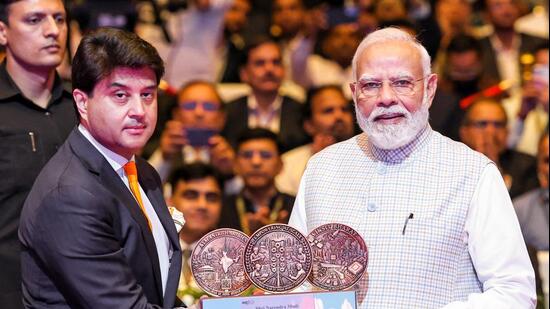
Inaugurating the Indian Mobile Congress (IMC) in New Delhi, the Prime Minister said, “Cyber fraud and cyber crime don’t abide by limits. They have already crossed the boundary.” He said a person sitting in one country could use someone in another country to commit a crime in a third country, making international cooperation necessary.
“I request GSMA and telecom operators to build a global mechanism which stops fraud before it happens,” Modi said, adding that India was ready to share its experience with other countries.
Also read: In Modi’s 25 years, lessons for building Viksit Delhi
Modi’s call for greater international cooperation comes weeks after the Brics summit in New Delhi, where the 11 member countries unanimously adopted a declaration expressing serious concern over organised scam networks, including cross-border fraud operations and “scam compounds.”
Scam compounds and cybercrime losses
Over the last three years, industrial-scale scam compounds have taken root in pockets of Cambodia, Myanmar and Laos, largely run by Chinese criminal syndicates and staffed in part by trafficked Indians — young workers lured with promises of IT-sector jobs abroad and then held captive to run phone banks. These compounds dial into India at scale, running the “digital arrest” scam in which fraudsters pose as law enforcement or judicial officials over video call and extort money by threatening imminent arrest; investment scams that funnel victims into fake trading apps; and loan-app extortion rackets. Individual losses here are large.
{{/usCountry}}Over the last three years, industrial-scale scam compounds have taken root in pockets of Cambodia, Myanmar and Laos, largely run by Chinese criminal syndicates and staffed in part by trafficked Indians — young workers lured with promises of IT-sector jobs abroad and then held captive to run phone banks. These compounds dial into India at scale, running the “digital arrest” scam in which fraudsters pose as law enforcement or judicial officials over video call and extort money by threatening imminent arrest; investment scams that funnel victims into fake trading apps; and loan-app extortion rackets. Individual losses here are large.
{{/usCountry}}The Brics declaration called for stronger cooperation among customs authorities, financial intelligence units, law enforcement agencies, tax authorities and supervisory bodies. It also called for greater information-sharing by telecom providers and technology platforms and the use of data analytics to identify and disrupt money laundering schemes at an earlier stage.
In India, losses to cybercrime overall tripled between 2023 and 2024, rising from ₹7,465 crore to ₹22,845 crore across roughly 2.2 million incidents, 85% of it is financial fraud, the ministry of home affairs told Parliament in July last year.
‘I stopped leakage of ₹5 lakh crore’
At IMC, Modi linked the need for digital security to the rapid expansion of mobile connectivity in India. He said telecom was no longer only about networks, spectrum, towers and internet speeds, but had become an important tool for governance and delivery of public services. Referring to India’s digital transformation, Modi said mobile phones had helped reduce the digital divide and made services such as education, healthcare, banking and government schemes more accessible.
The PM cited the government’s direct benefit transfer (DBT) system, saying ₹50 lakh crore had been transferred directly to beneficiaries through bank accounts linked to the digital ecosystem, while ₹5 lakh crore had been saved from going into “wrong hands”.
He then took a political swipe at those who, he said, had benefited from leakages in the earlier system. “Now tell me - whose free earnings have ended - will they love Modi?” he asked. “If old ways were adopted, government would have lost ₹5 lakh crore in leakage and would have filled their pockets. But Modi has stopped it.”
Also read: 'We will do it': PM Modi's self-confidence mantra for 'Viksit Bharat' by 2047
Modi also referred to the PM-Kisan Samman Nidhi, saying more than ₹4 lakh crore had been transferred to farmers. Beneficiaries receive messages on their mobile phones when the money is credited, he said.
He also highlighted the role of digital connectivity during the Covid-19 pandemic, saying banking, education, healthcare and government services continued to function because of India’s digital ecosystem. He cited the DIKSHA platform, saying it had recorded more than 500 crore learning sessions and 6,000 crore learning minutes by July 2022.
Wonders from blunders
Modi said cheaper data and wider connectivity had also helped create new opportunities in gaming, e-sports, social media, video and OTT content. He said India’s gaming ecosystem now has more than 500 million users, with young people from tier-2 and tier-3 cities also participating.
The PM said the next phase of India’s telecom journey should move from consumption to creation, with greater focus on products, technology and intellectual property being developed in India. He also highlighted reforms in the telecom sector, including the Telecommunications Act and changes to adjusted gross revenue and bank guarantee requirements. “We have created wonders from blunders,” he said.
Modi said India’s semiconductor manufacturing was also gathering pace, with commercial production having started at five locations. Under India Semiconductor Mission 2.0, he said, the government was focusing on the entire semiconductor supply chain.
He said IMC should now become a platform for products, investment, exports, research and development and technology, rather than only a showcase of connectivity.