
 E-Paper



PM Modi hits the ground running on G-20 Presidency
Prime Minister Narendra Modi made it a point to meet every G-20 leader at the Bali summit, painted India as a global economic bright spot for the decade and enunciated India’s lead role in the ongoing digital revolution.

 Prefer HTon Google


Normally countries take time to warm up after assuming G-20 presidency, but Prime Minister Narendra Modi hit the ground running at the Bali summit this week by joining hands with Indonesian President Joko Widodo to prepare a landing ground for resolution on Ukraine war.
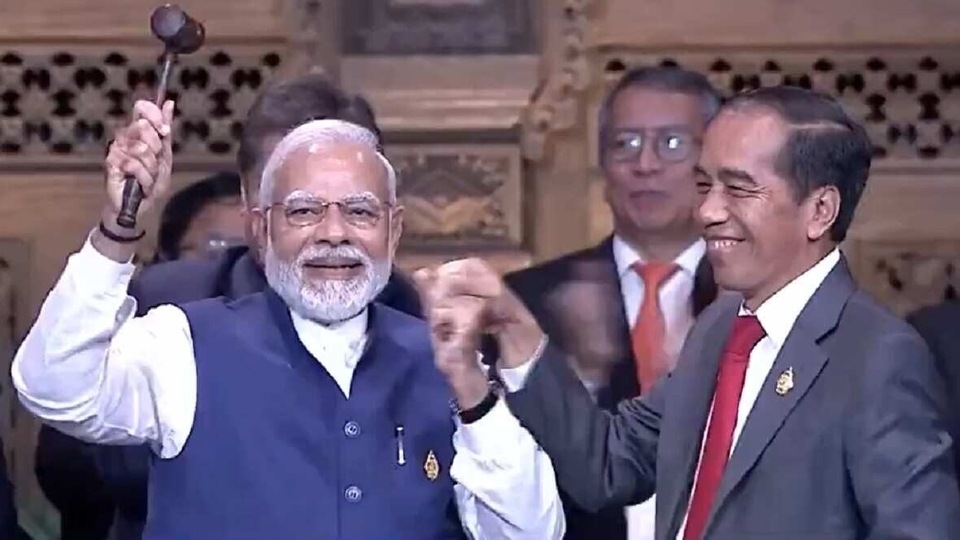
Preparing ground before India assumed Presidency of the G-20, PM Modi made it a point to meet every leader at the Bali Summit including Chinese President Xi Jinping apart from his friends US President Joe Biden, French President Emmanuel Macron, UAE President Mohammed bin Zayed Al Nahyan, Saudi Arabia Crown Prince Mohammed bin Salman and Canadian Prime Minister Justin Trudeau.
According to diplomatic sources based in Bali, PM Modi’s contribution on Ukraine was central to the Bali Declaration as he worked with Indonesia to find language consensus on Ukraine war which was close to the UNSC resolution as well as recognized the on-going debate on the war in Central Europe.
Simply put, it was he who ensured that the resolution was not a new attack on Russia but at the same time mirrored the sentiments of the other G-20 members particularly from the West who have taken strong individual positions on Ukraine war. This was evident from the phrase “ yeh yudh ka yug nahin hain (this is not an era for war)” finding place in the resolution.
PM Modi came across as a strong global leader as he pushed for positive global growth in times of gloom by telling the other G-20 leaders that India will hold its end for this decade on economic growth, infrastructure development and speedy recovery from pandemic and the impact of Ukraine war. The positive confidence of PM Modi apparently also infected his team in Bali as extra effort was put in to showcase India as the global bright spot of future.
PM Modi projection of India as a lead digital player also found appreciation at Bali as India found itself on pole position of the digital revolution. He made it clear that digital revolution was one of the keyways to revive global economy as well making governance transparent and not restrictive.
Fact is since he took over as PM in 2014, digital economy and “Aatmanirbhar Bharat” are the pet themes of Narendra Modi for pushing India’s growth and power in the world.
While the PM was hard-pressed for time at the G-20 summit, he made it a point to exchange notes with key leaders on the side-lines of the summit and coffee breaks. He is understood to have exchanged notes with all important leaders on the side-lines with whom he could not do a formal bilateral.
The significant part was how he reached out to India’s neighbour and host Indonesia among the G-20 members and Indian diaspora in Bali. Fact is given the central geographical location of Indonesia in the Indo-Pacific, India under Modi has been assiduously engaging Indonesia by not only extending help in disaster relief but even offering long range weapon delivery platforms to Djakarta.


