Prime Minister Narendra Modi's commitment towards climate action with India promising to achieve net zero emissions by 2070 appears to have been taken with global strategic landscape in mind. His speech at the COP26 indicates that India is all for saving the planet without inhibiting India's economic growth and at the same time monitoring other countries walk the talk on countering climate change.
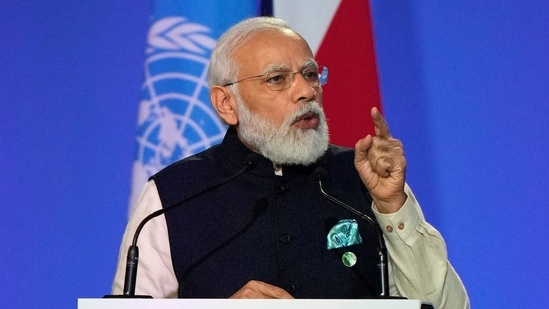
Coming straight to Glasgow from G-20 summit in Rome, PM Modi's statement takes into account the reality that India has the lowest per capita income in the top twenty grouping with Indonesia, South Africa ahead on multiple figures and China nearly four times ahead. That PM Modi did not spell out the peaking year also indicates that India has lot of economic growth potential in near future. And with better technology options available to India during the projected period of growth, the country will be in far more synergy with the global climate change objectives.
“PM Modi has tried to balance climate action with realistic assessment of resource position. He has made commitments by keeping the space for India’s economic development. The commitments are etched in stone unlike others who are all talk and no action,” said a former foreign secretary.
The fact is that PM Modi not only spoke for India but took upon himself to be the voice of global south at both the G-20 and the COP26. External Affairs Minister S Jaishankar on Monday night tweeted: “When it comes to climate action, India has delivered on its Paris commitments and has now set out ambitious goals at Glasgow. This reflects in our determination to shape key global outcomes and make our fullest contributions. India will count where it matters. When it comes to climate justice, we will speak our mind and flight for Global South. History shall not be repeated.” EAM Jaishankar also asked that countries which makes promises of greater climate finance should also be held accountable and that financing like mitigation should be monitored closely.
{{/usCountry}}The fact is that PM Modi not only spoke for India but took upon himself to be the voice of global south at both the G-20 and the COP26. External Affairs Minister S Jaishankar on Monday night tweeted: “When it comes to climate action, India has delivered on its Paris commitments and has now set out ambitious goals at Glasgow. This reflects in our determination to shape key global outcomes and make our fullest contributions. India will count where it matters. When it comes to climate justice, we will speak our mind and flight for Global South. History shall not be repeated.” EAM Jaishankar also asked that countries which makes promises of greater climate finance should also be held accountable and that financing like mitigation should be monitored closely.
{{/usCountry}}Climate change was also one of the main agendas at the G-20 conference with covid vaccine, Afghanistan and Islamic radicalization being the other big issues facing the world. But the global order, trust and transparency and resilient supply chains in the context of Indo-Pacific was the under-current of the Rome summit.
While PM Modi met key leaders at the G-20 and the COP26 including French President Emmanuelle Macron and Australian PM Scott Morrison, EAM Jaishankar had a nuts and bolt meeting with his US counterpart Antony Blinken with detailed step by step focus on Afghanistan and the growing Islamic radicalization in the Indian sub-continent as well as the Indo-Pacific.
While the response to PM Modi’s climate action is expected to be revealed later today, it is quite evident that India has put up a positive agenda at the COP26 with a room for maneuvering country’s future economic development.