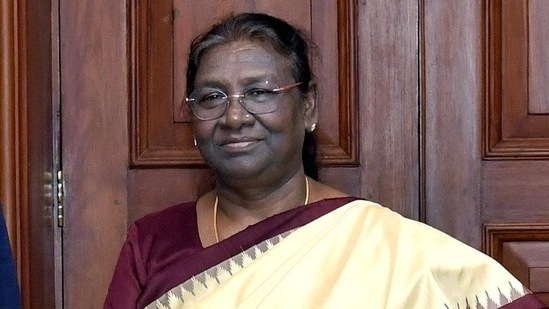
Speaking at the Constitution Day celebrations organized by the Supreme Court on November 26, President Droupadi Murmu spoke at length about how the criminal justice system has failed the poorest of the poor. “President Murmu struck an emotional chord with the judges and lawyers regarding the plight faced by prisoners whose trial takes years to be decided while they remain incarcerated for years without being aware of their fundamental rights...”, HT reported. The President also spoke about how the poor
Incarcerated under trial prisoners are the main reason for overcrowded prisons
Overcrowding in prisons is not because of a large number of people convicted of crimes. In fact, on average, convicts have been just around 30% of all prisoners in Indian jails since 2010. In 2021, they were just 22% of all prisoners, the lowest share since 2010. It is under trial prisoners – on average 69% of all prisoners since 2010 – who are the reason for overcrowding . A breakup of their duration of confinement in 2021 shows that 29% of under trial prisoners had been inmates for over an year and 16% for over two years. If one were to consider releasing such long-term under trial prisoners, even as a theoretical exercise, it would be enough to end the problem of overcrowding. For 2021, the number of prisoners would be higher than the total prison capacity by just 278 prisoners or 0.06% of capacity.
{{^htLoading}} {{/htLoading}} Under trial prisoners are also accused of less severe crimes
Among those convicted of crimes under the Indian Penal Code, 88% were in prison for “offences affecting the human body”, such as murder, kidnapping, or rape. Among under trial prisoners, this proportion was relatively lower at 64%. 29% of under trials accused of IPC crimes were in prison for “offences against property”, such as theft and robbery, compared to 9% among convicts. The breakup of this group of offences also shows under-trials being accused of the relatively less severe crimes (theft as opposed to robbery) in the group compared to convicts.
{{^htLoading}} {{/htLoading}} Demographic data shows the socio-economic link to overcrowding problem
The President also highlighted the problem of language and cost being a roadblock in accessing justice. While it is difficult to establish a cause-effect relationship without an academic study, a demographic breakup of prisoners shows that the poor and uneducated are indeed more likely to be in prison. A quarter of both under-trials and convicts were illiterate in 2021 and around 40% were educated below the 10th standard. Those with higher levels of education were only around 10% of the both prisoners and convicts. Caste and religion-wise breakup similarly shows a slightly higher proportion of Scheduled Castes, Scheduled Tribes, and Muslims among prisoners than their share in population. To the extent that this over-representation is because such communities cannot access justice or because they have to resort to crime to fulfil their monetary needs, fixing the problem of overcrowding in prisons might need work beyond what judges alone can do when deciding cases.
{{^htLoading}} {{/htLoading}}