
 E-Paper



Rajnath refuses to sign SCO joint statement as India’s terror concerns ignored
India’s defence minister Rajnath Singh, who attended the meeting in China’s Qingdao, refused to sign the document, citing its failure to address terrorism-related concerns

 Prefer HTon Google


New Delhi: The Shanghai Cooperation Organisation (SCO) defence ministers’ meeting could not issue a joint communique on Thursday as India’s defence minister Rajnath Singh refused to sign the document, citing its failure to address terrorism-related concerns, officials aware of the development said.
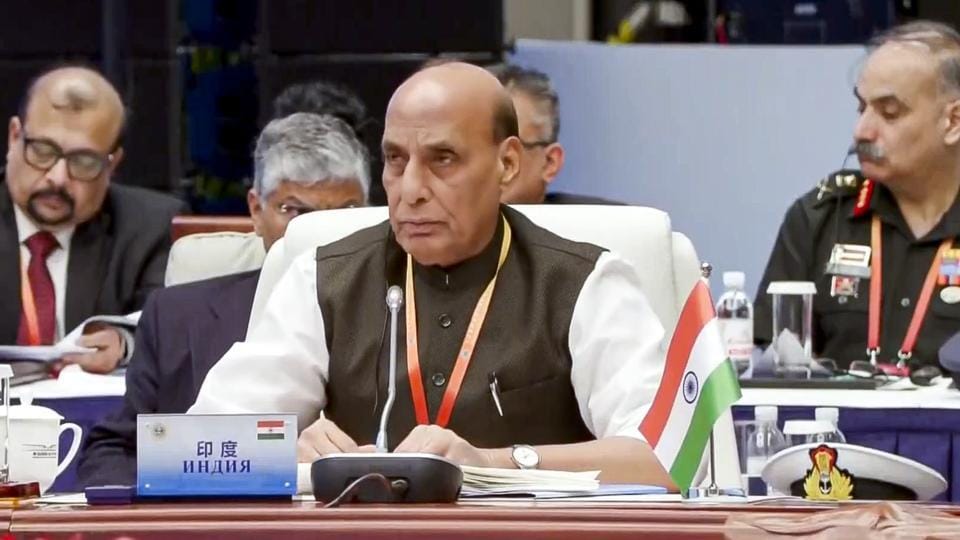
Singh, who attended the meeting in China’s Qingdao, did not sign the joint communique as it omitted the April 22 Pahalgam terror attack—in which 26 people were killed—while mentioning the Jaffar Express hijacking in Pakistan by the Balochistan Liberation Army on March 11, an official requesting anonymity said.
China, the current president of the SCO, has deep military and strategic ties with Pakistan, which it strongly supported during the recent four-day clash with India under Operation Sindoor.
Singh had earlier said that every act of terrorism was criminal and unjustifiable, and that the bloc must unite in eliminating the menace for collective safety and security. He said India launched Operation Sindoor in exercise of its right to defend itself against terrorism, and to pre-empt and deter further cross-border attacks.
Following the Pahalgam terror attack, the Resistance Front—a proxy of the UN-designated terror group Lashkar-e-Taiba (LeT)—claimed responsibility. Singh added, “The pattern of the Pahalgam attack matches with LeT’s previous terror attacks in India. India’s zero tolerance for terrorism was demonstrated through its actions. We have shown that epicentres of terrorism are no longer safe, and we will not hesitate to target them.”
India launched Operation Sindoor in the early hours of May 7, when the military hit nine terror camps inside Pakistan and Pakistan-occupied Kashmir (PoK), killing more than 100 terrorists. It was New Delhi’s direct military response to the April 22 Pahalgam terror strike. The operation triggered four days of strikes and counterstrikes using drones, missiles, and long-range weapons before the two sides reached an understanding to stop all military action on May 10.
Singh said the biggest challenges faced by the region relate to peace, security, and trust-deficit, with increasing radicalisation, extremism, and terrorism being the root causes. “Peace and prosperity cannot co-exist with terrorism and the proliferation of weapons of mass destruction in the hands of non-state actors and terror groups. Dealing with these challenges requires decisive action,” he added.
Also Read: How the 9 targets India hit during Operation Sindoor were providing support to terrorists
On May 15, Singh questioned whether nuclear weapons were safe under Pakistan’s control and custody and demanded that its arsenal be placed under the supervision of the global nuclear watchdog, the International Atomic Energy Agency (IAEA), calling the neighbour “irresponsible and rogue.”
“It is imperative that those who sponsor, nurture, and utilise terrorism for their narrow and selfish ends must bear the consequences. Some countries use cross-border terrorism as an instrument of policy and provide shelter to terrorists. There should be no place for such double standards. SCO should not hesitate to criticise such nations,” he said in Qingdao, adding that the perpetrators, organisers, financiers, and sponsors of terrorism, including cross-border terrorism, should be held accountable and brought to justice.
Also Read: Enemy surrendered in 22 minutes: PM on Op Sindoor
Singh also called for proactive steps to check the spread of radicalisation among the youth, acknowledging the significant role of RATS (Regional Anti-Terrorist Structure—a body under the SCO) in tackling the challenge. “The joint statement of the Council of SCO Heads of State on ‘Countering Radicalisation leading to Terrorism, Separatism and Extremism’ issued during India’s chairmanship symbolises our shared commitment,” he said.


