Deeming the hijab an essential religious practice would affect the personal freedom of Muslim women, Karnataka’s advocate general Prabhuling Navadagi argued in high court on Tuesday on the eighth day of hearing on petitions filed by students of Udupi government preuniversity college contesting the ban on wearing headscarves inside classrooms.
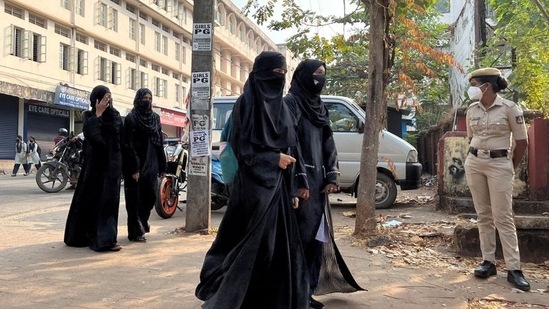
Countering the petitioners, Navadagi said the right to wear the headscarf falls under the category of 19(1)(A) and not Article 25 as has been argued by the Muslim students.
If the wearing of a hijab is recognised as an essential religious practice by way of a court order, all Muslim women would be obligated to wear it, including those who do not want to do so, Navadagi said, representing the state government.
“It hits at the liberty of that individual. The choice to wear what we want and choose not to wear what we do not want. Every woman of every faith has that choice. There cannot be religious sanction by way of judicial declaration,” he told the bench of chief justice Ritu Raj Awasthi and justices Krishna S Dixit and JM Khazi.
Arguing further, he said the independent claim of 19(1)(A) cannot go together with Article 25. “The consequence of the demand to declare Hijab as an essential religious practice is huge because there is an element of compulsion or else you will be expelled from the community,” Navadagi told the court.
{{/usCountry}}Arguing further, he said the independent claim of 19(1)(A) cannot go together with Article 25. “The consequence of the demand to declare Hijab as an essential religious practice is huge because there is an element of compulsion or else you will be expelled from the community,” Navadagi told the court.
{{/usCountry}}In this case, he argued, responding to a specific query by the bench, the question of choice does not arise because it is about school and college uniforms.
The demand of the petitioners that the right to wear hijab is part of the right to freedom of speech and expression under Article 19(1)(a) of the Indian Constitution also means that people who do not wish to wear it would have a fundamental right not to wear it, he argued.
Going by that argument, if anyone who wants to wear the hijab under the Article is restrained by the government, would it not amount to a violation of a fundamental right, chief justice Awasthi asked.
In response, Navadagi argued that there is no ban on wearing the hijab in India. The right to wear a hijab under Article 19(1)(a) is subject to reasonable restrictions under Article 19(2), he said. “ In our case, Rule 11 (of the Karnataka Education Rules) places reasonable restrictions for institutional discipline.”
The restrictions on wearing a hijab are limited to classrooms, and not the campus of educational institutes, he clarified.
The wearing of the hijab was not an essential religious practice of Islam, the advocate general reiterated. “If it is not obligatory, it is not compulsory. What is not compulsory is not essential. Therefore, it does not fall within the realm of essential religious practice,” he argued.
He mentioned the ban on wearing a hijab in public places in France and Turkey. At this point, justice Dixit intervened and said that it depends on the constitutional policy of every country. Navadagi then said that he only wanted to mention that there was no such prohibition in India.
“Ultimately, if anyone is coming to the court for a declaration that we want every woman of a particular faith to wear that (hijab), would it not violate the dignity of that person whom we are all subjugating?” he asked in his concluding remarks.
Responding to this, justice Dixit said: “If in a Hindu marriage, we hold tying of mangalsutra is essential, it does not mean all Hindus that the country should compulsorily wear mangalsutra. We declare a legal position and leave it there.”
During the hearing, the bench directed the counsels to complete their arguments by this week. It also asked Navadgi to complete his submissions at the earliest.
Chief justice Awasthi informed all counsels that the bench wants to complete the hearing on the case this weekend and directed them to keep the arguments brief.
(With agency inputs)