Ahead of its centenary celebrations in 2025, by when it aspires to have a presence in every district, the Rashtriya Swayamsevak Sangh (RSS) has set out to double its network of volunteers, who will be responsible for expanding its footprint across the country. The RSS is the ideological fount of the ruling Bharatiya Janata Party (BJP).
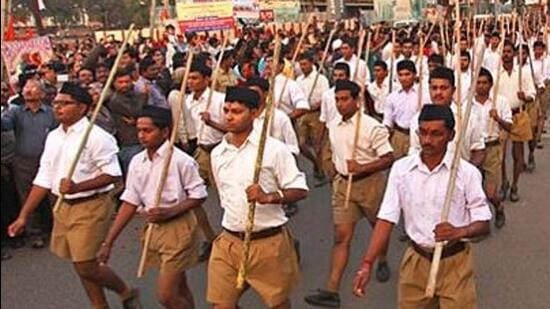
There are about 3,000 pracharaks, or full-timers, who are given various duties within the numerous offshoots of the RSS that work in sectors such as education, labour unions and in tribal areas. For the centenary celebrations, the Sangh is aiming to double that figure by roping in part-time volunteers, or vistaraks, who will have the option of working with the various offshoots, a Sangh functionary said.
“We are looking at training and deputing these vistaraks for various programmes that the Sangh undertakes across the country. We are hoping that by March 2023 (when centenary celebrations begin), the total number of volunteers will be double the present number and the part-timers will help spread out the shakhas (branches) in areas where there are none, or too few,” the functionary said, speaking on condition of anonymity.
At present, the shakhas, or the units on the ground where the activities of the Sangh are carried out, are in 95% of the districts. The Sangh brass has set a target of having at least one shakha in every district.
{{/usCountry}}At present, the shakhas, or the units on the ground where the activities of the Sangh are carried out, are in 95% of the districts. The Sangh brass has set a target of having at least one shakha in every district.
{{/usCountry}}There are 60,929 shakhas spread across 38,390 locations in the country, according to the annual report presented at the March annual meeting of the Akhil Bharatiya Pratinidhi Sabha, the apex decision making body of the RSS.
Volunteers are the backbone of the Sangh’s outreach; the full-timers are not married, and are sent on rotation to various offshoots and have to work in different geographical areas. “Since they are continuously on the move and interact with people from a cross section of society, they are aware of the problems that people face and generally well versed in issues, which help the society and government to take remedial measures,” said a second functionary, also declining to be named.
Though the Sangh vehemently denies being involved in electoral politics, the feedback from its cadre has a significant bearing on government policies and electioneering campaigns.
On whether the vistaraks will have the option of taking on full-time work, the functionary quoted above said, “It is a very difficult job to be a committed full-timer. The process of training itself is very rigorous, and we will be observing them to see if they have the tenacity to be a full-timer. Of course, they will have the option of continuing.”
Earlier this year, RSS functionaries in Delhi said the organisation has trained 1 million volunteers to be able to offer help during the Covid-19 pandemic, in addition to providing services during natural calamities, disasters and other emergencies.
“Apart from taking part in the Azadi Ka Amrit Mahotsav (celebrating 75 years of India’s Independence), the Sangh had also identified areas where it needs to focus more,” said the second functionary. “These include creating awareness about the unsung heroes of the Independence movement, particularly those who came from the SC (scheduled caste), ST (scheduled tribe) communities; education, health care and welfare of people in far flung areas, and giving a fillip swadeshi (made in India).”
The Sangh has started initiatives such as Sankul Yojana, or self-reliance scheme, and is carrying out training camps in about 350 villages, where women and youth are trained to become self-employed. “We are also working in the field of environment and ecology, and ensuring that activities such as tree plantation, plastic ban and cleaning of rivers are carried out,” the second functionary said.