Western media reports, quoting Biden administration officials, have stated that Russia has asked China for military equipment to push its invasion of Ukraine. The reports citing other US officials say that there were signs of Russian special military operations running out of non-specified weaponry after the war began nearly 20 days ago.
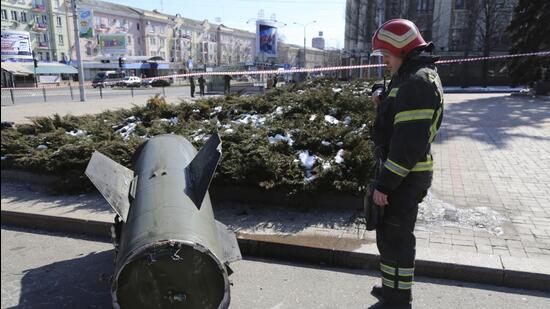
Given that the US intelligence got the timing of Russia’s invasion of Ukraine right, it is likely that Washington knows exactly what hardware Russian President Vladimir Putin has sought from China. Still, that Russian forces are running out of supplies, spares and oil is a sobering thought for the Narendra Modi government with India still dependent on Russia for military spares and supplies for its frontline equipment across the three services. The Russian T-90 tanks, Su-30MKI fighters and under maintenance INS Vikramaditya aircraft carrier, are all reliant on the original equipment manufacturer based in Moscow. The biggest Indian fear is a disruption of the spares supply chain on account of the massive western sanctions on Russia and the diversion of hardware by Moscow to the Ukraine front.
With Ukraine having a history of nationalism in western parts of the country and Russia still not being able to capture the main cities, the war shows no sign of ending in a quick win for Putin”s “Z” forces. And Moscow’s problems are going to compound by the day with the west injecting high-tech arms into Ukraine leading to rise in morale of the defending troops. Despite the fog of war, Russian armour losses are quite evident, as is the obvious incapability of Moscow to achieve air dominance over the Ukraine skies. This has resulted in Ukraine using Turkish Bayraktar TB 2 drones to take out Russian armoured columns at will.
{{/usCountry}}With Ukraine having a history of nationalism in western parts of the country and Russia still not being able to capture the main cities, the war shows no sign of ending in a quick win for Putin”s “Z” forces. And Moscow’s problems are going to compound by the day with the west injecting high-tech arms into Ukraine leading to rise in morale of the defending troops. Despite the fog of war, Russian armour losses are quite evident, as is the obvious incapability of Moscow to achieve air dominance over the Ukraine skies. This has resulted in Ukraine using Turkish Bayraktar TB 2 drones to take out Russian armoured columns at will.
{{/usCountry}}Experienced Russia watchers are reminded of the confidence with which the erstwhile Red Army went into Afghanistan in 1979, expecting to conquer Kabul within days. The Afghan war ultimately turned out to be a quagmire for the Red Army with Pakistan-based and US armed jihadis ensuring a humiliating return home a decade later.
While Cold War relics in Indian diplomacy are batting for Russia in the Ukraine war, it is only a matter of time before New Delhi will come under serious pressure from its QUAD partners to change its neutral position on Moscow. India does not have to answer to anyone in Europe on its stance after explaining its position to France. European powers such as UK and Germany maintained radio silence when the Chinese Army transgressed into Ladakh in May 2020.
However, the hardware decoupling from Russia is complex and will take years despite PM Narendra Modi constantly pushing the “Atmanirbhar Bharat” (self-reliant India) agenda; its translation on ground will take time. And that too only if the military bureaucracy, the PSUs, and the R&D establishment do not place any hurdles in the process. With the US being hit with Iranian missiles in Erbil, Houthis rebels firing ballistic missiles into UAE from Yemen, China belligerent in the South China Sea over Taiwan and Russia underestimating the Ukrainians, the world is becoming uncertain by the day.