E-Paper



Sanctioned trophy hunting by another name a grey area in man-animal conflict
The latest case came from Uttarakhand on Dec 11, when the forest department caught a tiger in Naukuchiatal area near Bhimtal on suspicion that it killed a woman

 Prefer HTon Google


The steady shrinkage of natural habitats and the resultant rise in man-animal conflict have led to increasing incidents of big cats being labelled “man-eaters” and caught or shot down in authorised kills by hobby hunters deployed by authorities, triggering a wider debate on the ethical as well as environmental dimensions of the practice.
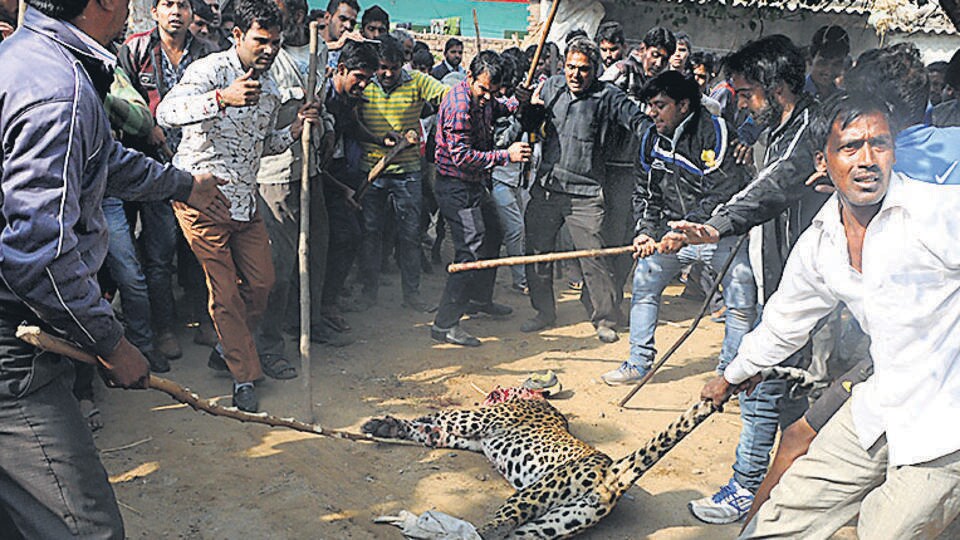
The latest case came from Uttarakhand on December 11, when the state forest department caught a tiger in the Naukuchiatal area near Bhimtal on suspicion that it had killed a woman. The woman, a 52-year-old local, was allegedly killed in a big cat attack on November 25, though forest officials were not sure whether it was a tiger or a leopard. Now, the department is trying to ascertain if the captured animal was a man-eater.
There are at least 3,167 tigers in India, of which 3,080 were photographed in 2022, the Status of Tigers Report released by the National Tiger Conservation Authority last year said. In 2018, there were estimated to be at least 2,967 tigers. There were 1,411 tigers in 2006; 1,706 in 2010; 2,226 in 2014 and 2,967 in 2018. There has been a 124.45% increase in tiger numbers since 2006, according to the estimation results.
Several other changes have taken place in the management and land use of recorded and unrecorded forests: Of the approximately 400,000sq km of forests in tiger states, only one-third are in relatively healthy condition, the tiger estimation results have pointed. Also, the country’s green cover may be increasing according to the headline findings of the India State of Forest Report 2023 but the study itself points to the degradation of large tracts of forests, increase in plantations and a lack of clarity on the status of so-called unclassed forests — all of which could have serious implications for biodiversity and wildlife, experts have said. The combination of these factors will lead to an escalation in conflicts, especially in the Terai region that has as many as 757 tigers in about 8,103sq km of forested habitat.
On the Naukuchiatal incident, Vijay Melkani, range officer of Manora, said, “A tiger was trapped in a cage that we had set up at night in Naukuchiatal near Bhimtal in Nainital district. On information of the locals, a forest team rushed to the spot and rescued the big cat and sent it to Ranibagh animal rescue centre. Also, its samples are being sent for examination to the Wildlife Institute of India (WII), Dehradun, so that it can be confirmed whether the tiger killed the woman or not.”
“The tiger caught in the cage is a male and is five years old. As a precautionary measure, cages have been kept installed in the area and the forest department is patrolling,” he added.
On December 3, forest department officials had caught a leopard in the same area. Its samples were also sent to the WII to check whether it was the “man-eater” that killed the woman on November 25.
“The samples of the leopard and the tiger caught after the November 25 incident were examined. The victim’s samples matched with the tiger. The leopard will now be released in the forest after examination by a veterinarian,” Melkani said.
There are 260 tigers inside Corbett Tiger Reserve and 229 outside Corbett Tiger Reserve, forest officials said.
In June, forest officials had caught a tigress from the Chakarpur forest area in Udham Singh Nagar district where two people lost their lives in alleged tiger attacks in the previous two months. In April, a tigress that allegedly killed a 35-year-old farmer in the Manorathpur Basiteela village in Corbett Tiger Reserve was caught after a 10-day operation by forest officials. In January, forest department officials caught a tiger in a cage in Kosi Forest range in Ramnagar of Nainital district after an elderly man lost his life in a tiger attack in the area.
All of this raises concerns about several issues: The challenge of declaring tigers and other big cats as man-eaters, the process of capturing them and thereafter eliminating them or moving them out. In October, the Rajasthan forest department commissioned shooter Nawab Shafath Ali Khan from Hyderabad to hunt down a “man-eater” leopard that had allegedly claimed at least eight lives.
HT reported in 2018 from Masinagudi, where Shafath and his son Asghar live and work in the jungles of Nilgiris, about Asghar Ali Khan, 38, the man who shot dead tigress T1 (Avni), under controversial circumstances, in Maharashtra’s Yavatmal forest on November 2, 2018. A Nagpur bench of the Bombay high court dismissed a PIL this year related to the 2018 killing of Avni.
But concerns remain about the grey area of the use of hunters and shooters in dealing with so called “problem animals” or “man-eaters” because private shooters often arrive with the goal of eliminating them, treating them as game.
Under section 11 (1)(a) of the Wildlife (Protection) Act, only the chief wildlife warden has the authority to permit any person to hunt such an animal and before doing so, the official has to state in writing the reasons thereof.
The guidelines for the declaration of big cats as man-eaters say: “If a tiger/panther begins to seek out, stalk and wait for human beings and has after killing a person, eaten the dead body, it is established beyond doubt that the animal has turned into a man-eater. It is not necessary in such cases to wait till several human lives are lost.”
The guidelines say when a tiger has been declared a man-eater, only experienced and senior forest officers should be authorised to kill it. In no case permits should be given to others. However, there is such heavy demand from hunters to get a permit to kill that it brings about heavy pressure, from both politicians and citizens, on authorities to declare an animal a man-eater, people aware of the details said.
The guidelines note that even as the chief wildlife warden is legally competent to permit anyone to hunt such animals, cases have occurred where civil authorities have unofficially authorised and encouraged hunting by shikaris, experienced and otherwise, leading to a “free-for-all” in the area of operation.
“Conflict can happen anytime, anywhere, we should be prepared to handle it. The reaction time is very important. There is no guideline for when the animal will be captured. We need a rapid action force to do it immediately. In the case of Avni, I would say authorities waited too long, three years, which led to too many human deaths and crores of money lost,” Asghar Ali said over phone, dwelling on his experience of shooting Avni.
“Nearly 30% tigers are outside protected forests. When most areas are dominated by construction and human habitations and there is no forest cover or prey base outside, conflict is bound to happen. We sometimes come in to solve these issues because it runs in our family. I am the fourth generation to have picked up these skills,” he said.
But, why do authorities still rely on private hunters to manage such situations?
A retired senior IFS officer, who was the head of a forest force, said: “We are already trained to tranquillise. Every now and then we see animals being tranquillised by forest staff to move them away from a conflict situation. Why would you get hunters to do your job? The main problem is degradation of forests. We now know through the state of forest report that 33% of forest area will be available for plantations and regeneration.”
“We are thinking of forests only in terms of trees which is a very colonial way of thinking. What about habitats? The root cause of the problem should be addressed by restoring habitats. Also, even if a conflict situation arises the more humane alternative of capturing and moving them to a big enclosure should be explored. As far as I understand, it is forest departments that call these shooters under political pressure,” he said.