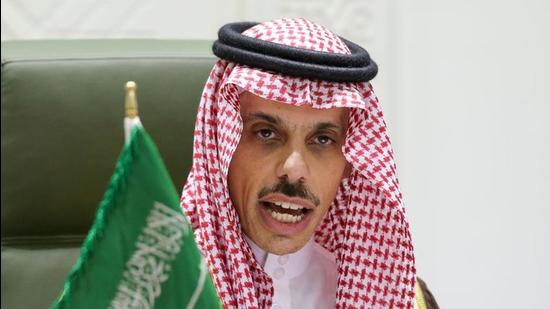
Saudi Arabia’’s foreign minister Prince Faisal bin Farhan Al Saud is expected to visit India this weekend to discuss the unfolding situation in Afghanistan even as Qatar has taken the lead in diplomatically engaging Kabul and legitimising the Taliban.
India’s close allies in the Middle East, Saudi Arabia and the UAE are worried about the security ramifications of the emergence of a medieval theocratic Afghanistan state and the ties of the global jihadist network with the Taliban regime. The two countries are also perturbed by the active role played by Qatar, Turkey and Pakistan in engaging with Kabul’s Sunni Islamist regime, with Islamabad quick off the blocks in sending its first commercial flight to Kabul. Qatar is handling the technical side of airport operations in Kabul, while the Taliban is still considering handing over perimeter security of the airport to the Turkish military.
While Prime Minister Narendra Modi discussed the Afghanistan situation with UAE crown prince Sheikh Mohammed bin Zayed Al Nahyan on September 3 over telephone, external affairs minister S Jaishankar hosted Anwar Gargash, Diplomatic Advisor to the UAE President, on August 30 and exchanged notes on the Kabul crisis.
It is in this context that the Saudi foreign minister is scheduled to arrive in India on September 19. Prince Faisal is expected to hold meetings with EAM Jaishankar, National Security Advisor Ajit Doval and call on Prime Minister Modi. Jaishankar departs for New York for the UNGA and the QUAD summit the next day.
{{/usCountry}}It is in this context that the Saudi foreign minister is scheduled to arrive in India on September 19. Prince Faisal is expected to hold meetings with EAM Jaishankar, National Security Advisor Ajit Doval and call on Prime Minister Modi. Jaishankar departs for New York for the UNGA and the QUAD summit the next day.
{{/usCountry}}Even though Qatar has been the lead player in the rise of Taliban in Afghanistan with Foreign Minister Sheikh Mohammed bin Abdul Rahman Al Thani and Special Envoy Mutlaq bin Majed Al Qahtani visiting Kabul last Sunday, the global community is a long way from legitimizing the ultra-conservative regime in Kabul. It is evident to the international community that the present Taliban regime has full military and political support of Pakistani ISI with its chief playing the kingmaker in government formation in Kabul.
The international community is also worried that 17 out of the 33 ministers of the new Afghan cabinet are designated as global terrorists by the UN and sanctioned against.Interior minister Sirajuddin Haqqani actually has a bounty of $5 million on his head from the US State Department. The head of Haqqani Network, the most lethal of terrorist groups operating in Afghanistan, is also the country’s new head of intelligence.
While countries such as China, Pakistan, Turkey and Qatar are engaging the Taliban, the international community is measuring the Sunni Islamists with UNSC resolution 2593 before taking a call on legitimising the male-dominated regime, which has indicated that it has no space for women and minorities. This time , Afghanistan apart from Indo-Pacific and coronavirus will resonate at the UNGA next week.