Holding that the earlier prohibition on releasing stray dogs was “too harsh”, the Supreme Court on Friday modified its August 11 directions on the mass capture of stray dogs, clarifying that canines picked up by municipal authorities in Delhi and four adjoining districts, Noida, Ghaziabad, Gurugram and Faridabad, will be released in the same locality after sterilisation and immunisation, except for those suffering from rabies or displaying aggressive behaviour.
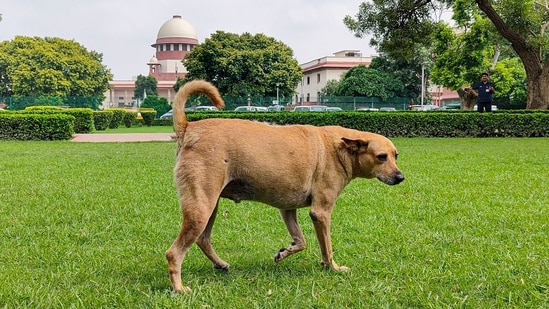
The top court’s clarification that community dogs must be picked up, sterilised and vaccinated, and then released -- save for rabid or demonstrably aggressive animals -- essentially reiterates the Animal Birth Control (ABC) Rules, 2023. Those rules, framed under Section 38 of the Prevention of Cruelty to Animals Act, require local authorities to run ABC and anti-rabies programmes premised on catch-neuter-vaccinate-release.
Significantly, the court expanded the scope of the suo motu case that prompted the August 11 order to the entire country. It impleaded all states and Union territories, seeking reports from their animal husbandry departments and local bodies on ABC compliance. It also ordered the transfer of all similar petitions pending before high courts to itself “so that a national policy could be framed to deal with the issue.”
A three-judge bench, led by Justice Vikram Nath, noted that some of the mandates in the August 11 order by a bench of two judges were “impossible to comply with” given existing infrastructure as it underlined that the revised framework must be implemented in consonance with the Animal Birth Control (ABC) Rules, 2023.
While the intent behind the August 11 order was “salutary” in seeking to protect citizens from aggressive and rabid dogs, the bench, also comprising justices Sandeep Mehta and NV Anjaria, said it could not be enforced in disregard of the statutory framework under the ABC Rules.
{{/usCountry}}While the intent behind the August 11 order was “salutary” in seeking to protect citizens from aggressive and rabid dogs, the bench, also comprising justices Sandeep Mehta and NV Anjaria, said it could not be enforced in disregard of the statutory framework under the ABC Rules.
{{/usCountry}}“The direction given in the order dated 11th August, 2025, prohibiting the release of the treated and vaccinated dogs seems to be too harsh, in our opinion…A blanket direction to pick up all the strays and place them in dog shelters/pounds without evaluating the existing infrastructure may lead to a Catch-22 situation because such directions may be impossible to comply with,” the bench held.
The court reiterated that municipal authorities in Delhi, Noida, Ghaziabad, Gurugram and Faridabad must proceed with the mass capture of stray dogs and establish shelters or pounds for their relocation. Reports on the creation of such infrastructure across NCR will have to be filed before the court.
However, it made clear that stray dogs must undergo sterilisation, vaccination and deworming, and then be released in the same locality, as mandated under ABC Rules. Dogs infected or suspected of rabies, or showing aggressive behaviour, are to be sterilised and immunised but kept in separate shelters.
The bench further ordered municipal authorities to create dedicated feeding spaces in each ward, with signage prohibiting feeding in public spaces, streets and residential areas. “Under no condition shall the feeding of stray dogs on the streets be permitted,” the order said, warning that violations will invite legal action.
Reiterating that no person or organisation can obstruct municipal staff in the lawful discharge of their duties, the court stressed that public servants must be protected from interference. It also imposed a financial condition on animal welfare organisations and individual petitioners in the case, directing each NGO to deposit ₹2 lakh and each individual petitioner ₹25,000 with the Supreme Court registry within seven days. These sums, it clarified, will be utilised by municipal bodies for building facilities for stray dogs.
The order also permits dog lovers to adopt strays by applying to municipal authorities, with the condition that adopted dogs be tagged and not returned to the streets. Municipalities, in turn, must file affidavits of compliance detailing their resources, including shelters, veterinarians, vehicles and staff for sterilisation and immunisation programmes.
The bench acknowledged the competing concerns at the heart of the litigation -- “the right of the stray dogs to live on the streets” versus “the safety and security of the citizens particularly the kids and elderly people”, and stressed that a “holistic approach” consistent with the Prevention of Cruelty to Animals Act and the ABC Rules was necessary to balance both.
The matter will be listed again after eight weeks to review compliance reports from municipal authorities and States.
The Friday order modified the August 11 order, passed by justices JB Pardiwala and R Mahadevan, which required the Municipal Corporation of Delhi (MCD) and civic agencies in Noida, Ghaziabad, Gurugram and Faridabad to round up all stray dogs “at the earliest” and keep them in dedicated shelters, with no re-release onto the streets. The authorities were also directed to establish shelters with capacity for at least 5,000 animals within eight weeks. A detailed written order, issued on August 13, reiterated those directions while also laying down welfare safeguards for dogs kept in shelters. But the sweeping measures quickly became contentious, drawing strong objections from animal welfare groups who warned of cruelty and statutory violations.
After criticism and fresh pleas complaining about inconsistencies with the Prevention of Cruelty to Animals Act and the Animal Birth Control (ABC) Rules, Chief Justice of India Bhushan R Gavai, in a rare administrative step, withdrew the matter from the Justice Pardiwala bench and reassigned the matter to the three-judge bench led by Justice Nath. The larger bench heard the matter at length on August 14 before reserving orders.
The suo motu case was triggered by the death of a six-year-old girl following a dog bite, with the Pardiwala bench citing “disturbing patterns” of dog-bite incidents and local agencies’ inability to keep public spaces safe.
Alokparna Sengupta, managing director, Humane World for Animals India, said the true impact of the order will depend on how dedicated civic staff is in implementing it. “Infrastructure like health centres and feeding zones need to be equipped and managed responsibly. The path forward requires collaboration, accountability, and above all, compassion.
Experts also said that sustained funding and timely reimbursements to NGOs were essential for the programme to succeed. “Without correcting these basics, no order from the Supreme Court can work on the ground,” said Geeta Seshamani, vice-president of Friendicoes, an animal welfare NGO.