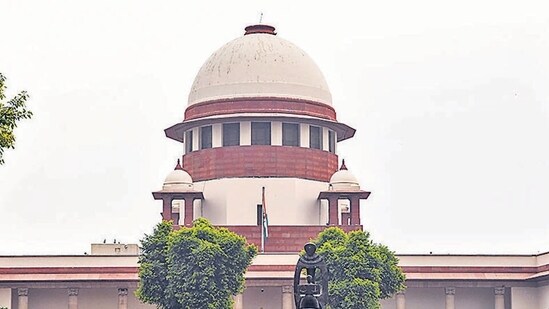
The Supreme Court on Friday refused to restrain the Bihar government from acting on or releasing more data based on its landmark caste survey, observing that most policy decisions proceed on data and that a government, in an interim measure, cannot be stopped from taking decisions.
Read here: ‘Congress wants to divide Hindus’: PM Modi on Rahul Gandhi’s caste census remark
A bench of justices Sanjiv Khanna and SVN Bhatti issued formal notice on a bunch of petitions challenging the August 1 judgment of the Patna high court that allowed the state government to carry out the caste census. The bench fixed the next hearing of the matter in January — three months later — asking the state government to put its reply on record even as it refused to issue any interim directive to restrain the government.
“The high court judgment is fairly detailed. After all, all policies proceed on data,” the bench told senior lawyer Aparajita Singh, who appeared for one of the petitioners assailing the collection of data in the caste survey as being violative of privacy and beyond the legislative power of a state government.
The court further pointed out that one of the moot issues in the matter relates to the breakdown of data and as to how much of it could finally be made public by the state government.
{{/usCountry}}The court further pointed out that one of the moot issues in the matter relates to the breakdown of data and as to how much of it could finally be made public by the state government.
{{/usCountry}}The decision by the top court, and the next date of hearing, practically removes legal hurdles in front of the state government in releasing the next batch of data collected on socioeconomic parameters such as land and vehicle ownership, education, income levels and employment status.
Welcoming the court order, Bihar minister and JD(U) leader Ashok Choudhary said, “It is a matter of joy for people like us who support this (caste-based survey). It is good for those who support the caste-based census and are in politics alongside Nitish Kumar, who made an effort to empower the most backward by providing them reservations in Panchayat Raj system, made an effort to empower the Dalits and women.”
Last week, the state released the first tranche of data from the caste survey — the first to successfully enumerate all castes in independent India — that showed extremely backward communities constituted 36.01% of the population, and backward classes made up another 27.12%. Together, other backward classes (OBC) — the umbrella group that consists of backward classes and extremely backward classes (EBCs) in the state — were 63.13% of the population.
The release of the data marked the completion of an exercise that has the potential to radically change heartland politics and propel caste into the core of the electoral discourse in the 2024 polls. But data on other socioeconomic parameters collected — 17 criteria ranging from employment, education and marital status to land holding and property ownership were part of the survey’s questionnaire — was not released. This data could be crucial in understanding how castes are benefitting from reservations, and how intra-caste bloc divisions are evolving.
Since the caste survey began in January this year, it has been dogged by a raft of legal challenges. A clutch of petitioners first approached the Patna high court, arguing that the exercise resembled a census that only the Union government could order, and that revelation of caste data would infringe on privacy rights. After suspending the survey for close to three months, the high court in August greenlit the exercise. The petitioners then approached the apex court, which refused to immediately suspend the survey.
During the hearing on Friday, Singh complained that the state government pre-empted the court proceedings by releasing the first set of data, based on the caste survey, on October 2 and therefore, asked that a stay on any further action be granted.
But the bench retorted: “No, no. They might have given data on X. The question, however, would be whether breakdown of data can be made available or not.”
Responding, Singh argued that the petitioner’s case is that the data was collected contrary to the Supreme Court’s nine-judge bench judgment in the KS Puttaswamy case because not only personal information of individuals were collected violating their privacy, but also because the Bihar government had failed to demonstrate any “legitimate purpose” for the exercise.
Singh urged the court to order a status quo so that the state government could neither act on the data from the caste survey, nor release any further statistics. The bench, however, shot down the plea.
“We are not staying anything. We (judges on the bench) have already discussed it. We will not stay... We cannot stop a state government or any government from taking decisions,” it told Singh.
During the brief hearing, the bench also asked the state government as to what prompted it to release the data that it did.
Senior counsel Shyam Divan, appearing for the Bihar government — run by the Mahagathbandhan, or Grand Alliance of the Janata Dal (United), Rashtriya Janata Dal and the Congress — replied that there was no restraining order against them. “The court had not passed any order against the publication of data. This court, in fact, indicated that first and foremost it will decide whether notice is to be issued in these matters,” Divan added.
At this, the bench said that the matter requires to be heard at length at a future date, observing further that the breakdown of data is going to be an important issue.
As the proceedings drew to a close, Singh again said that the data was collected illegally and cannot be acted upon, prompting the bench to respond: “Prima facie, you will be on some difficulty with respect to this argument. We have read the high court judgment and formed a prima facie view, which of course is subject to change after hearing you.”
By its judgment in August, Patna high court affirmed the state’s June 6, 2022 notification announcing the survey. The judgment called the state’s action “perfectly valid, initiated with due competence, with the legitimate aim of providing development with justice”. It said that the survey passed the test of proportionality, and thus, was not in breach of the rights of privacy of the individual.
Read here: Priyanka Gandhi promises caste census in Chhattisgarh if Congress retains power
The high court further held that the word “census” fell under entry 69 of List I which is solely within the prerogative of the Centre but this did not prohibit any state government from collecting data for implementing welfare schemes and carrying out affirmative action. The state had relied on the Collection of Statistics Act, 2008 to justify its survey, although the June 6 notification made no mention of it.
Challenging this judgment, the petitioners before the top court, which included Nalanda resident Akhilesh Kumar and the NGO Ek Soch Ek Prayas, accused the survey of being violative of the right to privacy as personal details about religion, caste and income were collected by the state in the alleged absence of any mechanism to protect the data. The petitions contended that the Bihar government lacked the power to carry out the survey and that it also impinged on the right to privacy.
Since the release of the survey, a political firestorm has raged with Opposition parties hoping to use the survey details to make inroads in the Bharatiya Janata Party’s rainbow Hindu coalition — especially among marginalised castes — ahead of the 2024 polls.
Soon after the data was released, Bihar chief minister Nitish Kumar congratulated the entire team involved in the process and said further action would be taken on its basis for the development and upliftment of all sections. At an all-party meeting last week, some constituents of the ruling coalition even raised the demand for increasing reservations.
On October 3, speaking at a rally in poll-bound Chhattisgarh’s Jagdalpur town, Prime Minister Narendra Modi hit back. Modi accused the Congress of trying to divide society through its call of apportioning resources proportional to the demographic weight of communities, and asked if it was advocating for curtailing the rights of minorities, marking his first response to Bihar’s caste survey. “For me, poor people are the biggest population of the country and they have the first right over resources. Welfare of the poor is my aim,” he added.