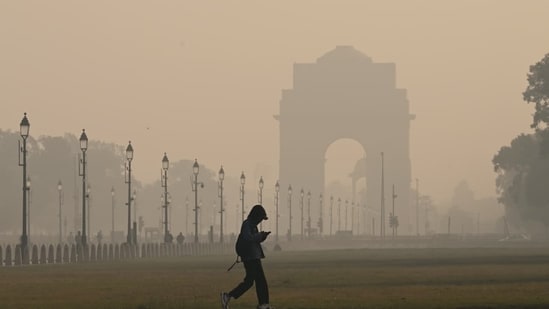
Delhi woke up to dense smog on Saturday as the air quality in major areas was recorded past 400, falling under the ‘Severe’ category. According to data from the Central Pollution Control Board, the overall AQI in Delhi at 10 am stood at 389.
With air quality in Delhi depleting, CAQM has already implemented Stage III of the GRAP across the National Capital Region. (Vipin Kumar/Hindustan Times)
{{^htLoading}} {{/htLoading}}
Earlier on November 14, the overall AQI of Delhi at 4 pm was 387.
Several areas, including Wazirpur, Bawan, Rohini, Anand Vihar, Mundka and Jahangirpuri, recorded an AQI above 400. Wazirpur recorded the highest AQI at 450 at 9 am.
Area
AQI
Category
Wazirpur
450
Severe
Bawana
443
Severe
Rohini
426
Severe
Anand Vihar
426
Severe
Mundka
425
Severe
Jahangirpuri
423
Severe
Vivek Vihar
420
Severe
Chandani Chowk
420
Severe
Narela
419
Severe
ITO
419
Severe
View All
With air quality in the national capital depleting, the Commission for Air Quality Management (CAQM) has already implemented Stage III of the Graded Response Action Plan (GRAP) across the National Capital Region.
{{^htLoading}} {{/htLoading}}
{{^usCountry}}
Earlier this week Directorate of Education directed all schools in the Delhi NCR region to shift to hybrid mode for students up to class 5.
{{/usCountry}}
{{#usCountry}}
Earlier this week Directorate of Education directed all schools in the Delhi NCR region to shift to hybrid mode for students up to class 5.
Meanwhile, the Supreme Court directed the governments of Punjab and Haryana to file a status report on the measures taken to curb stubble burning, which contributes to the air pollution crisis in the Delhi-NCR region.
According to data from the Decision Support System (DSS), stubble burning contributed 8.5 per cent to Delhi's pollution on Friday, while transport emissions accounted for 19.8 per cent, the highest share of all sources.
{{^htLoading}} {{/htLoading}}
High pollution combined with Meteorological conditions has been the cause of depleting air quality in the city. Winds have been consistently slow, and low temperatures have worsened the situation.
EWS bulletin released on Friday said that the city will see mainly clear skies with smog/shallow fog during morning hours. It also said that the wind speed will decrease, becoming less than 05 kmph during the evening and night on 15 November.
CPCB places an AQI above 400 in the 'severe' category, while 301-400 in the ‘very poor’ category, 201-300 ‘poor’category, 101-200 ‘moderate’, and 51-100 ‘satisfactory’category.
Follow the latest breaking news, major developments and agenda-setting stories from India and around the world with the newsdesk at Hindustan Times. Operating round the clock, the desk brings together experienced editors, reporters and correspondents to deliver fast, accurate and contextual reporting across subjects that influence public policy, governance, business, society and international affairs. The HT News Desk covers politics, elections, government policies, the economy, business and markets, science and technology, the environment, law and order, infrastructure, education, climate issues and geopolitics, while closely tracking developments across states, institutions and global capitals. The team also leads coverage of major breaking news events, policy announcements, court proceedings, natural disasters, public emergencies and significant international developments. Reports published by the newsdesk are based on information gathered from reporters on the ground, official statements, government agencies, court records, regulatory filings, recognised institutions and other authoritative sources. Stories undergo editorial scrutiny and verification processes to ensure accuracy, fairness and relevance, and are updated as events evolve and additional information becomes available. Whether covering a key political decision in New Delhi, an economic policy shift affecting millions, a landmark court ruling or a major global event, the HT News Desk aims to provide readers with reliable, fact-based journalism that delivers not only the latest developments but also the context and analysis needed to understand their wider implications.
Get real-time updates on CJP Delhi Protest LIVE , breaking headlines, and top India News, breaking headlines, and real-time updates from across the nation. Stay informed on politics, government policies, crime, Today Weather, and major developments on Hindustan Times
Get real-time updates on CJP Delhi Protest LIVE , breaking headlines, and top India News, breaking headlines, and real-time updates from across the nation. Stay informed on politics, government policies, crime, Today Weather, and major developments on Hindustan Times
Home/India News/‘Severe’ air chokes Delhi despite GRAP-III restricts, AQI crosses 450 in Wazirpur
{{^htLoading}}
Advertisement
{{/htLoading}}
SHARE THIS ARTICLE ON
{{#usCountry}}{{/usCountry}}
Notifications
Get breaking alerts directly from the newsroom
Notifications are on!You'll be notified when news breaks