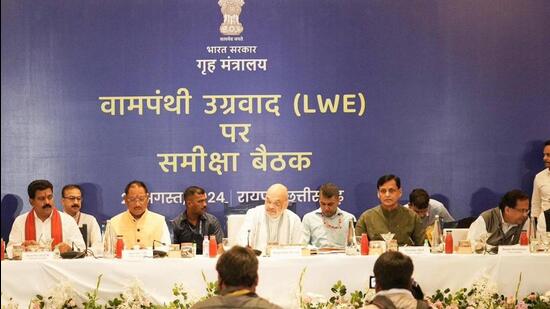
New Delhi: Union home minister Amit Shah chaired an inter-state coordination meeting of states affected by Naxal violence on Saturday in Chhattisgarh, as the Centre is aiming to end the reign of red ultras in the next one year.
The high-level meeting is being attended by the Chhattisgarh chief minister Vishnu Deo Sai, including the dy CM and Union ministers of state (X/@neerajwriting)
{{^htLoading}} {{/htLoading}}
The high-level meeting is being attended by the Chhattisgarh chief minister Vishnu Deo Sai, deputy CM Vijay Sharma, Union minister of state for home Nityanand Rai, Union home secretary Govind Mohan, Intelligence Bureau director Tapan Deka, chief secretaries and police chiefs of affected states, and director generals of police of central paramilitary forces, among other senior officers from the security establishment.
Officials who did not wish to be named said that the home minister will review the status of action taken by the security forces and intelligence agencies since the last such meeting in January this year, a month after the Bharatiya Janata Party (BJP) stormed into power in the state.
{{^htLoading}} {{/htLoading}}
{{^usCountry}}
“The home minister has directed that the left-wing extremism (LWE) must be eliminated from the country in the next couple of years, and Saturday’s meeting will discuss the strategy for the coming months. The ground forces are ready for a last push to remove Naxals from their core areas, which are now limited,” said a counter-insurgency official who did not wish to be named.
{{/usCountry}}
{{#usCountry}}
“The home minister has directed that the left-wing extremism (LWE) must be eliminated from the country in the next couple of years, and Saturday’s meeting will discuss the strategy for the coming months. The ground forces are ready for a last push to remove Naxals from their core areas, which are now limited,” said a counter-insurgency official who did not wish to be named.
{{/usCountry}}
According to official government data, the security forces have killed 147 Maoists in 104 gunfights since December 2023 until this month. Besides, a whopping 723 Naxal cadres have been arrested, while 622 have also surrendered before the forces.
HT had reported in May that a large number of Naxal cadres are deserting the Communist Party of India (Maoist) fearing they will be killed or arrested in the intensive operations being carried out by the security forces.
{{^htLoading}} {{/htLoading}}
The Centre has also accelerated the opening of new camps—also known as forward operating bases (FOBs)—in the Maoists’ strongholds in the last three, which has provided an operational edge to the security forces.
Since December last year, 33 new FOBs have been opened—four in Sukma, eight in Bijapur, two in Dantewada, four in Narayanpur, one each in Kanker and Rajnandgaon, and others. “These camps have helped in coordinated intelligence-based operations of the security forces and have assisted civic authorities in taking development work to the remote villages, shrinking the area controlled by Naxals,” said a second officer.
The minister of home affairs (MHA) informed the Parliament earlier this month that the geographical spread of LWE violence has constricted substantially with the reduction of LWE affected districts from 126 across 10 states in 2013 to only 38 districts in 2024 (with effect from April 2024) across nine states.
{{^htLoading}} {{/htLoading}}
The government data revealed that the LWE violence incidents have reduced by 73% from the high level of such violence incidents in 2010.
“The resultant deaths (security forces + civilians) have reduced by 86% from an all-time high of 1,005 in 2010 to 138 in 2023. In the current year 2024 (up to 30.06.2024), there has been a sharp reduction of 32% in LWE-perpetrated incidents and 17% in the resultant deaths of civilians and security force personnel in comparison to the figures of the corresponding period of 2023,” said the second officer.
Neeraj Chauhan is a senior journalist with Hindustan Times and an investigative reporter specialising in national security, terrorism, organised crime, narcotics, corruption, financial crime and complex investigations. With over 21 years of experience across Hindustan Times, The Times of India, The Indian Express and The Pioneer, he has built deep expertise in India’s internal security and law-enforcement landscape. Neeraj has extensively covered India’s principal investigative, intelligence and security agencies, including the NIA, CBI, ED, IB, R&AW, MHA and other central security forces. His work has included deeply reported investigations into terrorism, terror financing, cross-border crime, narcotics trafficking, cybercrime, financial fraud and political and corporate corruption. He has reported on some of the most significant terror attacks and security developments in India over the past two decades, including the Delhi serial blasts, the 26/11 Mumbai attacks, the 2019 Pulwama terror attack and the recent Pahalgam attack. His reporting has also chronicled the rise and decline of the Indian Mujahideen, the activities and subsequent crackdown on the Popular Front of India (PFI), Islamist extremist networks, the conflict in Jammu and Kashmir, insurgencies in the Northeast and Maoist violence. Some of Neeraj’s major breaking stories are in Aryan Khan drug case, Sushant Singh Rajput suicide, interception of a 3,000-kg Afghan heroin consignment worth about ₹21,000 crore at Mundra port, Sri Lanka easter bombings, Aarushi-Hemraj murders in Noida, 2G scam, coal block allocation scam, AgustWestland VVIP chopper deal and major bank frauds and extradition cases involving Mehul Choksi, Nirav Modi and Vijay Mallya. His reporting is marked by an ability to cultivate sources, analyse confidential and complex documents, and follow investigations over several years—from the initial breakthrough to chargesheets, trials and international legal proceedings. He specialises in making complicated security and investigative developments accessible while examining their wider implications for governance and public policy. A Chevening South Asia Journalism Programme Fellow at the University of Westminster, Neeraj also spent time at the Financial Times as part of the fellowship. He was also a Robert Bosch Media Ambassadors India-Germany Fellow, studying at the University of Tübingen and working with Der Tagesspiegel in Berlin. He has previously taught investigative journalism and crime reporting as a guest faculty member at the Times School of Journalism. Over more than two decades, Neeraj has established himself as an authoritative voice on India’s national security and investigative landscape, with his reporting closely followed by officials, investigators, lawyers, policymakers and readers seeking insight into some of the country’s most complex and consequential developments.
Get real-time updates on CJP Delhi Protest LIVE , breaking headlines, and top India News, breaking headlines, and real-time updates from across the nation. Stay informed on politics, government policies, crime, Today Weather, and major developments on Hindustan Times
Get real-time updates on CJP Delhi Protest LIVE , breaking headlines, and top India News, breaking headlines, and real-time updates from across the nation. Stay informed on politics, government policies, crime, Today Weather, and major developments on Hindustan Times
Home/India News/Amit Shah chairs high-level meet on anti-Maoist operations in Chhattisgarh
{{^htLoading}}
Advertisement
{{/htLoading}}
SHARE THIS ARTICLE ON
{{#usCountry}}{{/usCountry}}
Notifications
Get breaking alerts directly from the newsroom
Notifications are on!You'll be notified when news breaks