
 E-Paper



Solid waste situation horrifying, says SC
SC questions untreated solid waste in Delhi, neighboring cities violating citizens' right to pollution-free environment. Urges urgent action to curb pollution.

 Prefer HTon Google


What signal are we sending to the world if “3,800 TPD (tonnes per day) of solid waste” remains untreated in the Capital, the Supreme Court asked on Monday, noticing the gap in the treatment of solid waste in Delhi and neighbouring cities of Gurugram, Faridabad and Greater Noida.
This failure of local civic bodies is violative of the fundamental right of citizens to live in a pollution-free environment, the top court remarked.
The comments came while a bench of justices AS Oka and Ujjal Bhuyan was hearing a petition filed by environmental activist and lawyer MC Mehta in 1985 on Delhi pollution in which several orders have been passed over the years.
Also read: SC junks plea for Arvind Kejriwal’s removal as Delhi CM
During the hearing, the court was apprised by the Commission for Air Quality Management (CAQM) for Delhi and adjoining areas of the steps taken to curb pollution.
“Generation of solid waste in such large quantity affects the environment and also directly affects the fundamental rights of citizens under Article 21 of the Constitution of India to live in a pollution free environment,” the court observed. The court described the situation in Delhi, where solid waste around 3,800 TPD goes untreated, as “shocking state of affairs”.
In other towns in the national capital region (NCR), Gurugram faces a gap of 1,050 TPD, Faridabad 760 TPD and Greater Noida 218 TPD, according to an affidavit filed by the ministry of housing and urban affairs. The problem is “horrifying”, the court said.
Wondering why the issue of untreated solid waste is not being taken seriously by civic agencies, the bench told solicitor general Tushar Mehta, “This is a vital issue for the Capital city. This issue should travel beyond politics. What the whole world will say that in the capital city of India, 3,800 TPD of solid waste is remaining untreated. What signal are we giving to the world when we talk of development.”
Mehta was appearing for the Centre.
The bench also directed the Union secretary of housing and urban development to convene a meeting of all stakeholders to find a solution and place it before the court, as it flagged that the amount of waste generated is set to increase with the pace of development.
“Considering development which is taking place in Delhi and surrounding areas, it is obvious that generation of solid waste is bound to increase. Immediate attention should be to ensure present accumulation of untreated solid waste is not allowed to increase till proper facilities are in place. All authorities have to consider various methods including putting restraint on construction activities,” the court said.
Also read: Clear Delhi govt’s legal costs at the earliest, Supreme Court tells Centre
“In the event the authorities fail to come out with any concrete proposals, we will have to consider passing drastic order with a view to take care of the environment in the capital city of Delhi and surrounding areas,” the bench said.
Municipal solid waste is a term used to describe all kinds of domestic waste, sanitary waste, commercial waste, institutional waste, catering and market waste, silt removed from drains, horticulture waste, agriculture and dairy waste, bio-medical waste, battery and e-waste.
Delhi is currently estimated to generate 11,328 TPD of waste, data from the Solid Waste Management Committee of Delhi shows. Of this, around 3,525 TPD remains untreated and ends up in landfills. There are two active landfills in the city, at Ghazipur and Bhalswa, after the dumping of waste was stopped at Okhla about a year ago.
In 2019, MCD started the process of biomining of the three dumpsites when the total accumulated waste was about 28 million tonnes (14 MT at Ghazipur, 8 MT at Bhlaswa and 6 MT at Okhla). In five years, there has been limited progress, with the three sites still hosting about 17.2 MT of waste, data from MCD’s progress report in February showed.
The deadline for clearing the Ghazipur landfill has been pushed back from 2024 to 2026, and Bhalswa landfill is estimated to be cleared by 2025. For Okhla landfill, the deadline is 2024.
Additional solicitor general (ASG) Aishwarya Bhati, also appearing for Centre, informed the court that the Centre recently held a meeting with all stakeholders and gathered information on the steps being taken to improve the capacity to deal with untreated waste.
As regards Delhi, the affidavit said that against a daily waste generation of 11,000 TPD, the processing capacity is 8,073 TPD, leaving around 3,800 TPD of fresh waste getting dumped at Ghazipur and Bhalswa dumpsites.
MCD also receives on a daily average, 6,000 TPD construction waste as against its capacity to treat 5,000 TPD.
The other civic agencies — New Delhi Municipal Council and Delhi cantonment board — do not face any issue of untreated solid waste.
The untreated waste either leaks into the environment or ends up in city’s oversaturated landfill sites which cause air pollution, emit greenhouse gases and contaminate ground water aquifers in their vicinity through leachate.
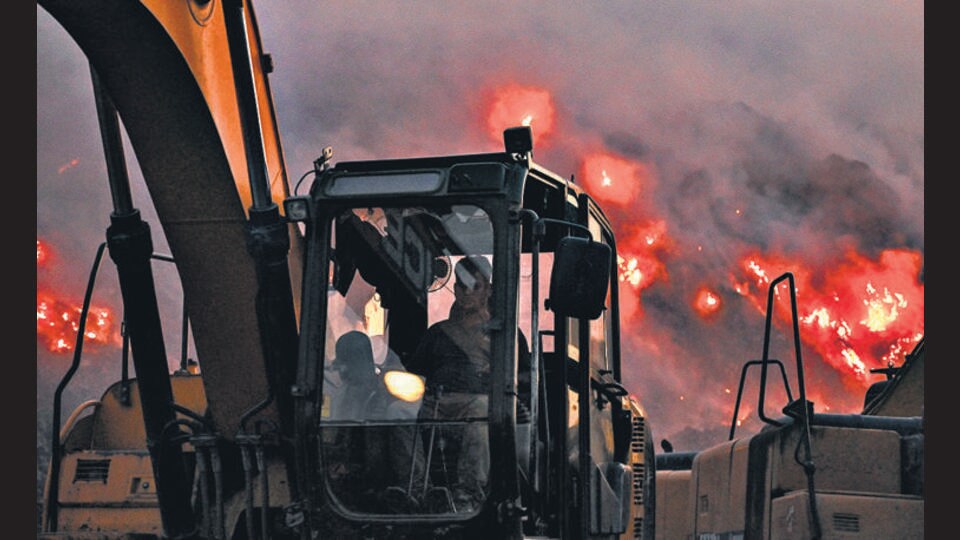
The mounds of waste have created an annual fixture of landfill fires, as gases, primarily methane, react, that rage on for days at times. Delhi witnessed its first landfill fire of the year on April 21 when a blaze erupted at the Ghazipur landfill site.
Senior advocate Menaka Guruswamy appearing for the Municipal Corporation of Delhi (MCD) told the court that waste processing facilities at Narela, Ghazipur, Okhla, Tehkand and Gogha Dairy are expected to increase the waste processing capacity from 8,073 TPD to 15,473 TPD capacity by the year 2027.
The bench said, “It is a sorry state of affairs. This is the Capital city and you say only by 2027, we will increase the capacity. If today it is 3,800 TPD, have the authorities taken any estimate of how much it will increase in next three years. This poses grave danger to the environment of the Capital city.”
The affidavit further disclosed that in Gurugram, the urban local bodies have a capacity to treat 150 out of 1,200 TPD, Faridabad treating 240 out of 1,000 TPD and Greater Noida with a capacity of treating 132 out of 350 TPD. These figures only concerned municipal solid waste, apart from legacy waste and construction waste present at the waste dumping sites.
“Everywhere the situation is horrible. Nobody seems to be bothered to make any estimate of achieving full capacity treatment of solid waste. We may have to pass orders ordering some category of construction to stop. Unless that is done, the quantity of solid waste cannot be stopped,” the court said.
Senior advocate Aparajita Singh, assisting the court as amicus curiae, pointed out, “These figures of untreated waste is horrifying. Steps to be taken by the civic agencies must be done on a war footing.”
The bench said a report shall be prepared by the secretary of the ministry of housing and urban affairs and placed before the court by July 19.
On April 22, the court had flagged the issue of untreated solid waste in the Capital going by the statistics provided by the commission for air quality management (CAQM). The CAQM report also focused on other causes of pollution in Delhi, which included dust pollution from construction sites, and farm fires in neighbouring states. The court agreed to examine the other issues on the next date of hearing.
(With inputs from Paras Singh)


