The indigenous Tejas Mark II fighter jet will have the capacity to conduct operations such as the one the Indian Air Force undertook in Balakot, with beyond-visual-range missiles with a greater reach and virtually jam-proof AESA radars in order to be suitable replacements for the Indian Air Force (IAF)’s aging Mirage 2000 fighters, according to the agency overseeing the development the aircraft. The Mark II, fitted with heavier GE 414 engine, will roll out in 2022, take to the skies in 2023 and join IAF by 2026.
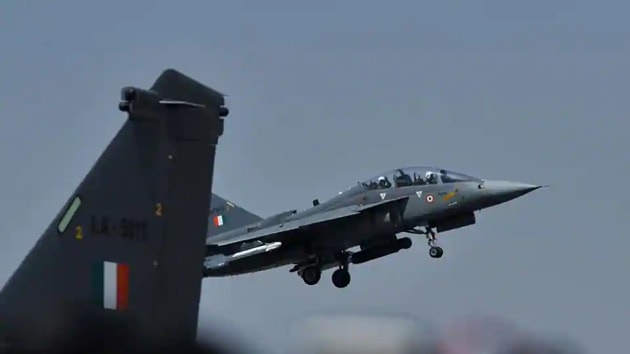
Satisfied with performance of Tejas MK I in its full operational configuration on Tuesday, Girish Deodhare, Program Director (Combat Aircraft), Aeronautical Development Agency said that the MK II will have double the range of its predecessor and fitted with Astra II BVR air-to-air missiles with a range of at least 150 km. “ While Tejas MK I is for combat air patrol within the Indian territory, MK II will have the capacity to conduct Balakot-like surgical strikes in enemy territory as it will carry heavy standoff weapons like Crystal Maze and Spice missiles,” added Deodhare. On February 26, 2019, IAF’s Mirage 2000 entered Pakistani territory to target a Jaish-e-Mohammed (JeM) terror training camp at Jabba Top in Balakot, Manshera in retaliation for the terror group’s suicide attack on a CRPF convoy in Pulwama, Jammu & Kashmir.
While work on MK II is proceeding apace, ADA, in consultation with IAF will also freeze the design of its twin-engine advanced medium combat aircraft (AMCA) in the next three months. IAF, last November gave a written commitment to DRDO that it would buy the fifth-generation AMCA to strengthen its strike capabilities. AMCA is expected to roll out in 2024 and take to the skies the following year. The Tejas MK II is a 4.5 generation aircraft.
{{/usCountry}}While work on MK II is proceeding apace, ADA, in consultation with IAF will also freeze the design of its twin-engine advanced medium combat aircraft (AMCA) in the next three months. IAF, last November gave a written commitment to DRDO that it would buy the fifth-generation AMCA to strengthen its strike capabilities. AMCA is expected to roll out in 2024 and take to the skies the following year. The Tejas MK II is a 4.5 generation aircraft.
{{/usCountry}}Also Watch | ‘Ghus Kar Maarenge...’: Former IAF chief on first anniversary of Balakot air strike
According to Deodhare, Hindustan Aeronautics Limited (HAL) will produce 16 FOC 9Final Operational Clearance) Tejas plus eight trainers before the reverse integration of IAF’s Tejas in initial configuration is taken up. “ HAL has done a commendable job to produce a FOC Tejas within a year of the design being frozen. This will help up in faster development of MK II as this only involves in upscaling of the existing platform with superior armaments, radar and avionics,” he said.
For the MK II, ADA in collaboration with its parent DRDO is developing the indigenous active electronically scanned array (AESA) radar, which is not ony difficult to detect but also has high resistance to jamming by the enemy during engagement. As of now, the Tejas MK I platform has been integrated with Israeli Derby BVR missiles with enhanced range so that enemy planes are picked up and targeted even as they cross the Indian border.