New Delhi: On August 15, 2019, Prime Minister Narendra Modi announced creation of the post of Chief of Defence Staff (CDS) , paving the way for creation of theatre commands to promote ‘jointness and synerg’ in the Indian armed forces, a move that came more than 18 years after a recommendation to the effect by the Group of Ministers (GoM) on Kargil.
Five years later, CDS Gen Anil Chauhan is virtually ready with the blueprint of three adversary specific theatre commands, based in Lucknow, Jaipur and Thiruvananthapuram, and will shortly be seeking approval for the implementation from the Modi government later this year.
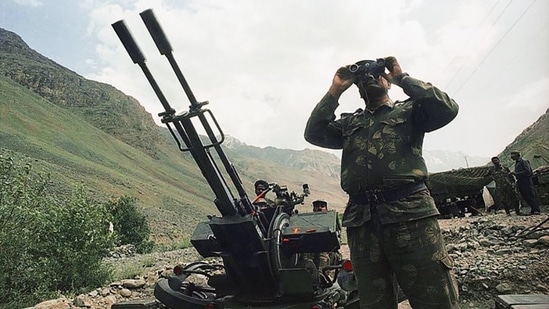
The Kargil war came as a rude shock to the Indian Army and national intelligence. But the 84-day war fought at the glacial heights of up to 15,000 feet across a 200km range turned out to be a catalyst for major reforms and overhaul of the Indian military. The big lesson of Kargil for national security planners was to simply expect the unexpected — the Indian Army did not expect Pakistanis under Gen Pervez Musharraf to exploit the unheld gaps and glacial features next to the Line of Control (LoC) in Kargil sector.
While China’s PLA mobilised in Eastern Ladakh during the Kargil war, it was more of a precautionary measure as Beijing overtly stayed away from the IndiaPakistan border skirmish. However, after the PLA transgressions in East Ladakh in May 2020, India has to be prepared for a armed drones from US with price negotiations currently underway.
{{/usCountry}}While China’s PLA mobilised in Eastern Ladakh during the Kargil war, it was more of a precautionary measure as Beijing overtly stayed away from the IndiaPakistan border skirmish. However, after the PLA transgressions in East Ladakh in May 2020, India has to be prepared for a armed drones from US with price negotiations currently underway.
{{/usCountry}}Even though the Committee’s recommendation of separation of the post of principal secretary to the Prime Minister and National Security Advisor was implemented after the fall of the Vajpayee government, the creation of Integrated Service Headquarters and the Defence Intelligence Agency have hardly made a dent in overall military reforms. But the replacement of the Joint Intelligence Committee (JIC) by the National Security Council Secretariat (NSCS) has paid dividends during the Modi government with National Security Advisor Ajit Doval being able to create a structure that provides a 360-degree view of national security with one military advisor and three deputy NSAs. With
Vikram Misri serving as Deputy NSA before taking over as Foreign Secretary this month, it is likely that only diplomats with national security exposure will be appointed to the post in the future.
It was on the basis of the recommendations of the GoM headed by then deputy prime minister LK Advani that India has now acquired a robust and functional nuclear triad as part of its minimum credible nuclear deterrent doctrine. With long-range missiles, ballistic missile carrying submarines and Rafale fighters capable of nuke deliveries, India’s nuclear deterrent has high survivability, a key to the country’s “no first-use” policy . With one ballistic missile nuclear submarine patrolling, another on verge of being launched and a third ready for sea trials, India’s sub-surface deterrent is taking shape with two nuclear-powered conventionally armed submarines on the verge of being sanctioned by the Modi government.
However, one of the key lessons of the war in Kargil and the 2002 military mobilisation under Operation Parakram was the need for India to be self-sufficient in modern weaponry, delivery platforms and ammunition. During 1999 and 2002, India had to rush in last minute supplies (procured at higher rates from Israel and Russia) to take on the Pakistan Army and its maverick generals. Despite Modi’s total commitment to the “Aatmanirbhar Bharat” (self-reliant India) doctrine, Indian armed forces are still interested in off-theshelf acquisitions as defence PSUs and DRDO almost always fail to deliver in time. It was the late Manohar Parrikar as defence minister who cut down redundancies and ensured that India had enough ammunition for a 10-day war.
Today, the Indian Army is self-reliant in ammunition after corporatisation of Indian Ordnance Factories ; the Indian Navy now has the capability to build its own aircraft carriers, destroyers, frigates and submarines.
The Kargil war not only initiated reforms in Indian military structures and field formations but also triggered a change in Indian intelligence.
Shyamal Datta, director, Intelligence Bureau, on the basis of intelligence picked up by then additional director Ajit Doval sent a signed letter to then PM Vajpayee warning a build-up of Pak Army across the LoC in Kargil Sector, the Indian Army was categorical that there was no intelligence alert on Pakistani intrusions apparently due to poor dissemination of information and appreciation of the intelligence collected.
It was the war in Kargil that led to creation of the National Technical Research Organization (NTRO) on the lines of the US’ National Security Agency (NSA), the multi-agency centre (MAC) for pooling of central intelligence and the joint task force on intelligence (JFTI) for liaison between the central agencies and their counterparts in the states. Based on the recommendation of the Kargil GoM, then DIB Ajit Doval created MAC and the JTFI in 2004 so that actionable intelligence could be provided to the consumer.
Twenty-five years after the war in Kargil, the security and military structure recommended by the Subrahmanyam Committee and the GoM are in place but the speed of implementation is very slow due to inherent resistance from armed forces and intelligence agencies.
Decision-making within the national defence establishment is laborious and tedious with each branch of the armed forces, the ministry and DRDO protecting their own turf. In both dimensions, China presents a contrast. The overhaul of the military, and local manufacturing of defence equipment have to accelerate for India to hold its own in a neighbourhood where Beijing is flexing its muscle.
(The author covered the Kargil war for Hindustan Times and has reported on Pakistan terror in Kashmir since 1994)